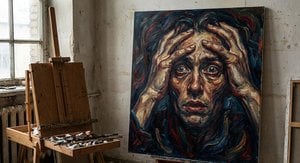
The Soul of the Rhodope: The Expressive World of Manana Parpulova
In the heart of Bulgaria, where the rugged peaks of the Rhodope Mountains meet the sky, the artistic spirit of Manana Parpulova found its most profound expression. Born on April 7, 1925, in the culturally rich town of Panagyurishte, Parpulova emerged as a vital voice within the expressionist movement, weaving the textures of her homeland into canvases that pulsed with life and emotion. Her journey was not merely one of capturing scenery, but of translating the very essence of Bulgarian identity through a lens of subjective intensity. To look upon her work is to witness a dialogue between the physical landscape and the internal psychological state, a hallmark of an artist who sought truth far beyond the surface of reality.
Parpulova’s artistic development was deeply rooted in the traditions of her upbringing, yet she possessed a restless, visionary intellect that pushed her toward the avant-garde. While the specifics of her formal training remain shrouded in a certain academic mystery, her mastery suggests a profound engagement with the masters of expressionism. One can trace the echoes of Edvard Munch and Ernst Ludwig Kirchner in her use of distorted forms and her ability to manipulate color to evoke tension and longing. She moved away from the meticulous constraints of realism, choosing instead to embrace bold, sweeping brushstrokes and a vibrant palette—often dominated by striking reds, deep blues, and sun-drenched yellows—to communicate the visceral rhythms of existence.
A Legacy of Line and Light
While many remember her for her evocative paintings, Parpulova was also a master of graphic intimacy. Her work as a book illustrator and her prowess in woodcut printing allowed her to explore the stark beauty of contrast. In her woodcuts, particularly those featuring figures in traditional Bulgarian attire, she utilized powerful black-and-white compositions to celebrate cultural heritage. These works, such as the notable "The Three Women," demonstrate her ability to use strong, decisive lines to create depth and a sense of monumental presence. Through this medium, she captured the dignity of everyday life, turning simple gestures and traditional garments into symbols of enduring national strength.
Her most celebrated achievement remains her ability to personify the landscape itself, most famously realized in her masterpiece, "Rhodope Girl." In this work, the subject becomes an extension of the mountains—resilient, beautiful, and deeply connected to the earth. This piece serves as a cornerstone of her oeuvre, embodying the intersection of portraiture and landscape painting that defined her career. Her ability to imbue a single figure with the weight of history and the freshness of nature cemented her status as a significant figure in Bulgarian art history.
The significance of Manana Parpulova lies in her role as a bridge between tradition and modernity. She did not abandon her Bulgarian roots; rather, she used the language of international expressionism to elevate them. Her life, which concluded in Sofia in 1987, left behind a legacy that continues to resonate with anyone seeking the emotional truth behind the visual form. Her work remains a testament to the power of art to act as an echo of the soul, capturing the fleeting beauty of a culture and the permanent intensity of the human experience.