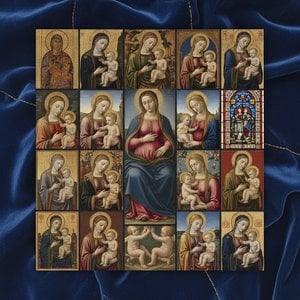
Luca di Tommè: A Sienese Master of the Late Medieval Period
Luca di Tommè, a name perhaps less familiar than those of his contemporaries Duccio or Simone Martini, nevertheless stands as a pivotal figure in the vibrant artistic landscape of Siena during the latter half of the 14th century. Active primarily between 1356 and 1389, he represents a crucial link in the chain of Sienese painting, inheriting the stylistic traditions of its most celebrated predecessors while simultaneously forging his own distinctive voice within the established decorative style. His prolific output – over fifty works have been confidently attributed to him – ensured that the elegant, luminous aesthetic of Siena’s artistic community continued to flourish well into the 15th century, a testament to his skill and the enduring appeal of his art.
Born around 1330 in Italy, Luca di Tommè's early life remains somewhat shrouded in mystery. He emerged as an artist during a period of considerable artistic dynamism in Siena, a city renowned for its independent spirit and thriving patronage system. The Sienese school, deeply influenced by the innovations of Duccio and Simone Martini at Florence, was characterized by a rich palette, delicate modeling, and a profound understanding of iconography – particularly within religious narratives. Luca’s work reflects this heritage, demonstrating a masterful command of tempera on wood panels, a technique common to the period and perfectly suited to capturing the subtle nuances of color and texture.
The Influence of Sienese Tradition
Luca di Tommè's artistic development is inextricably linked to the established traditions of Siena. He was undoubtedly influenced by the pioneering work of Duccio, Simone Martini, Pietro Lorenzetti, and Ambrogio Lorenzetti – artists who had revolutionized painting with their innovative use of color, perspective, and emotional expression. However, Luca didn’t simply imitate his predecessors; he skillfully absorbed their techniques and stylistic elements, integrating them into a distinctly personal approach.
Early in his career, Luca's paintings exhibit a clear debt to the Sienese masters, particularly in their meticulous attention to detail and their adherence to established iconographic conventions. His compositions are often balanced and harmonious, reflecting the prevailing aesthetic ideals of the time. However, as he matured as an artist, Luca began to introduce subtle shifts in his style, moving towards a more expressive use of line and a greater emphasis on decorative elements. This evolution is particularly evident in his later works, where he demonstrates a growing independence from purely imitative approaches.
Key Works and Artistic Style
Luca di Tommè’s oeuvre comprises a diverse range of subjects, primarily religious scenes depicting the Virgin Mary with the Christ Child, saints, and biblical figures. His most celebrated works include “Virgin and Child with Saints,” a poignant depiction of the Madonna surrounded by a haloed assembly of holy men, and “Virgin and Child with Sts. Louis of Toulouse and Michael,” which showcases his skill in rendering delicate drapery and conveying a sense of serene spirituality. The "Madonna and Child" is another notable example of his style.
A defining characteristic of Luca’s art is his masterful use of tempera on wood panels, a medium that allowed him to achieve remarkable luminosity and depth of color. His paintings are characterized by their rich palette, shimmering surfaces, and intricate detailing. He employed a technique known as *sfumato*, creating soft transitions between colors and tones, which contributes to the ethereal quality of his works. Furthermore, Luca’s compositions often feature a dynamic interplay of light and shadow, adding drama and visual interest.
Collaboration and Legacy
Luca di Tommè's career was marked by significant collaborations, most notably with Bartolo di Fredi and Andrea di Bartolo on a large altarpiece commissioned for the cathedral of Siena in 1389. These partnerships demonstrate his ability to work effectively within a team and contribute to complex artistic projects. His association with these prominent artists further solidified his position as a leading figure in the Sienese art world.
Despite his relatively short career – he died around 1389 – Luca di Tommè left an enduring legacy. His prolific output ensured that the decorative Sienese style continued to thrive well into the 15th century, influencing subsequent generations of artists. His work serves as a valuable bridge between the late medieval and early Renaissance periods, embodying the artistic spirit of Siena during a time of profound cultural change. The meticulous documentation by Sherwood A. Fehm Jr., in his book “Luca di Tommè: A Sienese Fourteenth-Century Painter,” provides invaluable insight into this artist’s life and work.
Further Exploration
For those seeking to delve deeper into the world of Luca di Tommè, several resources offer valuable information. The Web Gallery of Art (https://www.wga.hu/bio/l/luca/biograph.html) provides a comprehensive biography and images of his works, while the Wikipedia article (https://en.wikipedia.org/wiki/Luca_di_Tomm%C3%A8) offers a detailed historical overview of his life and artistic contributions. The Museo Thyssen-Bornemisza in Madrid also houses several examples of his work, offering visitors the opportunity to admire these masterpieces firsthand.
Kysymykset ja vastaukset
Voinko tutkia Luca Di Tommè teoksia värispektrin mukaan?
Luca Di Tommè-taiteilijan Värispektri järjestää teokset niiden värin mukaan.
Mistä voin nähdä Luca Di Tommè teosten väriprofiilin?
Luca Di Tommè:n teosten värien käyttö tämä sivusto-sivustolla on tarkasteltavissa artistin Paletin sielunmaisema -sivulla.
Millä muilla nimillä tai nimimerkeillä Luca Di Tommè tunnetaan?
Luca Di Tommè tunnetaan myös nimillä Luca Di Tomme.