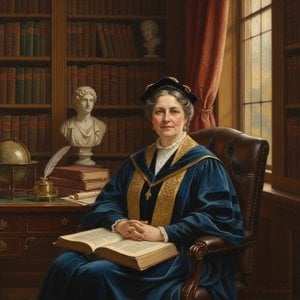
A Life Etched in Portraits: The World of Lowes Cato Dickinson
Lowes Cato Dickinson, born in Kilburn, London, in 1819, was a figure deeply embedded within the artistic and social currents of Victorian England. Coming from a family intimately connected to the art world—his father, Joseph Dickinson, being a respected lithographer and publisher on Bond Street—Dickinson’s path seemed preordained. Yet, his journey wasn't merely one of inheritance but of active engagement with the evolving aesthetic sensibilities and progressive social movements of his time. One of eleven siblings, he received his early education at Topsham School and Dr Lord's School in Tooting, grounding him in a solid foundation before fully immersing himself within the family business following his father’s death in 1849. He then joined forces with his brothers, Gilbert Bell Dickinson and William Robert Dickinson, to continue the legacy of Dickinson Brothers on Bond Street, a firm that quickly became synonymous with quality art publishing and photography. This early exposure wasn't simply about commerce; it was an apprenticeship in visual culture, shaping his eye for detail and composition—qualities that would define his later work as a portraitist.The Pre-Raphaelite Circle and the Call of Social Reform
Dickinson’s artistic development took a significant turn with a three-year sojourn in Italy around 1850. This period proved formative, exposing him to the masterpieces of the Renaissance and influencing his evolving style. Upon his return to England, he found himself drawn into the orbit of the Pre-Raphaelite Brotherhood. Though not a formal member, Dickinson engaged in correspondence and collaboration with key figures like Dante Gabriel Rossetti and John Ruskin, absorbing their emphasis on truth to nature and emotional intensity. He even lectured alongside them, solidifying his position within this influential artistic milieu. This association wasn’t purely aesthetic; it was intertwined with a burgeoning sense of social responsibility. Dickinson became deeply involved in the Christian socialist movement, a group advocating for social justice through the lens of faith. His commitment manifested most concretely in 1854 with the co-founding of the Working Men's College in London. This institution, dedicated to providing accessible education to working-class individuals, was a testament to his belief in the transformative power of knowledge and a reflection of his desire to bridge social divides. The presence of Ford Madox Brown, who worked for Dickinson Brothers, further underscores his connection to this vibrant artistic and intellectual network. He championed the idea that art should serve as a catalyst for societal betterment—a conviction that underpinned his lifelong dedication to fostering intellectual curiosity and promoting ethical values.A Portraitist of Victorian Society
Dickinson’s skill lay not in grand historical narratives or dramatic allegories but in capturing the essence of his sitters—the prominent figures who shaped British society. He painted Queen Victoria herself, members of Parliament, leading scientists like Arthur Cayley and James Clerk Maxwell, and fervent Christian socialists such as Charles Kingsley and Thomas Hughes. He developed a remarkable technique, often focusing solely on rendering the faces of his subjects with meticulous detail, leaving the depiction of clothing and accessories to other artists. This collaborative approach allowed him to concentrate on conveying personality and character through nuanced facial expressions and subtle shading. Perhaps one of his most celebrated achievements was the 1868 cabinet portrait of Mr. Gladstone—a work that offers a fascinating glimpse into the inner workings of British politics. He meticulously studied anatomy and light, striving for an unparalleled level of realism. His portraits weren’t merely representations; they were windows into the souls of their subjects, imbued with warmth, dignity, and psychological insight.Notable Achievements and Legacy
Dickinson regularly exhibited portraits at the Royal Academy from 1848 to 1891, missing only the years 1849, 1853, and 1884. Among his numerous subjects were Princess Alice, Lord Napier of Magdala, Sir Henry Norman, George Grote, Viscount Goschen, Sir Henry Maine, Prof. Edmund Lushington, Sir Arthur Helps, Professor Cayley, Sir George Gabriel Stokes, Professor Clerk Maxwell, Dean Stanley (now at Rugby), Mr. Gladstone's cabinet in 1872 (now in the Devonshire club), Mr. Gladstone, Lord Cairns, Lord Palmerston, *Sir Granville*, *John Bright,* and Quintin Hogg. His striking posthumous portrait of General Gordon at Khartoum hangs in the dining-hall of the Gordon Boys’ Home—a testament to his enduring fascination with heroism and resilience. Many of his portraits hang in college halls at Cambridge, and those marked with an asterisk have been engraved. He had an almost unique gift for posthumous portraiture in crayons—a technique he perfected to capture subtle nuances of expression that would otherwise be lost. Dickinson’s life embodies a fascinating confluence of artistic talent, social conscience, and intellectual curiosity. He wasn't merely a painter of portraits; he was a chronicler of his time—a visual historian who captured the spirit of an era defined by both progress and profound societal challenges. His legacy endures not only in the images he created but also in the institutions he helped build, continuing to inspire generations with their commitment to education, social justice, and the power of art.Kysymykset ja vastaukset
Kuinka monta Lowes Cato Dickinson teosta on katseltavissa?
Voit selata taiteilijan Lowes Cato Dickinson 76 teosta teosta sivulla Kaikki teokset.
Mistä voin nähdä Lowes Cato Dickinson teosten väriprofiilin?
Lowes Cato Dickinson-taiteilijan Paletin sielunmaisema esittelee taiteilijan tuotannon väriprofiilin.
Voinko tutkia Lowes Cato Dickinson teoksia värispektrin mukaan?
Lowes Cato Dickinson:n teoksia voi tutkia värin perusteella artistin Värispektri -sivulla.