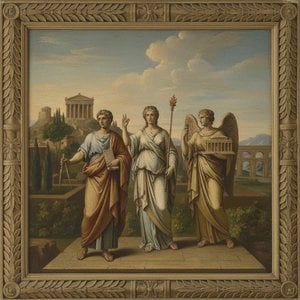
Louis Surugue: The Painter of Versailles’s Grandeur
Louis Surugue (1686 – 1762) stands as a pivotal figure in the decorative arts of the French Rococo period, primarily celebrated for his breathtaking interiors and monumental murals adorning the Palace of Versailles. Though overshadowed by contemporaries like Boucher and Watteau, Surugue’s distinctive style—characterized by shimmering surfaces, delicate pastel hues, and an emphasis on illusionistic perspective—secured him a prominent place within the artistic landscape of Louis XV's reign.
Early Life and Training
Born in Paris around 1686, Surugue’s formative years were steeped in the intellectual ferment of the Enlightenment. His father, Jean Surugue, was a Huguenot silk merchant who instilled in his son a passion for craftsmanship and artistic excellence. Recognizing Louis' talent early on, he apprenticed him to François Girardon, sculptor extraordinaire known for his monumental sculptures at Versailles and Saint-Germain-des-Prés. This apprenticeship provided Surugue with invaluable experience in mastering classical techniques alongside the burgeoning stylistic innovations of Rococo.
Versailles: A Patron’s Vision
Surugue's career truly blossomed under the patronage of Louis XV, who recognized his exceptional abilities and commissioned him to undertake ambitious decorative projects at Versailles. He swiftly ascended the ranks of artistic circles, becoming a favored artist of Madame de Pompadour, Louis XV’s influential mistress. Together they embarked on transforming several halls within the palace into opulent spaces reflecting the grandeur of the monarchy. Surugue's most celebrated achievement remains the ‘Escalier des Ambassadeurs,’ or Ambassador’s Staircase—a breathtaking mural depicting a fantastical landscape populated by mythological figures and shimmering waterfalls, executed with unparalleled skill in trompe-l'œil technique. This monumental artwork exemplifies Surugue’s mastery of illusionistic perspective and his ability to create immersive environments that captivated viewers.
Style and Technique
Surugue’s artistic style distinguishes itself from its peers through a meticulous attention to detail and an unwavering commitment to achieving visual splendor. He favored pastel hues—particularly pink, peach, and lemon yellow—creating luminous palettes that evoked the ethereal beauty of nature. His brushstrokes were remarkably delicate, blending seamlessly into textured surfaces to generate a velvety sheen. Crucially, Surugue perfected the art of trompe-l'œil, employing techniques like curvilinear perspective and hidden canvases to deceive the eye and heighten the illusion of depth within his murals. This masterful manipulation of visual perception underscored Surugue’s belief that decoration should transcend mere ornamentation; it should transport the viewer into a realm of imaginative delight.
Beyond Versailles: Parisian Landscapes
While Versailles cemented Surugue's reputation as a master of monumental interiors, he also produced a significant body of work depicting Parisian landscapes—particularly Place des Victoires and Saint-Germain-des-Prés. Unlike Watteau’s dreamy promenades, Surugue’s scenes captured the vibrancy of urban life with remarkable accuracy, portraying bustling marketplaces, elegant carriages, and lively gatherings of aristocrats. These canvases demonstrate Surugue's versatility as an artist and his ability to convey both grandeur and intimacy within a single composition.
Legacy and Historical Significance
Louis Surugue’s contribution to the decorative arts is undeniable. He helped define the aesthetic sensibilities of the Rococo period, elevating interior design to new heights of sophistication and artistry. His influence extended beyond Versailles, shaping artistic tastes throughout France and establishing him as one of the foremost painters of his time. Though largely forgotten by subsequent generations, Surugue’s legacy persists in the enduring beauty of his murals and landscapes—testaments to a singular talent dedicated to capturing the splendor of the Enlightenment era.