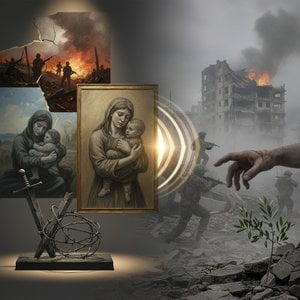
Leslie Cole (1910–1976): British War Artist Documenting WWII’s Realities With Unflinching Realism, From Malta To Bergen-Belsen
Leslie James Cole, born in Swindon, United Kingdom, in 1910, was an artist whose life became inextricably linked with the tumultuous events of the Second World War. Though his name may not be as instantly recognizable as some of his contemporaries, Cole’s contribution to documenting the realities of conflict – and its devastating aftermath – is profoundly significant. His work stands as a powerful testament to human resilience in the face of unimaginable horror, offering a visual record that continues to resonate with viewers today. Cole's artistic journey began with formal training at Swindon Art School from 1927 to 1932, followed by studies at Birmingham College of Art and culminating in a diploma from the Royal College of Art in 1937, where he specialized in mural decoration, fabric painting, and lithography. This diverse foundation equipped him with a versatile skillset that would prove invaluable during his time as an official war artist. Even before the outbreak of war, Cole demonstrated a commitment to both artistic practice and education, beginning his teaching career at Hull College of Art – a dedication he would continue throughout his life.Early Artistic Development & Formal Training
Cole’s formative years were marked by a passion for visual arts nurtured through rigorous academic instruction. Swindon Art School provided him with foundational skills in draughtsmanship and composition, while Birmingham College of Art honed his understanding of color theory and artistic technique. However, it was the Royal College of Art that truly cemented his artistic vision, particularly his specialization in mural decoration and fabric painting—skills which would prove crucial for capturing the grandeur and drama of monumental artworks during the war years. His professors recognized Cole’s talent early on, encouraging him to explore innovative approaches to artistic expression and fostering a deep appreciation for historical precedents. This intellectual grounding instilled within him a meticulous attention to detail and an unwavering commitment to conveying emotion through visual language—characteristics that would define his distinctive style throughout his career.A Call To Service: Joining the RAF & Initial Artistic Aspirations
Despite initial challenges securing a position within the Royal Air Force due to medical concerns, Cole’s determination propelled him forward in pursuit of artistic fulfillment. Recognizing the importance of practical experience alongside theoretical knowledge, he actively sought opportunities to engage with the wider art world and hone his craft. His involvement with Hull College of Art solidified his dedication to teaching and mentoring aspiring artists—a vocation that would shape his life's trajectory. Simultaneously, Cole maintained an unwavering focus on developing his artistic abilities, experimenting with various mediums and techniques while absorbing inspiration from influential figures in British art history. This multifaceted approach ensured that he remained intellectually stimulated and creatively engaged as he navigated the complexities of early adulthood.The War Artist’s Commission & Documenting Conflict
The outbreak of World War II irrevocably altered Cole's artistic path, presenting him with an unprecedented opportunity to contribute to documenting the unfolding drama of conflict. Despite initial rejection by Sir Kenneth Clark and the War Artists’ Advisory Committee (WAAC), Cole persevered in demonstrating his capabilities through independent missions accompanying trawlers involved in minesweeping and serving aboard destroyers—projects that showcased his unwavering dedication and artistic talent. These self-initiated endeavors impressed the WAAC, ultimately securing him a full-time commission in 1943. This marked the commencement of an extraordinary period wherein Cole traveled extensively across Europe and Asia, capturing scenes from Malta during the final stages of its siege, Normandy alongside the Royal Marines, Cairo, Greece amidst inter-factional violence following German withdrawal, and further afield to Singapore, Burma, Borneo, and Java. However, it was his assignment to document the liberation of Bergen-Belsen concentration camp that would solidify his artistic legacy—a harrowing undertaking undertaken with unflinching realism and profound empathy.Style & Substance: Realism Tempered With Emotion
Cole’s artistic style is characterized by a compelling realism—an ability to convey both the physical and emotional weight of his subjects. He wasn't afraid to confront difficult truths, depicting violence and death with honesty and directness—qualities specifically recognized by the WAAC as essential for documenting wartime experiences. His earlier training in lithography proved particularly useful in capturing the immediacy of events, allowing him to create powerful images that conveyed a sense of urgency and authenticity. While his work demonstrates technical skill, it is the emotional depth that truly sets it apart. He possessed a remarkable capacity to portray not only what he saw but also the human cost of conflict—imbuing his paintings with a palpable sense of sorrow, resilience, and quiet dignity. This sensitivity, combined with his meticulous attention to detail, resulted in works that are both historically significant and deeply moving.Legacy & Remembrance: Ensuring Cole’s Vision Endures
Cole's artistic legacy extends beyond the canvases he created; it resides in the enduring power of his images to provoke reflection and inspire compassion. Renewed interest in his contributions emerged in 1985 with an exhibition titled "To the Front Line" at the Imperial War Museum, and again in 2009 when two of his paintings appeared on Antiques Roadshow—a testament to their continued relevance and artistic merit. Today, Cole’s works are held by the Imperial War Museum and numerous other public collections across Britain, ensuring that his powerful depictions of wartime experiences continue to be seen and appreciated by future generations. His art serves as a vital reminder of the sacrifices made during World War II and the importance of bearing witness to history's most challenging moments—a solemn tribute to those who endured unimaginable suffering and reaffirmed humanity’s capacity for compassion amidst darkness.Kysymykset ja vastaukset
Mistä Leslie Cole on kotoisin?
Leslie Cole on syntynyt Iso Britannia.
Miten löydän tietyn teeman mukaisia Leslie Cole teoksia?
Löytääksesi tietyn teeman mukaisia Leslie Cole teoksia, käytä taiteilijan Avainsanoittain -sivua, joka ryhmittelee teokset avainsanojen mukaan.
Kuinka monta Leslie Cole teosta on katseltavissa?
Voit selata 65 teosta teosta taiteilijalta Leslie Cole sivulla Kaikki teokset.