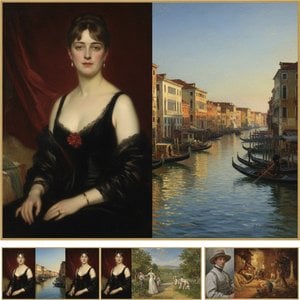
Laslett John Pott: A Master of Victorian Maritime and Portraiture
Laslett John Pott (1837-1898) stands as a significant, yet often overlooked, figure in 19th-century British art. His career, spanning nearly six decades, reveals a remarkable evolution from early academic training to the creation of intensely evocative maritime scenes and meticulously rendered historical portraits. Pott’s work offers a poignant glimpse into Victorian society, capturing both its grandeur and its underlying anxieties through a distinctive blend of realism, sentimentality, and a deep understanding of naval history and aristocratic life.
Born in Nottinghamshire in 1837, Pott's artistic journey was far from straightforward. Initially, his father, a staunch advocate for architectural pursuits, compelled him into an apprenticeship with a local architect. This early constraint ignited within Pott a profound desire for creative freedom, ultimately leading him to pursue art formally. He enrolled at the Slade School of Fine Art in London, where he studied under Alexander Johnstone, a respected Scottish history and genre painter. Johnstone’s influence proved crucial, shaping Pott's technical skills and fostering his appreciation for narrative painting – a style particularly well-suited to depicting historical events and figures.
Pott’s artistic development truly blossomed during the 1860s and 70s. He quickly gained recognition at the Royal Academy of Arts, exhibiting an impressive string of works that resonated with Victorian audiences. His subjects were diverse, ranging from dramatic scenes of naval battles – notably his celebrated depictions of Napoleon's campaigns in Russia – to intimate portraits of British nobility, often imbued with a palpable sense of melancholy and introspection. His paintings weren’t merely historical records; they were carefully constructed narratives designed to evoke emotion and contemplation. Pott possessed an uncanny ability to capture the psychological states of his subjects, imbuing them with a quiet dignity or profound sorrow.
The Maritime Vision: Ships, Sailors, and the Victorian Sea
Perhaps the most enduring aspect of Pott’s oeuvre is his fascination with maritime subjects. He produced a vast body of work depicting ships in all their glory – majestic warships, humble merchant vessels, and daring privateers. These paintings are characterized by an extraordinary attention to detail, meticulously rendered rigging, sails, and hull planking that convey the power and complexity of naval technology. However, Pott’s maritime scenes transcend mere technical virtuosity; they are infused with a deep sense of atmosphere and drama.
His depictions of naval battles, such as “On the March from Moscow,” are particularly noteworthy for their dynamic compositions and their ability to capture the chaos and heroism of combat. He wasn’t simply illustrating historical events; he was conveying the human cost of war – the bravery, the sacrifice, and the devastating consequences. Pott's understanding of naval life extended beyond grand battles; he also painted scenes of everyday maritime existence, capturing the lives of sailors, dockworkers, and shipbuilders with a sympathetic eye.
Portraits of Power and Prestige: The Aristocracy’s Image
Alongside his maritime paintings, Pott was equally adept at portraying members of the British aristocracy. His portraits are not simply likenesses; they are carefully constructed representations of social status, wealth, and power. He frequently depicted figures from the royal family, including Queen Victoria herself, as well as prominent politicians, military officers, and wealthy industrialists.
Pott’s aristocratic portraits are distinguished by their formal elegance and their subtle psychological insights. He skillfully captured the personalities of his subjects – their pride, their ambition, and their vulnerabilities – through carefully observed details in their clothing, posture, and expressions. His depiction of Mary Queen of Scots on her way to her execution is a prime example, conveying both the queen’s regal bearing and her impending doom with remarkable sensitivity.
Influences and Legacy
Pott's artistic style reflects the prevailing trends of Victorian painting – a blend of academic realism, Romantic sentimentality, and historical narrative. He was influenced by artists such as William Turner, whose atmospheric landscapes and dramatic compositions inspired Pott’s own approach to depicting maritime scenes. John Brett, another Royal Academy painter, also exerted an influence on Pott's work, particularly in his depictions of aristocratic subjects.
Despite not achieving the widespread fame of some of his contemporaries, Laslett John Pott left a significant contribution to British art. His meticulously rendered paintings offer a valuable window into Victorian society and its fascination with naval history and aristocratic life. His works are now housed in several major museums across Britain, testament to their enduring artistic merit and historical significance.