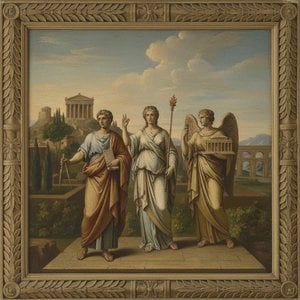
Jules Eugène Lenepveu: A Titan of Historical Painting
Jules Eugène Lenepveu (1819 – 16 October 1898) stands as a monumental figure in French Neoclassical art, celebrated primarily for his colossal frescoes adorning the Opéra Garnier and the Panthéon—works that cemented his reputation as one of the foremost painters of his era. Born in Angers, Lenepveu’s artistic journey began with rigorous training at the École des Beaux-Arts in Paris, where he honed his skills under the tutelage of François-Édouard Picot, absorbing the stylistic precepts of classical antiquity and mastering techniques vital for monumental decoration. His success at the Prix de Rome in 1847—winning acclaim for *The Death of Vitellius*—provided him with invaluable experience abroad and propelled him towards Rome, where he continued his artistic education and cultivated a profound appreciation for humanist ideals.
- Early Life & Education: Lenepveu’s formative years were marked by an unwavering dedication to scholarly pursuits alongside artistic endeavors. He excelled in mathematics and philosophy, demonstrating a mind as disciplined as his hand was skilled. This intellectual grounding profoundly influenced his artistic vision, informing his meticulous attention to detail and his commitment to conveying historical narratives with accuracy and grandeur.
- The Prix de Rome & Roman Influences: The Prix de Rome award wasn’t merely a recognition of talent; it was a gateway to immersion in the artistic traditions of Italy—a crucible where Lenepveu encountered Michelangelo, Raphael, and Bernini, artists whose mastery captivated him. These encounters instilled within him an enduring fascination with idealized beauty and monumental scale, shaping his stylistic preferences for decades to come.
- Opéra Garnier & Joan of Arc: Lenepveu’s artistic zenith arrived with the commission to decorate the Opéra Garnier (1869–71), undertaking a project that demanded unparalleled technical prowess and imaginative vision. His depiction of Joan of Arc at the Panthéon—a monumental fresco completed in 1890—represents arguably his most ambitious undertaking, embodying the spirit of Romantic idealism while adhering to classical principles of composition and color.
Lenepveu’s artistic legacy extends beyond these iconic works; he served as Director of the French Academy in Rome from 1872 to 1878, fostering a vibrant intellectual environment that nurtured young artists and championed humanist values. His influence permeated the Parisian art scene, shaping the aesthetic sensibilities of his contemporaries and establishing him as a pivotal figure in the revival of Neoclassical painting—a movement dedicated to recapturing the grandeur and clarity of antiquity. He died peacefully in Paris in 1898, leaving behind an oeuvre that continues to inspire admiration for its monumental ambition and unwavering commitment to artistic excellence.
- Notable Paintings: Lenepveu’s output encompassed numerous canvases depicting historical subjects—often imbued with moralizing undertones—demonstrating his mastery of chiaroscuro and his ability to convey emotion through subtle tonal variations.
- Technique & Style: Lenepveu's distinctive style was characterized by meticulous draftsmanship, precise color palettes rooted in classical tradition, and a deliberate avoidance of expressive brushstrokes. He prioritized clarity of form and harmonious composition, reflecting the ideals of rationalism prevalent during his time.
His frescoes at the Opéra Garnier and the Panthéon stand as enduring monuments to artistic achievement—testaments to Lenepveu’s unwavering dedication to elevating art as a vehicle for conveying profound human truths. He remains an artist whose work embodies the spirit of Neoclassicism, securing his place among the titans of French painting history.