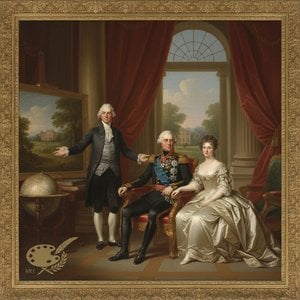
John Wonnacott: A Painter of Emotion and Observation
John Henry Wonnacott CBE (born 1940, London, England) is a British painter renowned for his evocative portraits and historical scenes—works that capture not just likeness but also the essence of human experience. His artistic journey began at Slade School of Fine Art in 1958–63 where he honed his skills alongside luminaries like Frank Auerbach and Michael Andrews, fostering an approach rooted in meticulous observation and disciplined drawing. This formative influence would shape his distinctive style for decades to come.
- Early Career & Teaching: Wonnacott’s dedication to artistic education extended beyond the Slade; he taught at Reading University's department of fine art alongside Ray Atkins from 1965 to 1973, emphasizing the importance of analytical measurement and fostering a studio environment mirroring Atkins’ energetic imagery.
- Norwich School & Continued Exploration: Continuing his teaching pursuits, Wonnacott moved to Norwich School of Art in 1977–86, further refining his pedagogical methods and nurturing young artists' understanding of artistic principles.
- Southend-on-Sea Residency & Artistic Focus: Seeking inspiration and tranquility, Wonnacott established a home in Southend-on-Sea, Essex, where he continued to develop his artistic vision—primarily concentrating on portraiture and historical narratives.
Notable Achievements & Exhibitions
Wonnacott’s artistic reputation grew steadily throughout the 1980s and 1990s, culminating in solo exhibitions at prestigious institutions like the Scottish National Portrait Gallery (Edinburgh, 1986) and the National Portrait Gallery (London, 2000). His canvases graced the Barbican Centre, the Royal Academy, and Tate Gallery—all landmarks of London’s cultural landscape—demonstrating his commitment to sharing his art with a wider audience. A particularly significant commission was the portrait of John Major in 1997, followed by an ambitious depiction of the British royal family in 2000 – a monumental artwork measuring twelve feet tall.
Recognition & Awards
In 2000, Wonnacott received the Ondaatje Prize for Portraiture—a testament to his mastery of capturing psychological depth and conveying emotion through visual representation. His unwavering dedication to artistic excellence was formally acknowledged with Commander of the Order of the British Empire (CBE) honor bestowed in recognition of his contributions to the arts.
Style & Technique
Wonnacott’s distinctive style is characterized by a profound respect for drawing—a cornerstone of his artistic practice. He prioritizes meticulous observation and employs techniques that aim to distill complex visual information into simplified forms, resulting in paintings imbued with palpable energy and emotional resonance. Auerbach and Andrews' influence on Wonnacott’s formative years undoubtedly contributed to this approach, emphasizing the importance of disciplined analysis and expressive gesture.
Legacy & Continuing Relevance
John Wonnacott’s work continues to captivate audiences with its ability to convey profound human emotion and capture historical moments with remarkable accuracy. His enduring presence in major galleries—including the Royal Academy and Tate Gallery—solidifies his place as a pivotal figure in British art history, ensuring that his evocative paintings inspire contemplation and appreciation for generations to come.