The Soul Captured in Oil: The Life and Legacy of John William Brooke
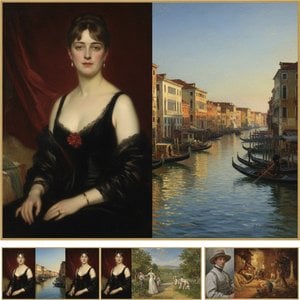
In the golden twilight of the Victorian era, a period defined by both rigid social structures and an burgeoning fascination with psychological depth, John William Brooke emerged as a master of the human countenance. Born in Yorkshire in 1853, Brooke carried the industrious spirit of his northern roots into the heart of the London art scene. His journey was one of disciplined refinement, beginning with his formative years at the prestigious Slade School of Fine Art. It was here that Brooke encountered the monumental influence of Frederic Leighton, a titan of the era whose commitment to classical beauty and the Salon style would become the bedrock of Brooke’s own artistic identity. Through this mentorship, Brooke learned not merely to paint faces, but to translate the very essence of character onto canvas through meticulous realism and an unwavering dedication to accuracy.
Brooke’s technical prowess was rooted in a sophisticated understanding of light and texture. He favored the medium of oil on canvas, employing a delicate glazing technique that allowed him to layer translucent colors. This method bestowed a luminous, almost breathing quality to his subjects, creating a sense of depth that invited the viewer into a silent dialogue with the sitter. His work was characterized by an understated elegance; he avoided the theatrical in favor of a serene composure, using subtle gestures and nuanced facial expressions to convey the inner life of his subjects. Whether capturing the stern resolve of an industrialist or the quiet wisdom of a statesman, Brooke’s brushwork remained faithful to the classical tradition of capturing truth through beauty.
A Chronicle of Character: Portraits and Subjects
The breadth of Brooke’s oeuvre serves as a visual record of the social fabric of late 19th and early 20th-century Britain. His commissions were not merely exercises in vanity but were profound studies of the individuals who shaped his era. His portraiture spanned a wide social spectrum, bridging the gap between the political elite and the rising industrial class. Some of his most notable achievements include:
- J. Whiteley Ward, MP: A striking 1910 portrait (after Walter William Ouless) that stands as a testament to Brooke’s ability to capture dignity and psychological nuance, presenting the politician with a sense of timeless wisdom.
- Alderman Wright Mellor: A work that showcases his skill in rendering the formal gravity of civic leadership.
- Alfred Fishburn: A portrait celebrated for its remarkable detail and the artist's ability to focus on the intricate textures of clothing and skin.
- Alderman Charles Glendenning: An example of his capacity to imbue official portraits with a sense of personal character and presence.
While portraiture remained his primary calling, Brooke’s artistic curiosity led him to explore the realms of figure painting, landscapes, and mythological themes. In these works, one finds the same precision applied to his portraits, yet infused with a different kind of sensitivity—a poetic exploration of form and nature that demonstrated his versatility as a complete painter. Though perhaps less frequent than his commissioned portraits, these explorations into the classical and the naturalistic further solidified his reputation as an artist of immense technical command.
Historical Significance and Artistic Enduring Spirit
As the Edwardian era gave way to the complexities of the modern age, the meticulous realism championed by Brooke began to face the rising tide of Impressionism and more radical movements. Yet, the significance of his work lies in its steadfast preservation of a specific cultural moment. He acted as a bridge between the classical ideals of the mid-Victorian period and the dawn of the 20th century, maintaining a standard of excellence that honored the traditions of the Paris Salon while responding to the British demand for dignified, realistic representation.
Today, the works of John William Brooke remain vital windows into a lost world of formal elegance and social stability. His ability to translate the psychological weight of his subjects into visual form ensures that his legacy is not merely one of technical skill, but of emotional resonance. Through his mastery of light, color, and character, Brooke ensured that the faces of his time would continue to speak to future generations, long after the era of the great Yorkshire painter had passed into history.