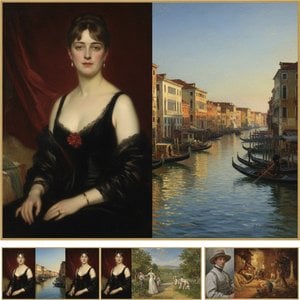
John Ernest Breun: A Victorian Portraitist of Distinction
John Ernest Breun (1862-1921) emerges from the late 19th and early 20th centuries as a quietly significant figure in British portraiture. While not commanding the same immediate fame as some of his contemporaries, Breun’s meticulous realism and discerning eye for capturing character established him as a respected artist, particularly within commissions for prominent figures of the era – Earls, Mayors, and members of the landed gentry. His work offers a valuable glimpse into Victorian society, revealing not just outward appearances but also subtle nuances of personality and social standing.
Born in Swansea, Wales, to John Needham Breun, a picture dealer and printseller, art was undoubtedly woven into his family’s fabric. This early exposure likely fostered an appreciation for visual representation and the business side of artistic creation. Details regarding his formal training remain somewhat sparse, though it's understood he received instruction that allowed him to hone his skills in observation and technique. Breun’s career began modestly, likely assisting his father in the family trade before establishing himself as a freelance portrait painter. His early works demonstrate a solid grounding in traditional academic methods – careful rendering of form, precise shading, and an adherence to established compositional principles.
The Palette of Prestige: Commissions and Subjects
Breun’s reputation was largely built upon his success with commissions. He became known for undertaking portraits of notable individuals, a role that demanded both artistic skill and a keen understanding of social etiquette. His subjects included members of the aristocracy – the Earl of Stamford, for instance, whose portrait exemplifies Breun's ability to convey dignified composure; Lord Leith of Fyvie, another prominent figure in Scottish society; and numerous Mayors and local dignitaries from across England. These commissions weren’t merely exercises in likeness; they were carefully constructed representations designed to project an image of wealth, status, and civic responsibility.
The selection of subjects speaks volumes about Breun's clientele and the prevailing social priorities of the time. He frequently depicted individuals associated with land ownership, government, and local administration – positions that carried considerable influence and prestige within Victorian society. His portraits served as visual markers of power and lineage, reinforcing established hierarchies and celebrating the accomplishments of those in authority.
Technique and Style: Realism Refined
Breun’s artistic style is best characterized as refined realism. He eschewed overtly dramatic or romanticized depictions, instead favoring a meticulous approach to capturing his subjects' features and expressions with remarkable accuracy. His brushwork is generally smooth and controlled, prioritizing tonal values and subtle gradations of light and shadow to create a sense of depth and volume. He demonstrated a particular skill in rendering fabrics – the textures of velvet, silk, and wool are depicted with convincing detail, adding richness and visual interest to his portraits.
While rooted in academic tradition, Breun’s work possesses a quiet dignity and understated elegance. He avoided excessive ornamentation or elaborate backgrounds, allowing his subjects to take center stage. His compositions are typically balanced and symmetrical, reflecting the Victorian emphasis on order and decorum. The use of muted color palettes – predominantly browns, grays, and creams – further contributes to the overall sense of restraint and sophistication.
Legacy and Influence
John Ernest Breun’s contribution to British portraiture may not be immediately apparent in the annals of art history, but his work holds a certain quiet charm. He represents a significant link between academic tradition and the evolving artistic sensibilities of the late 19th and early 20th centuries. His portraits offer valuable insights into Victorian society, revealing the social dynamics and cultural values of the era. While he didn’t achieve widespread fame during his lifetime, Breun's meticulous craftsmanship and discerning eye continue to be appreciated by art historians and collectors alike. His works are now housed in various collections, including the National Trust, demonstrating a lasting recognition of his skill and contribution to the field.
Further research into local archives and family records may yet reveal additional details about Breun’s life and artistic practice, enriching our understanding of this quietly distinguished portraitist.