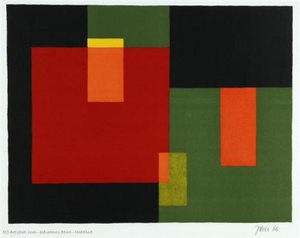
Johannes Itten – A Pioneer of Color and Form: The Life and Legacy of Johannes Itten
Johannes Itten, born in 1888 in the tranquil Swiss village of Südern-Linden, was more than just a painter; he was a visionary educator who fundamentally reshaped the landscape of modern art instruction. His journey began not within the hallowed halls of traditional art academies, but as an elementary school teacher—a formative experience that instilled in him a deep understanding of learning processes and the blossoming of creative potential. Itten’s early pedagogical explorations, inspired by Friedrich Fröbel's groundbreaking kindergarten concepts, emphasized intuitive development over rigid instruction, a philosophy he would carry throughout his career. Though briefly attempting formal training at Geneva’s École des Beaux-Arts, he found its methods stifling, returning to Bern where studies with Ernst Schneider proved pivotal. Schneider championed collective critique over individual assessment, nurturing creative impulses rather than suppressing them—a radical approach that became central to Itten's own teaching methodology. Influences from Eugène Gilliard, who explored abstract forms, and Adolf Hölzel, who utilized basic shapes as the foundation for artistic creation, further shaped his evolving aesthetic. He embraced Hölzel’s belief in lines, planes, circles, and spirals as essential starting points for visual exploration, laying the groundwork for his later theoretical work on color and form.Early Life and Education
Itten's formative years were marked by a profound appreciation for natural beauty and an early fascination with artistic expression. Growing up in Switzerland instilled in him a connection to the Alpine landscape—a recurring motif in his paintings—and fostered a sensitivity to light and texture. His decision to pursue teaching rather than pursuing conventional artistic pursuits stemmed from a conviction that fostering creativity in young minds was paramount. He believed that true understanding of art began not with technical skill but with an awareness of human psychology and developmental stages, mirroring Fröbel’s pioneering work on early childhood education. This belief would permeate his pedagogical approach for decades to come. His brief foray into École des Beaux-Arts in Geneva ultimately convinced him that the rigid academic system hindered genuine artistic exploration.The Bauhaus Revolution: The Vorkurs and Color Theory
Itten's arrival at Walter Gropius’ newly founded Bauhaus in Weimar in 1919 marked a turning point not only in his career but also in the history of art education. Appointed as a Master, alongside Lyonel Feininger and Gerhard Marcks, he was tasked with developing a foundational course—the *Vorkurs*, or preliminary course—that would become legendary. This wasn’t merely an introductory class; it was a complete reimagining of how artists were trained. Itten believed in stripping away preconceived notions and encouraging students to explore the fundamental properties of materials, composition, and, most importantly, color. He theorized seven distinct types of color contrast – hue, value, temperature, complements (neutralization), simultaneous contrast, saturation, and extension—and devised a series of exercises designed to unlock an intuitive understanding of these principles. His “color sphere,” encompassing twelve fundamental colors, became a cornerstone of Bauhaus curriculum. Itten’s teaching wasn’t confined to the intellectual; he incorporated gymnastic exercises, believing physical relaxation was essential for stimulating creativity and fostering self-expression. He championed collective critique over individual assessment, nurturing creative impulses rather than suppressing them—a radical approach that became central to Itten's own teaching methodology.Influences and Artistic Style
Itten’s artistic style evolved significantly throughout his career, reflecting a continuous engagement with diverse influences. Eugène Gilliard’s exploration of abstract forms profoundly impacted his visual vocabulary, encouraging him to prioritize simplification and expressive gesture. Adolf Hölzel’s emphasis on basic shapes—lines, planes, circles, spirals—provided a conceptual framework for his artistic endeavors. These foundational principles underpinned his later paintings, characterized by bold color palettes and dynamic compositions that conveyed emotion and psychological depth. Itten's work is notable for its exploration of geometric abstraction alongside organic forms, demonstrating a harmonious blend of rational and intuitive approaches to visual representation.Later Years and Legacy
Despite the Bauhaus’s eventual dissolution in 1934 due to political pressures—particularly Nazi ideology—Itten continued his artistic practice and teaching activities. He established a small art and architecture school in Berlin, furthering his commitment to fostering holistic learning and nurturing creative talent. His unwavering belief in Mazdaznan, a Zoroastrian fire cult that emphasized spiritual contemplation and ritual purification, profoundly shaped his worldview and informed his artistic vision. Johannes Itten’s legacy extends far beyond the Bauhaus; his pioneering color theory continues to inspire artists today, and his *Vorkurs* remains a model for foundational art courses worldwide—a testament to his enduring contribution to the advancement of modern art education. He is remembered as a visionary educator who championed intuitive development and challenged conventional artistic dogma, leaving an indelible mark on the history of visual culture.Kysymykset ja vastaukset
Mihin historialliseen aikakauteen Johannes Itten kuului?
Johannes Itten työskenteli Modernismi -aikakaudella. Aikakausi sijoittaa taiteilijan toiminnan historialliseen kontekstiin.
Missä kaupungissa ja maassa Johannes Itten on syntynyt?
Johannes Itten on syntynyt Suedern Linden, Suomi.
Voinko selata Johannes Itten teoksia tekniikan mukaan?
Löytääksesi kaikki Johannes Itten teokset tietyssä tekniikassa, käytä taiteilijan Kaikki tekniikat -sivua.