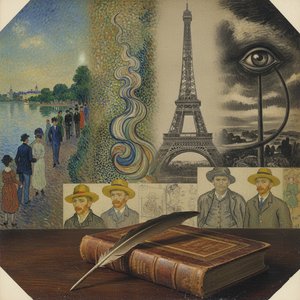
Francis Bacon: A Chronicle of Anguish and the Human Condition
Born in Dublin, Ireland, on October 28th, 1909, Francis Bacon’s life was one marked by a profound sense of unease and an unrelenting exploration of the darker aspects of human existence. Initially pursuing a career as an interior decorator and bon vivant – a lifestyle he famously indulged in throughout his middle years – Bacon only began to seriously dedicate himself to painting in his late twenties, a decision fueled by a persistent feeling that he hadn’t yet discovered subjects capable of sustaining his artistic interest. This delay, coupled with a restless spirit and a keen observation of the world around him, ultimately shaped an oeuvre characterized by raw emotion, unsettling imagery, and a deeply psychological intensity.
Bacon's early influences were diverse and complex. He acknowledged a significant debt to Pablo Picasso’s Cubism, particularly in his “bio-morphs” of the 1930s – distorted, fragmented figures that seemed to exist on the threshold between human and animal. However, he quickly moved beyond this stylistic influence, developing a highly personal language of expression. The impact of Surrealism is also evident in his work, though Bacon resisted any easy categorization. He was deeply affected by the writings of existentialist philosophers like Jean-Paul Sartre and Albert Camus, whose ideas about absurdity, alienation, and the inevitability of death permeated his art. Furthermore, he drew inspiration from the works of Hieronymus Bosch, whose grotesque depictions of human folly and suffering resonated with Bacon’s own preoccupation with mortality.
Bacon's mature style is instantly recognizable for its visceral impact. His paintings often feature distorted, screaming faces – a motif that has become synonymous with his work. These figures are frequently depicted in claustrophobic interiors, surrounded by sharp angles and unsettling geometries. He employed a limited palette of predominantly dark colors—reds, blacks, browns—to heighten the sense of drama and anxiety. Bacon’s technique involved applying paint directly to the canvas, often using knives and other tools to create textured surfaces that mirrored the emotional turmoil he sought to convey. He frequently worked on multiple canvases simultaneously, allowing ideas and images to bleed into one another, creating a dynamic and interconnected body of work.
Throughout his career, Bacon explored a wide range of subjects, including portraits of friends, self-portraits, crucifixions, and depictions of animals. His most famous series, the “screaming popes,” emerged in the mid-1950s, capturing a moment of profound anguish and spiritual crisis. The "Three Studies for Figures at the Base of a Crucifixion" (1944), arguably his most iconic work, is a harrowing depiction of suffering and death, reflecting the trauma of World War II and Bacon’s own personal experiences. Later in life, he shifted towards more intimate portraits of friends, often depicting them in states of vulnerability and isolation. His final works, produced in the 1980s, are characterized by a somber stillness, suggesting a profound acceptance of mortality.
Francis Bacon’s legacy is one of uncompromising honesty and emotional intensity. He refused to shy away from difficult subjects or uncomfortable truths, offering viewers a brutally honest reflection of the human condition. His work continues to provoke and disturb, challenging us to confront our own fears and anxieties. Despite his initial reluctance to embrace painting as a serious vocation, Bacon ultimately became one of the most important and influential artists of the 20th century, leaving behind a body of work that is both profoundly unsettling and deeply moving. He died on April 28th, 1992, in London, leaving behind a testament to the power of art to explore the darkest corners of the human psyche.