The Master of the Etched Line: The Life and Legacy of Jacques Callot
In the grand tapestry of the Baroque era, few threads are as fine or as piercingly detailed as those woven by Jacques Callot. A virtuoso who eschewed the broad strokes of oil painting in favor of the precise, biting needle of the etching tool, Callot transformed printmaking from a secondary craft into a profound medium of social commentary and technical brilliance. Born in the region of Lorraine around 1592, his journey was one of movement and metamorphosis, carrying him from the privileged halls of his noble upbringing to the vibrant, often chaotic streets of Rome and Florence. He did not merely record history; he etched its very soul onto copper plates, capturing the fleeting shadows of human suffering and the opulent splendor of courtly life with equal intensity.
Callot’s artistic evolution was deeply shaped by his travels across Europe, which allowed him to absorb the diverse textures of the seventeenth century. His early training in Nancy provided a foundation of discipline, but it was his time in Italy that truly ignited his genius. Under the guidance of masters like Philipp Tessmann in Rome and later within the prestigious workshops of Florence, Callot learned to marry the humanist ideals of the Renaissance with the dramatic, emotional weight of the Baroque. His service to the Medici court provided him with unparalleled access to the heights of aristocratic culture, yet he remained a keen observer of the world beneath the gilded surface, documenting the grit and grime of urban existence with an unflinching eye.
Technical Revolution and the Échoppe
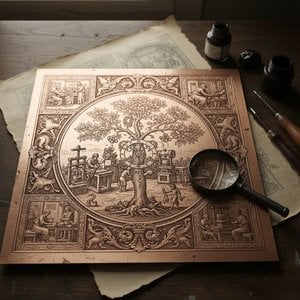
What truly set Callot apart from his contemporaries was his revolutionary approach to the medium itself. Before Callot, etching often lacked the tonal depth and varied line weight characteristic of traditional engraving. He bridged this gap through a brilliant technical innovation: the creation of the échoppe. This specialized etching needle, featuring an oval-shaped tip, allowed him to manipulate the pressure of the stroke to create swelling and tapering lines. This breakthrough enabled him to mimic the graceful, varying widths of an engraver's tool, bringing a new level of sculptural dimension and fluid movement to his prints. Through this mastery, he achieved a level of detail that could render the delicate lace of a nobleman’s sleeve or the harrowing, jagged textures of a battlefield with equal precision.
This technical prowess allowed for an unprecedented range of subject matter, most notably in his celebrated series documenting the darker side of humanity. His work often serves as a visceral window into the Miseries of War, where he captured the raw, chaotic violence of conflict. In masterpieces such as Le Pillage, the viewer is thrust into a world of disorder and destruction, where the fine lines of his needle convey the frantic energy of a landscape in upheaval. Conversely, his ability to capture light and theatricality is evident in works like Interlude in the Medici Theater, where the intricate compositions evoke the vibrant, staged magic of Renaissance performance.
A Lasting Impression on Art History
The historical significance of Jacques Callot extends far beyond the borders of the seventeenth century. He was a pioneer of what we now recognize as "old master prints," establishing a standard of narrative complexity and technical execution that would inspire generations of printmakers. His influence can be traced through the centuries, most notably in the works of Francisco Goya, who shared Callot’s ability to use the graphic medium to explore the darker, more grotesque aspects of the human condition. By elevating the etching needle to a tool of profound psychological and social depth, Callot ensured that his vision would endure.
Ultimately, Callot’s body of work remains a hauntingly beautiful paradox: it is both a meticulous record of historical brutality and a celebration of artistic finesse. Whether he was depicting the grim reality of La Roue (Breaking on the Wheel) or the delicate grace of a courtly dance, his prints possess a timeless quality that transcends their era. He remains a singular voice in the Baroque canon—a master who found the infinite within the infinitesimal, proving that even the smallest etched line could carry the weight of the world.