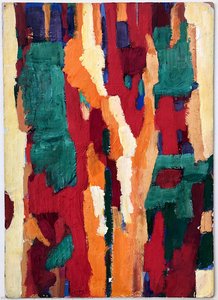
Early Life and Artistic Beginnings
Hryhorii Havrylenko, more commonly known as Grigory Gavrilenko, was born on July 7th, 1927, in the small village of Holopkove, located within the Sumy region of Ukraine. This humble beginning would profoundly shape his artistic vision – a deep connection to the land and its people, interwoven with a restless spirit seeking to break new ground. His early years were marked by the hardships of wartime Ukraine, experiences that instilled in him a keen awareness of human suffering and resilience, themes which would later permeate much of his work. He began his artistic journey formally at the Kyiv State Institute, graduating in 1955, an institution renowned for nurturing Ukrainian avant-garde talent. This education provided him with a solid foundation in traditional techniques while simultaneously exposing him to the burgeoning currents of modern art both within Ukraine and internationally.A Pioneer of Ukrainian Avant-Garde
Havrylenko’s artistic style is most accurately described as belonging to the vibrant and revolutionary Ukrainian avant-garde movement of the 1960s. Rejecting the prevailing realism, he embraced bold experimentation with color, form, and composition – a deliberate departure from established norms. His work was characterized by dynamic energy, often employing distorted figures and fragmented perspectives, reflecting a desire to capture not just appearances but also the underlying emotional currents of his subjects. He drew inspiration from Cubism’s deconstruction of reality and sought to translate this into a distinctly Ukrainian visual language. The influence of Samuel Yellin, a prominent figure in Ukrainian art, is often noted as a key factor in shaping Havrylenko's approach, though he ultimately forged his own unique path.Themes and Techniques: A Woman’s Image
Havrylenko’s oeuvre is particularly notable for its recurring focus on the female form – not as idealized beauty but as a symbol of strength, vulnerability, and connection to nature. His paintings frequently depict women immersed in natural settings, their figures rendered with a striking blend of abstraction and realism. He masterfully utilized color to evoke mood and atmosphere, employing intense hues and dramatic contrasts to create powerful visual narratives. A significant portion of his work was executed through the technique of colored linocut, allowing for intricate detail and bold graphic effects. This medium perfectly suited his desire to convey complex emotions and ideas with a dynamic, almost sculptural quality. His later years saw him continue to refine this technique, pushing its boundaries and exploring new possibilities.Notable Works and Exhibitions
While a comprehensive catalog of Havrylenko’s work remains incomplete, several pieces stand out as particularly significant examples of his artistic vision. His “Nude” series, for instance, is celebrated for its raw emotional intensity and innovative use of color. The painting "Composition" showcases his ability to create dynamic visual relationships between shapes and forms. His book illustrations, especially those created in the 1970s, are equally impressive, demonstrating his versatility as an artist and his deep understanding of narrative storytelling. Havrylenko’s work has been exhibited at various prestigious venues throughout Ukraine, most notably at the Kharkiv Regional Art Museum, a key institution dedicated to preserving and showcasing Ukrainian art and culture. The museum's collection offers a valuable glimpse into the breadth and depth of his artistic legacy.Legacy and Lasting Influence
Hryhorii Havrylenko passed away on February 23rd, 1984, in Kyiv, leaving behind a body of work that continues to inspire artists today. His influence can be seen in the works of subsequent generations of Ukrainian painters who followed in his footsteps, embracing his spirit of experimentation and his commitment to exploring new artistic frontiers. He remains a pivotal figure in the history of Ukrainian art, a true pioneer whose bold vision helped to redefine the boundaries of contemporary expression. His legacy is not merely one of individual masterpieces but also of a vibrant artistic movement that challenged conventions and celebrated the unique cultural identity of Ukraine.Kysymykset ja vastaukset
Miten löydän tietyn teeman mukaisia Hryhorii Havrylenko teoksia?
Hryhorii Havrylenko-taiteilijan Avainsanoittain -sivu ryhmittelee taiteilijan teokset niiden avainsanojen mukaan.
Miten löydän kaikki Hryhorii Havrylenko teokset tietyssä tekniikassa?
Kaikki tekniikat-sivulla Hryhorii Havrylenko:n teokset on ryhmitelty tekniikan mukaan.
Voinko vierailla Hryhorii Havrylenko teosten virtuaalisessa museossa?
Hryhorii Havrylenko's teoksia voi ihailla 3D-galleriassa artistin 3D-museo -sivulla.