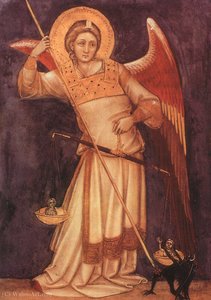
Guariento di Arpo: Bridging Florentine Realism and Venetian Gothic
Guariento di Arpo (c. 1310 – 1370) stands as a pivotal figure in fourteenth-century art, marking the transition between the stylistic dominance of Florence’s early Trecento and the increasingly ornate Venetian Gothic tradition. Born around 1310 in Padua—a city renowned for its burgeoning intellectual life and artistic patronage—Guariento's career unfolded amidst a dynamic cultural landscape shaped by humanist ideals and Byzantine influences. He is remembered primarily for his monumental frescoes adorning the Augustinian hermits’ church of San Bernardino, Padua, particularly the cycle depicting St Augustine’s Life – a commission that cemented his reputation as Padua’s foremost painter. His legacy extends beyond these iconic works, encompassing decorative panels commissioned by influential families like the Carrara and culminating in a fragmentarily preserved depiction of Paradise within the Palazzo Ducale.
- Early Life & Training: Precise biographical details remain elusive, yet Guariento's formative years were spent in Padua’s vibrant artistic milieu. Evidence suggests he received instruction from Giovanni Pisano and Giotto di Bondone—artists whose groundbreaking innovations profoundly impacted Venetian painting. This exposure instilled in him a commitment to naturalistic representation combined with expressive dynamism, characteristics that would define his distinctive style.
- The Frescoes of San Bernardino: Guariento’s magnum opus resides in the choir frescoes of San Bernardino, Padua – a monumental undertaking undertaken in 1338. These paintings depict scenes from St Augustine's Life, meticulously crafted with meticulous attention to detail and imbued with psychological depth. The cycle showcases Guariento’s mastery of volumetric modeling and spatial perspective—techniques borrowed directly from Giotto but adapted to the Venetian aesthetic. Notably, the frescoes suffered severe damage during World War II bombing raids, resulting in significant loss of pigment and surface area. Despite this tragedy, surviving fragments offer invaluable insight into Guariento's artistic vision.
- Decorative Panels & Patronage: Beyond San Bernardino, Guariento’s artistic output included decorative panels for the Palazzo Carrara—a commission that exemplifies his ability to synthesize Byzantine influences with Venetian Gothic ornamentation. These panels depict Madonna and Child figures alongside angels, demonstrating Guariento’s meticulous craftsmanship and stylistic sophistication. The Palazzo Carrara's reconstruction in 1779 facilitated the relocation of these panels to the Museo Civico di Padova, where they continue to captivate viewers today.
- Paradise Revisited: Guariento’s invitation to decorate the Palazzo Ducale with a fresco depicting Paradise represents one of his most ambitious projects—a commission that reflects Venetian artistic ambition and intellectual curiosity. Although only fragmentary remains exist due to subsequent renovations, scholars have reconstructed significant portions of the painting based on surviving sketches and documented observations. This artwork stands as testament to Guariento’s ability to synthesize Florentine realism with Byzantine grandeur, solidifying his position as a pioneer of Venetian Gothic style.
Historical Significance: Guariento di Arpo is recognized as the first artist to successfully merge the volumetric and spatial developments of Florentine painting from the early Trecento with the more linear and abstract Late Gothic and Byzantine manner that had hitherto prevailed in Veneto. He represents a crucial juncture in artistic history, marking the definitive departure from stylistic conventions established by Giotto and Pisano while simultaneously embracing the expressive dynamism characteristic of Venetian art. His frescoes continue to inspire admiration for their psychological realism and masterful execution—a legacy that ensures Guariento di Arpo’s place among the most influential painters of his era remains secure.