George Hyde Chambers (1803–1840): A Pioneer of Maritime Impressionism
George Hyde Chambers, born June 14, 1803, in Whitby, Yorkshire—a town synonymous with seafaring tradition and artistic fervor—was destined for a life inextricably linked to the ocean’s dramatic allure. His lineage traced back to a family deeply entrenched in maritime pursuits; his father, George Chambers senior (1803–1840), embarked on extensive voyages across Europe and America, nurturing within young George an early fascination for the boundless expanse of water and its captivating vistas. Despite confronting considerable hardships during his formative years—growing up in a poverty-stricken sharecropping household—Chambers possessed an unwavering resolve to cultivate artistic excellence, fueled by a lifelong devotion to sketching and painting—a passion that would propel him toward remarkable creative accomplishments.
Early Training & Influences: The Seeds of Impressionism
Chambers’s artistic education commenced informally at home, where he honed his skills under the tutelage of his father, who instilled in him meticulous attention to detail and a profound appreciation for capturing the essence of natural beauty. He was particularly captivated by the works of Eugène Delacroix and JMW Turner—artists whose bold brushstrokes and expressive use of color profoundly impacted Chambers’s artistic vision. Delacroix's dynamic compositions and Turner’s masterful depiction of atmospheric effects served as beacons guiding Chambers toward a stylistic trajectory that would ultimately define Impressionism—a movement championing spontaneity, immediacy, and subjective perception. The influence of Turner was especially palpable in Chambers’s exploration of coastal landscapes—where he sought to convey the sublime grandeur of the Yorkshire countryside with poetic sensitivity.
Whitby & The Flowering of Coastal Vision
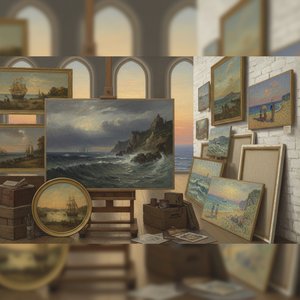
Whitby became Chambers's creative crucible—providing him with an inexhaustible reservoir of inspiration for his paintings. He painstakingly documented the rugged coastline, capturing the turbulent seascapes and atmospheric conditions that characterized the region—a stylistic hallmark that foreshadowed the burgeoning movement of Impressionism. Whitby’s windswept cliffs, crashing waves, and misty horizons became recurring motifs in Chambers's oeuvre—reflecting not merely visual observation but also a deeper engagement with the emotional resonance of place. His canvases pulsated with color—luminosity achieved through innovative techniques that departed from traditional academic conventions—demonstrating his unwavering commitment to portraying natural beauty with unparalleled vibrancy.
A Career Dedicated to Naval Art & Artistic Innovation
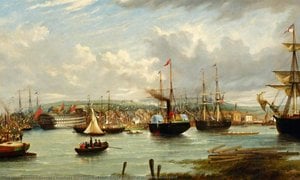
Chambers’s artistic career gained momentum in 1827 when he relocated to Wapping, London—securing a position as a house painter—allowing him to supplement his income while simultaneously pursuing his artistic ambitions. He swiftly established himself as a respected artist—attracting commissions from prominent patrons and exhibiting his work at the Royal Academy and the British Institution—solidifying his reputation within the artistic circles of Victorian England. His output spanned a diverse range of subjects—from maritime scenes to landscapes—reflecting his unwavering dedication to exploring the multifaceted dimensions of human experience through visual art. Notably, Chambers’s monumental depictions of naval battles—particularly “The Bombardment of Algiers” (1816)—stood as testaments to his mastery of composition, perspective, and tonal modulation—demonstrating his ability to convey the drama and intensity of historical events with remarkable precision.
Legacy & Recognition: An Impressionist Voice Amidst Tradition
George Hyde Chambers Junior stands as a pivotal figure in the transition from Romanticism to Impressionism—embodiment of innovation and artistic experimentation that defined the era—leaving behind a legacy of evocative landscapes and masterful depictions of naval battles that continue to inspire admiration and scholarly inquiry. Alan Russett eloquently summarized Chambers’s contribution to British art—observing “George Jnr’s are usually larger and his handling of the paint more free, the attention to detail and figures being less rigorous. His watercolours can be of sufficient quality to be confused with those of his father but the subject matter or other non-stylistic criteria usually provide the key.” Chambers's unwavering pursuit of artistic excellence—coupled with his profound connection to Whitby’s coastal environment—secured his place among Britain’s most celebrated painters—a testament to the enduring power of art to transcend time—capturing the spirit of an era and conveying profound insights into human experience. His canvases remain a vibrant reminder of Impressionism's transformative influence on Victorian artistic sensibilities.