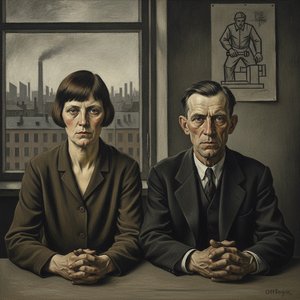
The Intellectual Tapestry of Theodor Engel
Theodor Engel (1820-1895) remains a figure shrouded in both intellectual fascination and scholarly debate—a testament to his profound impact on the trajectory of 19th-century thought. Born in Barmen, Germany, Engel’s life unfolded against the backdrop of burgeoning industrialization and the turbulent currents of European politics, shaping him into an artist whose creative output was inextricably linked with his engagement in radical social critique. While not widely recognized for visual artistry alone, Engel's contribution to philosophical discourse—particularly his partnership with Karl Marx—solidifies his place as a pivotal voice within the genesis of Marxism and consequently, a significant influence on subsequent artistic movements.
Engel’s upbringing in a wealthy textile family instilled in him an early appreciation for economic realities—a perspective that would prove crucial to his intellectual development. He pursued studies at Bonn University, immersing himself in classical philology and German Romanticism, absorbing the spirit of Weimar’s artistic milieu. However, it was his encounter with Karl Marx in 1844 that irrevocably altered his path. This serendipitous meeting sparked a collaborative relationship that would yield groundbreaking results: The Holy Family, arguably Marx's most influential work on family dynamics and social reproduction, and subsequently, the foundational texts of German Ideology and The Communist Manifesto. Engel’s meticulous research into Hegelian philosophy provided Marx with intellectual ammunition for dismantling traditional conceptions of history and advocating for proletarian revolution.
A Symbiosis of Theory and Symbolism
Engel's artistic endeavors weren't merely a personal indulgence; they served as conduits for conveying Marxist ideas. He explored symbolism—particularly through the lens of spiritual and occult themes—to bridge the gap between materialist dialectics and the intangible human experience. His work often sought to illuminate the underlying structures of society, using metaphor and imagery to represent the struggle of the working class and the inevitable shifts in historical consciousness. This unique intersection of political radicalism and esoteric symbolism allowed him to create a visual language that was as much about the soul as it was about the state.
The depth of his contribution can be seen through several key facets of his intellectual and creative life:
- Philosophical Collaboration: His role in refining the dialectical materialism that would define modern political thought.
- Symbolic Exploration: The use of occultist undertones to represent the hidden forces of social change.
- Historical Contextualization: Integrating the industrial realities of Barmen and the broader German landscape into a larger narrative of human progress.
Legacy and Historical Significance
The legacy of Theodor Engel is one of profound complexity, existing at the crossroads of political revolution and spiritual inquiry. Though his name is often inextricably linked to the monumental shadow of Karl Marx, Engel deserves recognition as an independent thinker who navigated the tensions between the material world and the metaphysical realm. His ability to weave together the threads of economic critique, classical philology, and symbolic expression created a unique intellectual texture that continues to intrigue historians of both art and politics.
In the broader scope of 19th-century history, Engel represents the era's restless search for meaning amidst the upheaval of the Industrial Revolution. His life serves as a reminder that the most transformative ideas often emerge from the unexpected intersections of disparate disciplines—where the rigor of political science meets the evocative power of the symbolic imagination.