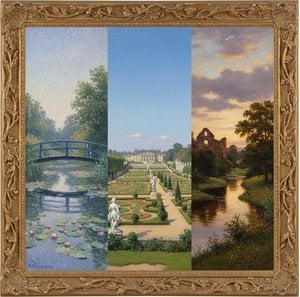
Daphne Fedarb (1912–1992): A Quiet Observer of Beauty
Daphne Fedarb, born in 1912, was a British painter who quietly established herself as a respected figure within the Bloomsbury Group and beyond. Though she remained largely outside the limelight of her contemporaries – Virginia Woolf, Vanessa Bell, Roger Fry, and Duncan Grant – Fedarb’s distinctive style and unwavering dedication to capturing the subtleties of nature cemented her place in twentieth-century art history. Her artistic journey began with a fascination for botanical illustration, honed during her formative years studying at Kew Gardens, where she meticulously documented plant specimens with remarkable accuracy. This early training instilled in her an appreciation for detail and observation—qualities that would permeate her subsequent paintings.
Early Influences: Monet’s Light
Fedarb’s artistic sensibilities were profoundly shaped by the Impressionist movement, particularly Claude Monet's explorations of light and color. Monet’s canvases weren’t merely representations of landscapes; they were attempts to distill the very essence of atmosphere—the way sunlight dances across surfaces, transforming them into shimmering pools of luminescence. Fedarb absorbed this ethos wholeheartedly, rejecting a more academic approach in favor of capturing fleeting moments of beauty with luminous glazes and delicate brushstrokes. She understood that true artistry resided not just in depicting what was seen but conveying how it *felt*.
The Bloomsbury Circle: Intellectual Dialogue
Fedarb’s engagement with the Bloomsbury Group began in the 1930s, a period marked by intense intellectual debate concerning art and literature. While she wasn't a central participant in their collaborative endeavors—the famed Bloomsbury painters often wrestled over stylistic choices and conceptual frameworks—her presence nonetheless enriched the group’s discussions. She possessed a keen intellect and a willingness to challenge conventional ideas, fostering an environment of creative experimentation that would define the era. Her conversations with fellow artists like Duncan Grant and Roger Fry undoubtedly influenced her artistic vision.
Style Characteristics: Restrained Palette & Layered Glazes
Fedarb's paintings are characterized by a remarkably restrained palette—often dominated by muted greens, blues, and browns—which serves as an ideal complement to her meticulous rendering of textures and forms. Unlike many artists of her time who embraced bold colors and dramatic contrasts, Fedarb favored subtlety and nuance. Her technique involved layering thin glazes of paint upon one another, a painstaking process that allowed her to achieve luminous effects and capture the ephemeral qualities of light and shadow. This careful layering created depth and resonance within her canvases—a testament to her mastery of artistic craft.
Notable Works & Recognition
Fedarb’s oeuvre comprises primarily landscape paintings and still lifes, reflecting her lifelong passion for depicting the natural world and domestic interiors with sensitivity and grace. Sh
Her most celebrated works include “The Garden at Juillac,” a serene depiction of a Cotswold cottage garden bathed in golden afternoon light—a painting that exemplifies Fedarb's ability to distill complex visual information into harmonious compositions imbued with tranquility. Similarly, "Japanese Fish and a Sun Blind" showcases her talent for capturing the quiet beauty of everyday objects—the subtle interplay of color and form conveying an understated elegance. Her meticulous attention to detail is evident in every brushstroke, demonstrating her unwavering commitment to artistic excellence. Daphne Fedarb was awarded an Honorable Mention by the Royal Academy in 1964 – a recognition of her enduring contribution to British art.
Legacy: An Aesthetic Rooted in Observation
Daphne Fedarb’s legacy resides not merely in her artistic output but also in her embodiment of a humanist aesthetic—one rooted in observation, empathy, and an unwavering devotion to capturing the beauty inherent in ordinary life. Her paintings continue to inspire admiration for their understated elegance and profound emotional resonance, serving as reminders that true artistry lies in conveying feeling rather than simply representing reality. She remains a significant figure within British art history, particularly as a representative of Bloomsbury’s quieter voices—artists who championed intellectual discourse alongside artistic innovation.