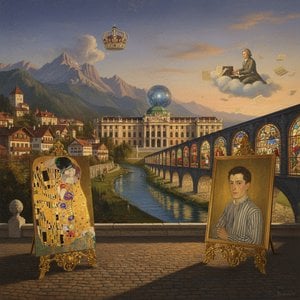
Carl Moll: A Pioneer of Austrian Modernism
Early Life and Education
- Born Carl Julius Rudolf Moll on April 23, 1861, in Vienna, Austria.
- He received his artistic training at the prestigious Academy of Fine Arts Vienna.
- Moll studied under Christian Griepenkerl and later with Emil Jakob Schindler, father of Alma Mahler-Werfel.
- A significant personal event occurred in 1892 when he married Anna von Bergen, Schindler’s widow, following a prior romantic involvement.
Artistic Development and Influences
- Initially influenced by the atmospheric realism prevalent in Vienna during his early career.
- Moll embraced the techniques of French Impressionism, particularly Pointillism, which became a defining characteristic of his style.
- He skillfully integrated Pointillist methods with a meticulous organization of the painting’s surface, creating unique visual effects.
- His work demonstrates an interest in capturing light and atmosphere, alongside detailed depictions of interiors and landscapes.
The Vienna Secession and Modern Art
- In 1897, Moll became a founding member of the Vienna Secession, a group of artists who broke away from traditional artistic institutions.
- He played a crucial role in advocating for modern art exhibitions, notably encouraging the use of the Belvedere Gallery for this purpose in 1903.
- In 1905, alongside Gustav Klimt, Moll left the Secession, though he remained actively involved in Vienna’s vibrant art scene.
- He was instrumental in introducing new artistic movements to Vienna, including organizing the first exhibition of Vincent van Gogh's work in the city.
Major Works and Themes
- Moll is celebrated for his interior scenes, such as “Der Frühstückstisch (The Breakfast Table)” and “Drawing-Room in House on the Hohe Warte,” which showcase opulent settings and detailed realism.
- His landscapes, like "Baumallee in Bruntál," demonstrate his mastery of Pointillist techniques and atmospheric perspective.
- Recurring themes in his work include domesticity, leisure, and the beauty of the natural world.
- He also created still life paintings, demonstrating a keen eye for composition and color.
Historical Significance and Legacy
- Carl Moll was a pivotal figure in the development of Austrian Modernism, bridging the gap between traditional academic painting and avant-garde movements.
- His contributions to the Vienna Secession helped establish Vienna as a major center for artistic innovation at the turn of the 20th century.
- Despite his later association with Nazism, his artistic achievements continue to be recognized and appreciated today.
- In recent years, Moll’s works have achieved record prices at auction, reflecting growing interest in his oeuvre.
Final Years and Death
- Tragically, Carl Moll committed suicide in Vienna at the end of World War II, along with his daughter Maria and son-in-law Richard Eberstaller.
- This act occurred as Soviet forces approached the city, and all three had been early supporters of the Nazi party.