


Augustus Earle (1793–1838)
augustus earle was a london-born travel artist. unlike earlier artists who worked outside europe and were employed on voyages of exploration or worked abroad for wealthy, often aristocratic patrons, earle was able to operate quite independently – able to combine his lust for travel with an ability to earn a living through art. the body of work he produced during his travels comprises a significant documentary record of the effects of european contact and colonisation during the early nineteenth century.- Early Life & Training: Augustus Earle was born in London on June 1, 1793. He was the youngest child of American-born parents, James Earle (not uncommonly spelt Earl), an artist, and Georgiana Caroline Smyth, daughter of John Carteret Pilkington and former partner (with two children) of Joseph Brewer Palmer Smyth, an american loyalist who spent some years in england. Earle’s father James was a member of the prominent american earle family. The elder of his two sisters was Phoebe Earle (1790–1863), also a professional painter and wife of the artist Denis Dighton, while his older half-sister was Elizabeth Anne Smyth (1787-1838) and his older half-brother was the scientist Admiral William Henry Smyth (1788–1865). There is no record of him marrying or having children. Earle received his artistic training in the Royal Academy and was already exhibiting there at the age of 13.
- Mediterranean Voyage & Initial Exhibitions: In 1815, at the age of twenty-two, Earle’s half-brother William Henry Smyth had sought and was given permission by Lord Exmouth to allow Earle passage through the Mediterranean aboard *Scylla*that Smyth commanded & which was part of Admiral Exmouth's Royal Navy fleet. Earle thus visited Sicily, Malta, Gibralter and North Africa, before returning to England in 1817. A portfolio of drawings from this voyage is held by the National Gallery of Australia, Canberra.
- The American Expedition & Early Successes: In March 1818, Earle left England, bound for the United States of America on the first stage of a journey that would end up taking him around-the-world to south america, tristan da cunha, new south wales, new zealand, the pacific, asia, india, mauritius and st helena before returning home in late 1829. The first leg of Earle’s 1818 voyage took him first to New York, before moving on to Philadelphia, where he exhibited two paintings at the Pennsylvania Academy of Fine Arts. No artworks are known to survive from this period.
- Australia & Aboriginal Studies: Continuing his voyage in February 1820, Earle sailed for Rio de Janeiro, Brazil, visiting Chile in June and was resident in Lima, Peru from July to December. On 10 December 1820, Earle left lima for rio de janeiro aboard the hms hyperion. During the subsequent three years spent in rio de janeiro, Earle produced a large number of sketches and watercolours.
- Later Years & Legacy: A number of the works produced dealt with the subject of slavery, including punishing negroes at cathabouco (calobouco), rio de janeiro, negro fandango scene, campo st. anna nr. rio, and games at rio de janeiro, during the carnival. Other works included landscapes and a series of portraits. On 17 February 1824, he left rio de janeiro aboard the ageing duke of gloucester bound for the cape of good hope, and onwards to calcutta. Earle’s departure was due to a letter containing the 'most flattering offers of introduction to lord amherst, who had just left england to take upon himself the government of india' . In the mid-atlantic storms forced the ship to anchor off the remote island of Tristan da Cunha. During the ship's stay in the island’s waters, Earle went ashore with his dog and a crew member, Thomas Gooch, attracted by the idea that 'this was a spot hitherto unvisited by any artist' . Sixteen works survive from the stay on Tristan da Cunha, including government house, Tristan d’acunha (i.e. da cunha), which was reproduced in his narrative , and flinching a young sea elephant.
Notable Achievements:
- Six Royal Academy Exhibitions (1806-1814)
- Successful Portrait Commissions in Sydney
- Detailed Record of Tristan Da Cunha Expedition
Kysymykset ja vastaukset
Millä muilla nimillä tai nimimerkeillä Augustus Earle tunnetaan?
Augustus Earle tunnetaan myös nimillä James Earle, Earle.
Onko olemassa yleiskatsaus kaikista niistä aiheista, joita Augustus Earle on maalannut?
Augustus Earle-taiteilijan Aiheatlas on sivu, joka ryhmittelee taiteilijan teokset niiden aiheiden mukaan.
Mistä voin nähdä kaikki Augustus Earle teokset?
Voit selata kaikkia tämä sivusto-sivuston Augustus Earle teoksia artistin Kaikki teokset -sivulta.
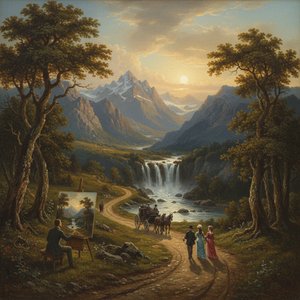


![Port Jackson, New South Wales [picture] / [augustus Earle] — Augustus Earle](/media/artworks/images-thumb/fb/08/fb08b9cec7c051c607c62da47c6f4247.jpg)

