

Miss Farrant (1949) on Anthony Devasin tunnetuin maalaus. Cocklers on the Beach (1944) ja Laurie Lee (1944) ovat seuraavat kaksi maailman tunnetuinta teosta. Tässä ovat Anthony Devas teoksista 25 eniten keräilijöiden ja museokävijöiden katsomia 25 teosta, sisältäen teoksen vuosiluvun, museon sekä tarinan jokaisesta teoksesta.
Sijoitus perustuu suosiotulokseemme, joka yhdistää kunkin teoksen hakuja, vierailuja ja tilauksia. Päivitetty marraskuu 2026.


The painting "Six O'Clock News" by Thomas Anthony Devas is a thought-provoking piece that invites the viewer to reflect on the everyday life of its subject. Created in 1940, this oil on canvas work measures 51 x 76 cm and is part of the Arts Council Collection in London, United Kingdom. Composition and Symbolism The composition of "Six O'Clock News" is characterized by a sense of calmness and serenity. The…


Thomas Sherrer Ross Boase (1898–1974): A Quiet Observer of British Society Thomas Sherrer Ross Boase was an artist whose work embodies the spirit of his time—a thoughtful engagement…
Nämä mestariteokset käsittelevät neljää yleisintä aihetta, joista jokaisesta on tässä hienoin esimerkki.
Tämän sivun teoksista eniten sisältävät 8 museota.
| Museo | Kaupunki | Anthony Devas teokset | Tämän listan maalaukset |
|---|---|---|---|
 Greenway |
2 | Cocklers on the Beach, Anthony Arthur Hicks (d. 2005), in a sun-hat | |
 Arts Council Collection |
Lontoo | 1 | Six O'Clock News |
 Wigan Arts And Heritage Service |
Wigan | 1 | Lady Daphne Straight |
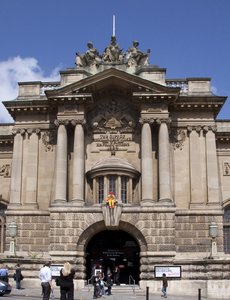 Bristol Museum - Art Gallery |
Bristol | 1 | Majorie Stanley Clarke |
 The Hepworth Wakefield |
Wakefield | 1 | Pamela McGeorge, BEM, of the Women's Royal Naval Service |
 University of Bristol Theatre Collection |
Bristol | 1 | John Gielgud (1904–2000), as Valentine in 'Love for Love' |
 National Maritime Museum |
Lontoo | 1 | Rear Admiral M. C. Morgan Giles (b.1914) |
 Bolton Museum And Art Gallery |
Bolton | 1 | Elizabeth II (b.1926) |


Miss Farrant (1949). Seuraavina ovat Cocklers on the Beach (1944) ja Laurie Lee (1944).
38 vuotta vanha: Miss Farrant on peräisin vuodelta 1949 ja Anthony Devas on syntynyt vuonna 1911.
Miss Farrant, Cocklers on the Beach, Laurie Lee, Six O'Clock News, Anthony Arthur Hicks (d. 2005), in a sun-hat, Bathing, Cocklers on the Beach, Lady Daphne Straight, Apple Blossom ja Girl in a Lace Blouse. Yllä oleva sijoitus kertoo kunkin teoksen vuosiluvun ja museon.
Luettelossamme on 25 teosta taiteilijalta Anthony Devas, aikaväliltä 1936–1953.
Suurin osa niistä sijaitsee kohteessa Greenway, Arts Council Collection (Lontoo) ja Wigan Arts And Heritage Service (Wigan). Yllä oleva taulukko listaa museot yksitellen.
Ajanjaksona 1940s: 15 sivun 25 teoksista on peräisin tuolta ajalta, mukaan lukien Miss Farrant.
Tämän sivun vanhin on Lady Daphne Straight (1936) ja uusin Sir William Kelsey Fry (1889–1963) (1953).
British art (5), Portrait (3) ja 1940s (2), 25 teoksen joukossa tällä sivulla.
Cocklers on the Beach ja Anthony Arthur Hicks (d. 2005), in a sun-hat ovat yksi 2 teoksesta tällä sivulla, jotka kuuluvat Greenway kokoelmaan.
In the annals of twentieth-century British portraiture, few names evoke the intimate, psychological depth of Thomas Anthony Devas. Born in 1911 in Bromley, Kent, Devas was a painter who possessed the rare ability to look past the surface of his subjects, seeking instead the flickering embers of character and the quiet truths of the human condition. His lineage, rooted in the industrious textile traditions of the Devas Routledge Textile Firm, provided him with an early appreciation for the tactile beauty of craftsmanship and the meticulous attention to detail that would later define his brushwork. This foundation of precision, paired with a profound sensitivity, allowed him to emerge as a significant voice within the influential Euston Road School, a movement that sought to reject wartime abstraction in favor of a renewed commitment to realism and social observation.
Devas’s artistic journey was shaped by the hallowed halls of the Slade School of Fine Art, where he entered in 1927. It was here, amidst a cohort of future masters such as William Coldstream and Rodrigo Moynihan, that his technical prowess began to coalesce with a distinct philosophical vision. He found profound inspiration in the expressive, unflinching technique of Augustus John, learning how to translate the complexities of personality onto canvas through a balance of structural integrity and emotive fluidity. His social and intellectual life was equally intertwined with the artistic avant-garde; his marriage to Nicolette Macnamara brought him into the orbit of prominent Slade alumni and connected him to the vibrant literary circles of the era, including the family of the poet Dylan Thomas.
The onset of the Second World War introduced a period of profound transformation for Devas, testing both his physical courage and his creative resolve. While serving as an Air Raid Warden in London, he witnessed firsthand the fragmentation of society under the weight of aerial bombardment. Rather than retreating from this chaos, Devas utilized the era's austerity to sharpen his focus on the human spirit. His work during this period became a vital historical record, capturing the dignity of those navigating the hardships of wartime Britain. The War Artists’ Advisory Committee recognized this talent, commissioning him to document the heroism and the quiet resilience of the age.
His wartime output was characterized by an evocative ability to capture both the monumental and the mundane. Through his portraits, he documented figures who embodied the era's courage, including notable individuals such as Wilfred Thesiger. His involvement in the Aero Girls campaign further demonstrated his ability to use portraiture as a medium for social documentation, celebrating the changing roles of women in the industrial landscape of wartime Britain. These works were not merely likenesses; they were psychological studies that breathed life into the historical moment, ensuring that the faces of the era would remain etched in the collective memory.
The significance of Thomas Anthony Devas lies in his ability to bridge the gap between formal tradition and modern psychological insight. His oeuvre serves as a window into a vanished world, offering glimpses of society figures ranging from the intimate circles of Caitlin Thomas to the regal presence of a young Elizabeth II. Even as the art world moved toward more experimental territories, Devas remained anchored in the belief that the portrait could serve as an enduring vessel for truth.
His contributions to British art can be summarized through several key pillars of his legacy:
Though his life was tragically short, ending in 1958, the impact of Devas’s vision continues to resonate. He remains a celebrated figure for those who value art as an act of profound listening—a painter who did not just see his subjects, but truly understood them.
