Portrait of Charles de Solier, Lord of Morette by HOLBEIN, Hans the Younger
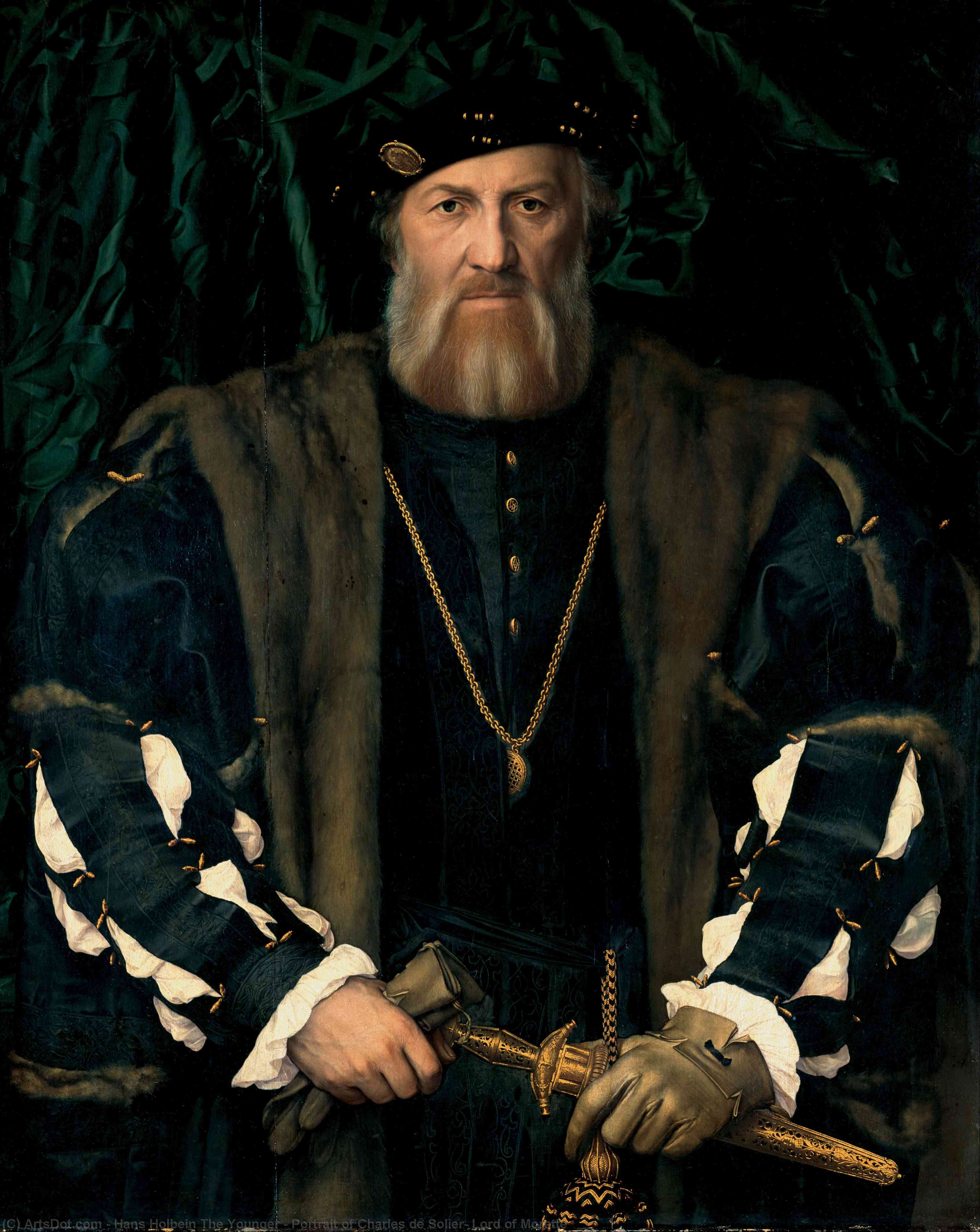
Hans Holbein the Younger’s “Portrait of Charles de Solier, Lord of Morette,” completed around 1534–1535, stands as a testament to Renaissance artistry and diplomatic grace. Held at Dresden’s Gemäldegalerie Alte Meister—a treasure trove for art historians—this oil painting transcends mere likeness; it embodies the spirit of its time and Holbein's unparalleled skill in capturing human character.
The portrait depicts Charles de Solier, Francis I’s ambassador to England, presented against a simple curtain of sea-green damask. Measuring 92 x 75 centimeters, the canvas immediately draws the eye with its masterful composition and meticulous detail. Holbein's approach wasn’t simply about reproducing what he saw; it was about distilling the essence of De Solier’s persona onto the surface of the paint.
The Anatomy of Power: Style and Technique
Holbein’s technique—characterized by “broken” glazing—creates an astonishing sense of depth and luminosity. Thin layers of pigment are applied over a dark underpainting, resulting in subtle tonal variations that bring forth remarkable realism. Notice the careful rendering of De Solier's attire: the black satin doublet slashed with white silk speaks volumes about wealth and status. The gold buttons, adorned with a delicate ‘M’ motif—perhaps referencing Morette’s name or his role as an ambassador—demonstrate Holbein’s painstaking attention to every element.
Beyond the luxurious fabrics, Holbein's mastery of line contributes significantly to the painting's impact. The contours of De Solier’s face and clothing are rendered with precision, conveying a sense of composure and dignity. This deliberate stylistic choice underscores Holbein’s humanist sensibilities—his belief in the importance of portraying human beings as rational and expressive individuals.
Symbolism and Context: A Window into the Renaissance
“Portrait of Charles de Solier, Lord of Morette” is rich in symbolic meaning. The chain around De Solier's neck represents his position as an ambassador—a symbol of authority and diplomatic responsibility. Similarly, the gloves held by the subject are gestures of control and deliberation—reflecting the complexities of international relations during the Reformation.
Holbein’s work reflects the broader artistic trends of the Renaissance, influenced by Italian masters like Leonardo da Vinci and Raphael. He skillfully blended classical ideals with Northern European realism, creating a visual language that continues to resonate with viewers today. The painting serves as a captivating glimpse into the intellectual and cultural landscape of 16th-century Europe.
A Legacy Preserved: Reproduction and Appreciation
WahooArt.com offers meticulously crafted oil painting reproductions of “Portrait of Charles de Solier, Lord of Morette,” allowing art enthusiasts to experience Holbein’s brilliance firsthand. Our skilled artists painstakingly recreate every nuance—from the subtle brushstrokes to the rich textures—ensuring that your reproduction captures the essence of the original with stunning accuracy.
This portrait is more than just a beautiful image; it's an invitation into a pivotal moment in European history, offering insights into the ambitions and aspirations of noblemen like Charles de Solier. Explore our high-quality reproductions today and connect with the enduring legacy of Hans Holbein the Younger.
Photo Description: The image is a painting of a man wearing a suit with a beard and mustache. He appears to be holding two swords in his hands. The man's attire includes a chain around his neck, which adds an element of formality to the scene. The painting itself is quite detailed, capturing the intricacies of the man’s clothing and facial features. It seems to be a portrait of a historical figure, possibly from the 16th century.
Size: 92 x 75 cm
Date: 1534
ARTIST INFORMATION:
==================
Artist: Hans Holbein the Younger
Birth Year: 1497
Death Year: 1543
Birth City: Augsburg
Birth Country: Italy
Biography:
A Life Etched in Detail: The World of Hans Holbein the Younger
Born around 1497 in the vibrant artistic hub of Augsburg, Germany, Hans Holbein the Younger emerged as a defining figure of the Northern Renaissance—a master portraitist whose work continues to resonate with breathtaking realism and psychological depth. His upbringing within an artistically gifted family laid the foundation for his exceptional talent; his father, Hans Holbein the Elder, was a respected painter and printmaker who instilled in young Hans a meticulous approach to observation and technique. This early training wasn’t merely about mastering brushstrokes or mixing pigments—it was about learning to *see*, to capture not just likeness but the very essence of a subject. Holbein's initial artistic explorations occurred within his father’s workshop, where he honed his skills before embarking on a journey that would lead him through Switzerland and ultimately to the heart of the Engli



 Esikatselu
 Siirry tulosteeseen
 Jaa
Jaa Jaa
Jaa
 Tarkemmat tiedot

 Lataa
Lataa
 Samanlaisia
 Röntgenkuva
 Diaesitys


 Näytä lisää






































 Lasivaihtoehto on saatavilla vain alle 110 cm kokoisina teoksina




![Jean de Dintevillen ja Georges de Selven kaksoismuotokuva (tunnetaan myös nimellä Suurlähetystöt) [yksityiskohta]](/media/artworks/images/thumbnails/23/11/2311efb8202f4a2ea763c4d4a9227550.jpg)





