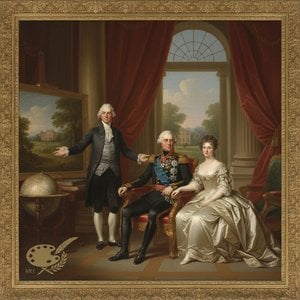
Alexander Roslin: Bridging the Worlds of Portraiture and Rococo
Born in Malmö, Sweden, in 1718, Alexander Roslin’s life was a testament to artistic adaptability and a remarkable journey across Europe. Initially trained as a naval draughtsman, his innate talent for portraiture quickly propelled him towards a career dedicated to capturing the likenesses of nobility and affluent patrons. While often categorized within the Rococo tradition—characterized by its elegance, ornamentation, and playful spirit—Roslin’s work possessed a profound psychological depth rarely found in purely decorative styles. He wasn't merely replicating appearances; he was striving to reveal the inner lives and character of his subjects, a feat achieved through masterful use of color, texture, and subtle gestures.
Roslin’s early years were marked by a restless spirit and a constant pursuit of artistic refinement. Following his apprenticeship in Stockholm, he embarked on an extensive European tour, seeking opportunities to hone his skills and establish himself within the prestigious circles of art patronage. He spent considerable time in France, becoming deeply immersed in the prevailing artistic trends of the era. This period proved pivotal, exposing him to the influence of figures like Hyacinthe Rigaud and Nicolas de Largillière, both masters of portraiture who emphasized naturalism and psychological insight. His relocation to Bayreuth, Germany, during the reign of Frederick Augustus II, saw him working for the Elector’s court, a position that afforded him considerable prestige and access to a wealthy clientele. This environment fostered his distinctive style – a harmonious blend of classical restraint and Rococo exuberance.
- Key Influences: Rigaud and Largillière instilled in Roslin a commitment to realistic representation and psychological depth, while the vibrant colors and decorative elements of the Rococo movement shaped his palette and compositional choices.
- Technique: Roslin’s brushwork was remarkably fluid and expressive, allowing him to capture the nuances of light and shadow with exceptional subtlety. He employed a layering technique, building up color gradually to achieve rich, luminous effects.
- Subject Matter: Primarily portraits of royalty, nobility, and wealthy merchants, Roslin's subjects were often depicted in lavish settings, reflecting their status and wealth.
The Parisian Years and the Countess Pignatelli
Roslin’s time in Paris (1752-1793) represents a golden age for his career. He quickly established himself as a sought-after portraitist, attracting commissions from prominent figures of French society. During this period, he produced some of his most celebrated works, including the iconic portrait of Countess Jeanne Sophie de Vignerot du Plessis, known as the “Countess Pignatelli.” This painting is particularly noteworthy for its psychological complexity; Roslin doesn’t simply depict a beautiful woman; he captures her inner turmoil and vulnerability with remarkable sensitivity. The subtle downturn of her mouth, the shadowed eyes, and the delicate hand gesture all convey a sense of melancholy and resignation – a poignant contrast to the opulent setting.
The Countess Pignatelli portrait exemplifies Roslin’s ability to infuse his subjects with personality and emotion. He skillfully used color and composition to create a dramatic effect, drawing the viewer's attention to the Countess’s face and conveying her emotional state. The painting is considered a masterpiece of Rococo portraiture, admired for its beauty, elegance, and psychological depth.
A Legacy in Multiple Lands
Following the French Revolution, Roslin faced significant challenges as an artist working under the new regime. He returned to Sweden in 1793, shortly before his death on July 5th of that year. His works continued to be exhibited and admired throughout Europe, particularly in Russia and Poland, where he had established a loyal following. His paintings are now housed in prestigious collections worldwide, including the Minneapolis Institute of Art and the Metropolitan Museum of Art, testament to their enduring appeal.
Roslin’s legacy extends beyond his individual works; he represents a crucial link between the classical traditions of portraiture and the exuberant spirit of the Rococo. His ability to combine technical skill with psychological insight established him as one of the most important portraitists of his era, leaving behind a body of work that continues to captivate and inspire viewers today.
Thematic Considerations & Historical Context
Roslin’s art is deeply intertwined with the social and political context of 18th-century Europe. The rise of the merchant class and the increasing importance of patronage fueled demand for portraits, reflecting the aspirations and status of wealthy individuals. Simultaneously, the Rococo style reflected a shift towards pleasure, luxury, and ornamentation – values embraced by the aristocracy. Roslin’s work embodies this duality, showcasing both the grandeur of aristocratic life and the subtle complexities of human emotion.
Furthermore, Roslin's travels exposed him to diverse artistic traditions, influencing his style and broadening his perspective. His time in Bayreuth, for example, introduced him to the Baroque aesthetic, while his years in Paris allowed him to absorb the latest trends in French art. His ability to synthesize these influences into a unique and personal style is one of the hallmarks of his enduring artistic legacy.