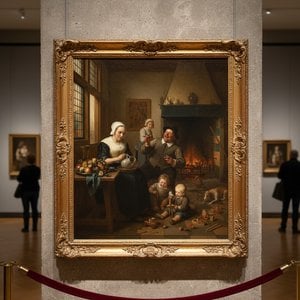
Gerard Hoet (1648 – 1733): A Baroque Visionary Bridging Myth and History
Gerard Hoet was a Dutch Golden Age painter and engraver whose prolific output spanned nearly six decades, leaving an indelible mark on the artistic landscape of his time. Born in Zaltbommel, Netherlands, around 1648, he emerged from a family steeped in glass painting tradition – his father and brother practiced this craft alongside him – fostering an early appreciation for meticulous detail and vibrant color palettes. This formative experience would profoundly shape his artistic sensibilities and contribute to the distinctive style that characterized his oeuvre.
Hoet’s formal training encompassed instruction from his father, brother, and Warnard van Rijsen, who himself had studied under Cornelis van Poelenburgh in Utrecht. Recognizing the importance of broadening his horizons, he relocated to The Hague in 1672, where he established connections with fellow artists like Jan van Bunnik and Justus Nieuwpoort, furthering his artistic education within Utrecht’s burgeoning artistic community. A pivotal moment arrived when Count Salis purchased paintings from Hoet's mother’s house in Zaltbommel, prompting him to return to painting for the nobleman – a relationship that would prove influential throughout his career.
His journey continued eastward to Rees, Germany, where he encountered Utrecht painters Jan van Bunnik, Justus Nieuwpoort and Andries de Wit, fostering collaborative artistic endeavors and exchanging ideas about Baroque aesthetics. Returning to Utrecht with De Wit, Hoet briefly served Frederick Nassau de Zuylestein before venturing to The Hague and Amsterdam, expanding his professional network and encountering diverse artistic influences. Driven by ambition and fueled by the promise of patronage from Marquis Louis XIV’s court in France – a prospect that ultimately fell through – he embarked on an exploratory trip to England, receiving encouraging news from Lucas Vorsterman regarding potential commissions in Paris.
Paris proved to be a transformative period for Hoet, where he spent over a year immersing himself in the vibrant artistic milieu of the French capital. Subsequently, he traveled back to the Netherlands via Brussels, encountering Adrian Frans Boudewyns who persuaded him to remain active in Brussels for eight months. Finally settling in Heemstede, Hoet secured employment with William Nassau de Zuylestein, 1st Earl of Rochford, dedicating himself to artistic pursuits while simultaneously raising a family. Notably, he collaborated with Hendrik Schoock to establish the Utrecht Drawing Academy in 1697 – an initiative that aimed to cultivate talent and advance artistic education within his region.
Throughout his career, Hoet produced breathtaking depictions of historical narratives and mythological scenes, notably commissioned for prominent residences in Utrecht’s aristocratic circles—the castles of Slangenborg and Voorst near Zutphen, and the Earl Albemarle's castle. His masterful technique combined meticulous observation with expressive brushwork, resulting in canvases imbued with dramatic lighting and vibrant color harmonies. Furthermore, Hoet’s engravings served as crucial sources for Houbraken’s ‘Schouburg,’ a celebrated biographical dictionary of Dutch artists—demonstrating his contribution to art history beyond his artistic creations. Gerard Hoet died peacefully in 1733, leaving behind a legacy of stunning artwork and an enduring influence on Baroque painting.