Albert Rieger: A Master of Atmospheric Landscapes
Albert Rieger (1834-1905) stands as a significant, yet often understated, figure in 19th-century Austrian art. His legacy isn’t one of grand, revolutionary movements, but rather a quiet mastery of capturing the subtle beauty and melancholic atmosphere of his native landscapes – primarily the rugged mountains and misty valleys of Austria and Bavaria. Born into an artistic lineage—his father, Giuseppe Rieger, was himself a renowned Italian painter—Albert inherited not just talent, but also a deep appreciation for the evocative power of light and shadow. His work offers a poignant glimpse into a vanishing world, a time when rural life remained deeply intertwined with the natural environment, and the dramatic beauty of the Alpine region held an almost mythical quality.
Rieger’s early training was largely under his father, providing him with a solid foundation in traditional landscape painting. However, it was during his time in Vienna that he truly developed his distinctive style – characterized by a muted palette, often dominated by deep blues, greens, and browns, punctuated by flashes of warm light. He eschewed the bright, optimistic tones favored by some of his contemporaries, instead opting for a more subdued and introspective approach. This deliberate choice created an atmosphere of quiet contemplation, inviting viewers to lose themselves in the scene before them.
The Influence of Romanticism and Beyond
Rieger’s artistic development was undoubtedly shaped by the prevailing currents of Romanticism, which emphasized emotion, individualism, and a reverence for nature. However, he wasn't simply a follower of this movement; rather, he filtered its influence through his own unique sensibility. Unlike many Romantic painters who focused on dramatic, heroic landscapes, Rieger concentrated on capturing the subtle nuances of light and weather, conveying a sense of mood and atmosphere far more than grand vistas. His paintings often depict solitary figures – shepherds, hunters, or travelers – dwarfed by the immensity of the mountains, highlighting humanity’s smallness in the face of nature's power.
Beyond Romanticism, Rieger also drew inspiration from the Barbizon School of French landscape painters, known for their commitment to painting *en plein air* (outdoors) and their focus on depicting the natural world with remarkable accuracy. His meticulous attention to detail – the texture of bark, the flow of water, the shifting patterns of light – reflects this influence. However, Rieger’s work possesses a distinctly Austrian character, rooted in his deep connection to the landscape of his homeland.
Key Works and Artistic Techniques
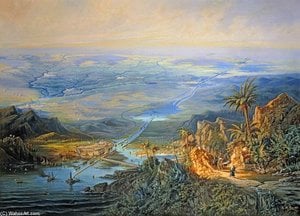
Several paintings stand out as particularly representative of Rieger's artistic vision. “The Ferdinandeum in Trieste” (1871), currently housed at the Ferdinandeum in Trieste, exemplifies his ability to capture a sense of atmosphere and drama through subtle color variations and carefully rendered details. The painting depicts the imposing fortress overlooking the city, bathed in the soft light of dusk – a scene imbued with both grandeur and melancholy. Other notable works include depictions of Alpine valleys, mountain streams, and solitary farmhouses, each conveying a distinct mood and sense of place.
Rieger’s technique was characterized by loose, expressive brushstrokes—a deliberate departure from the smooth, polished surfaces favored by some of his contemporaries. He employed a layering technique, building up color gradually to create depth and luminosity. His use of light is particularly noteworthy – he masterfully manipulated shadows and highlights to evoke a sense of atmosphere and drama. He frequently worked *en plein air*, allowing him to directly observe the effects of natural light on the landscape.
Legacy and Historical Significance
Despite not achieving widespread fame during his lifetime, Albert Rieger’s work has gained increasing recognition in recent decades. His paintings are now appreciated for their atmospheric beauty, technical skill, and poignant portrayal of a vanishing world. He represents a vital link between the Romantic era and the rise of Impressionism, demonstrating a transitional style that foreshadowed many of the developments to come.
Rieger’s legacy extends beyond his individual paintings; he embodies a broader cultural shift—a growing appreciation for the beauty and power of the natural world. His work serves as a reminder of the importance of preserving our landscapes and appreciating the subtle wonders that surround us. His paintings continue to resonate with viewers today, offering a glimpse into a bygone era and reminding us of the enduring appeal of atmospheric landscape painting.
Küsimused ja vastused
Kuidas leian Albert Rieger teosed konkreetse värvikombinatsiooniga?
Et leida Albert Rieger teoseid konkreetse värvikombinatsiooniga, külastage artisti Väripalettide järgi lehte.
Millised Albert Rieger teosed on kõige enim vaadeldud?
Albert Rieger lehekülg Statistika esitab statistika, mis on arvutatud see veebileht loetletud kunstniku teostest.
Kas saan Albert Rieger teoseid meeleheade järgi sirvida?
Albert Rieger lehekülg Tunnetunoodete tuba on koondanud kunstniku teosed meeleolu järgi.