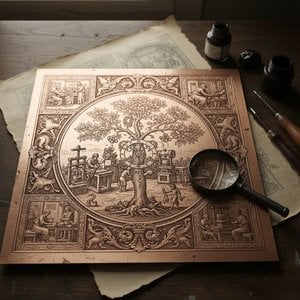
A Satirical Symphony in Ink: Unveiling Hogarth’s Masterpiece
In the heart of eighteenth-century London, amidst the swirling social transformations of the Georgian era, William Hogarth captured the very soul of a nation in flux. His etching, Frontispiece and Its Explanation (Hurdibras), is not merely an illustration but a profound, biting window into the anxieties and contradictions of Enlightenment England. As one gazes upon this intricate work, they are immediately swept into a dense, chaotic panorama that serves as a satirical tableau of a society struggling with its own moral identity. The piece functions as a visual critique, where every line and figure contributes to a larger narrative of social decay hidden beneath an elaborate, allegorical veneer.
The composition is anchored by a commanding verticality, centered around a grand carriage that dominates the viewer's field of vision. This central axis acts as a stage for a complex drama; above the carriage, an oval portrait frame houses the likeness of Samuel Butler, rendered with such meticulous precision that the texture of his attire and the depth of his expression feel almost tangible. Below this focal point, the scene erupts into a lively, often unsettling, crowd. Supplicants kneel in desperation while observers watch with varying degrees of detachment or curiosity, creating a sense of restless energy that mirrors the intellectual and cultural debates of the time.
The Mastery of Line and the Art of Detail
For the discerning collector or lover of fine printmaking, the technical brilliance of this work is nothing short of breathtaking. Hogarth, having honed his skills through a rigorous apprenticeship, employs the medium of line engraving to achieve a level of detail that borders on the miraculous. Through the sophisticated use of hatching and cross-hatching, he sculpts light and shadow, giving weight to the heavy fabrics of period clothing and a lifelike quality to the weathered skin of the figures. The interplay of fine, closely spaced lines creates a rich tonal range, allowing for a sense of depth that pulls the viewer into the crowded London streets depicted within the frame.
This technical virtuosity serves a higher purpose than mere decoration; it is the vehicle for Hogarth's storytelling. The texture of the metal, the roughness of the earth, and the intricate patterns of the carriage all contribute to an atmosphere of overwhelming sensory detail. This density of information demands slow, contemplative viewing, rewarding those who linger to discover the subtle nuances hidden within the shadows. For interior designers seeking a piece with profound character, this artwork offers a sophisticated layer of intellectual depth, providing a focal point that invites conversation and endless discovery.
Symbolism and the Emotional Resonance of Satire
Beyond its technical prowess, Frontispiece and Its Explanation is a work of deep emotional and symbolic resonance. Hogarth utilizes the language of allegory to critique the hypocrisies of his age. The very structure of the piece—the contrast between the elevated portrait and the chaotic scene below—speaks to the widening gaps in social hierarchy and the perceived erosion of traditional values. Every interaction, every gesture of a kneeling figure or a passing stranger, is laden with potential meaning, inviting the viewer to participate in a decoding of eighteenth-century morality.
The emotional impact of the work is one of controlled tension. There is an underlying sense of unease, a feeling that beneath the polished surface of the carriage and the formal portrait lies a world of turbulence and moral ambiguity. It is this very tension that makes Hogarth's work so enduringly relevant. To possess a high-quality reproduction of this etching is to bring into one's space a piece of history that challenges, provokes, and inspires. It is an ideal acquisition for those who appreciate art that does not merely decorate a room but enriches the intellectual landscape of a home.



 Eelvaade
 Osta print
 Saada
Saada Jaga
Jaga
 Teave teose kohta

 Laadi alla
 Sarnased teosed
 Röntgenuuring
 Slaidietendus

 Loe lähemalt






































 Klaasivalik on saadaval ainult suuruses kuni 110 cm