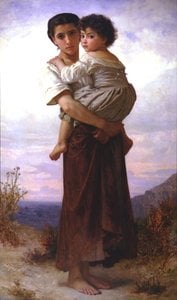
A Vision of Innocence: Exploring William-Adolphe Bouguereau’s “The Little Shepherdess”
William-Adolphe Bouguereau's "The Little Shepherdess," completed in 1889, stands as a quintessential exemplar of Academic Impressionism—a movement dedicated to upholding classical ideals and meticulous realism. More than just a depiction of pastoral beauty, it’s an invitation into a meticulously crafted world where idealized femininity embodies purity and serenity.
Subject Matter & Composition: The painting portrays a young woman seated gracefully amidst a tranquil meadow dotted with trees. A shepherd boy stands beside her, gazing intently at the girl—a gesture of adoration that speaks volumes about societal expectations during Bouguereau’s era. Two horses flank the scene, adding dynamism to the composition while simultaneously reinforcing the theme of rural life and tradition.
Style & Technique: Bouguereau's mastery lies in his painstaking attention to detail—a hallmark of Academic painting. He employed a glazing technique, layering thin washes of color over an underpainting to achieve luminous tonal gradations and unparalleled realism. The artist’s brushstrokes are subtle yet purposeful, capturing the textures of wool, grass, and skin with remarkable accuracy. Observe how Bouguereau skillfully renders light—creating a soft, diffused glow that illuminates the figures and imbues the landscape with warmth.
Historical Context: Created during the Belle Époque, “The Little Shepherdess” reflects the prevailing fascination with mythological narratives and idealized representations of womanhood. Bouguereau drew inspiration from Raphael’s frescoes in the Vatican Stanze—particularly “Madonna della Seggiola”—demonstrating his unwavering commitment to artistic precedent. The painting embodies the Victorian obsession with moral virtue and domestic tranquility, aligning perfectly with societal values of the time.
Symbolism & Emotional Impact: Beyond its visual splendor, "The Little Shepherdess" carries profound symbolic weight. The shepherdess represents innocence, chastity, and spiritual grace—qualities considered paramount in Victorian society. Her gaze conveys vulnerability yet unwavering resolve, suggesting a quiet strength rooted in inner purity. Bouguereau’s masterful rendering of emotion elevates the painting beyond mere visual representation, inviting viewers to contemplate themes of love, devotion, and timeless beauty.
Further Exploration: To delve deeper into Bouguereau's artistic legacy, consider visiting The Philbrook Museum of Art in Tulsa, Oklahoma, where a stunning reproduction of “The Little Shepherdess” resides. Alternatively, explore WikiArt’s comprehensive database for insights into Bouguereau’s oeuvre and the broader context of Academic Impressionism.
- Artist: William-Adolphe Bouguereau (1825-1905)
- Birth Year: 1825
- Death Year: 1905
- Birth City: La Rochelle
- Birth Country: France
Additional Resources:



 Eelvaade
 Lülita trükkitoodetele
 Saada
Saada Jaga
Jaga
 Teave teose kohta

 Laadi alla
 Sarnased teosed
 Röntgenuuring
 Slaidietendus
 Statistika


 Loe lähemalt






































 Klaasivalik on saadaval ainult suuruses kuni 110 cm