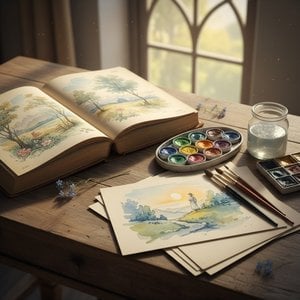
Pierre Bonnard: A Painter of Intimate Light
Born in Fontenay-aux-Roses, a charming suburb just outside Paris, on October 3rd, 1867, Pierre Bonnard was not initially destined for the artistic life. His father, Eugène Bonnard, held a position within the French Ministry of War, and young Pierre was steered towards a legal career – he even earned his law degree! However, a deep-seated passion for drawing and watercolor, nurtured during childhood excursions to his family’s country estate, ultimately led him down a different path. His early influences were diverse, ranging from the meticulous realism of Jean-Auguste-Dominique Ingres, whose influence can be seen in Bonnard's initial attempts at academic precision, to the vibrant color palettes and expressive distortions of Paul Gauguin, a connection that would profoundly shape his artistic vision.
Bonnard’s early career was marked by a struggle for recognition. He initially worked as an illustrator, producing posters and advertisements – a pragmatic step while he honed his skills. It wasn't until the late 1880s, through connections with artists like Paul Sérusier and Claude Terrasse, that he became involved with *Les Nabis*, a group of avant-garde painters who sought to move beyond Impressionism’s focus on capturing fleeting moments of light and instead explore subjective experience and emotional resonance. This movement emphasized decorative qualities and the use of color as a primary expressive tool – a philosophy Bonnard embraced wholeheartedly.
The Language of Color and Light
Bonnard's artistic style is instantly recognizable, characterized by its luminous palette, flattened perspective, and a deliberate avoidance of sharp outlines. He wasn’t interested in replicating reality; rather, he aimed to capture the *feeling* of a scene – the atmosphere, the mood, the subtle interplay of light and shadow. His compositions often feature domestic interiors, portraits of family members, and landscapes bathed in soft, diffused light. Unlike many of his contemporaries who sought to represent objects with photographic accuracy, Bonnard employed a technique of layering colors and applying paint in loose, gestural strokes, creating an effect that is both dreamlike and intensely personal.
A key element of Bonnard’s approach was his fascination with the way light transforms surfaces. He meticulously observed how color shifts depending on the angle of illumination, often using complementary colors to create a sense of vibrancy and depth. His paintings are filled with subtle gradations of hue and tone, inviting the viewer to linger and lose themselves in the play of light and shadow. He frequently depicted objects bathed in an almost ethereal glow, as if viewed through a veil of mist or memory.
Influences and Development
Bonnard’s artistic journey was shaped by a diverse range of influences beyond Impressionism and *Les Nabis*. He drew inspiration from Japanese prints, particularly the bold compositions and flattened perspectives of Hokusai. The influence of Käthe Kollwitz, a German Expressionist painter known for her poignant depictions of poverty and suffering, is also evident in Bonnard’s later work, as he began to explore themes of human vulnerability and emotional distress. His exploration of these darker subjects marked a significant departure from his earlier, more decorative style.
Throughout his career, Bonnard continued to experiment with color and form, refining his technique and developing a unique visual language. He never fully abandoned the principles of *Les Nabis*, but he gradually moved away from their emphasis on decorative patterns and towards a more introspective and emotionally charged approach. His later works are characterized by a heightened sense of melancholy and a profound awareness of the passage of time.
Legacy and Recognition
Pierre Bonnard died in La Route de Serra Capeou, near Antibes, France, on January 23rd, 1947, at the age of 79. Despite facing initial rejection from the Parisian art establishment, he eventually achieved widespread recognition for his distinctive style and profound emotional depth. Today, Bonnard is considered one of the most important figures in modern French painting, celebrated for his innovative use of color, his evocative depictions of domestic life, and his ability to capture the essence of human experience.
His work continues to resonate with viewers today, offering a glimpse into the intimate world of a sensitive and perceptive artist. Bonnard’s legacy lies not only in his individual achievements but also in his pioneering role in shaping the course of 20th-century art – a painter who transformed the way we perceive light, color, and the beauty of everyday life.



 Eelvaade
 Osta print
 Saada
Saada Jaga
Jaga
 Teave teose kohta

 Laadi alla
 Sarnased teosed
 Röntgenuuring
 Slaidietendus


 Loe lähemalt






































 Klaasivalik on saadaval ainult suuruses kuni 110 cm