

Sellel lehel kuvatav kunstiteos on kaitstud autoriõigusega, mis tähendab, et meil ei ole seaduslikku õigust luua või müüa identset reproduktsiooni. Seda kaitset rakendatakse rahvusvaheliste kokkulepete alusel, nagu näiteks Berne konventsioon ning riiklike seadustega, sealhulgas nendega, mida on sätestatud USA autoriõiguse seadus – 17. peatükk.
See meetod järgib täielikult autoriõiguse reegleid, kuna see ei põhine kaitstud kunstiteose kopeerimisel või dupliteerimisel. Selle asemel on tegu loova reinterpreetatsiooniga – uue maaldisega, mis on algteosest inspireeritud, kuid ei ole sellest identiline.
Muuseumikvaliteediga giclée- või kangasprint kiire tootmisega ja paindlikud viimistlusvõimalused. ( Osta käsitsi maalatud teos Lülita digitaalse pildi juurde)
Vali meie eelmääratud suurused, mis vastavad teose algupärastele proportsioonidele.

Sisestage vajalik laius ja kõrgus, et see sobiks teie raamile või seinale. Trükki saab ainult lõigata, seda ei saa kunagi pildist suuremaks teha, seega ka erineva mustega suurus kaotab osa pildist. Enne trükkimist saadame teile kinnitamiseks digitaalse näidisprojektsiooni. Sellel lehel näidatud pilt ei kujuta reaalset lõiget — seda näitab ainult näidisprojektsioon.
Ülemaailmne tarne () 2 nädala jooksul, tavalise 4/5 nädala asemel. (8 november)
L
Reproduktsiooni suurus
Teose "L" kõige silmapaistvam värv on Espresso (#422c27). Dominantne värv on kasulik teose sobitamisel interjööriga.
Teosed, mis sarnanevad teosega „L“, autor Ron Clive Moody, on koondatud selle teose lehel Sarnased teosed.
Modernism suunaga teos "L" on loodud kunstniku poolt, kes on pärit riigist Jamaica.

Born on August 12, 1900, in the vibrant heart of Kingston, Jamaica, Ron Clive Moody was a sculptor whose hands possessed the rare ability to breathe life into the silent medium of wood. While his early path seemed destined for the clinical precision of medicine—having moved to England in 1923 to pursue dentistry at King's College London—his spirit was irrevocably drawn to the tactile and the expressive. After earning his degree in 1930, Moody underwent a profound metamorphosis, setting aside the scalpel for the chisel. This transition from the scientific to the sculptural allowed him to approach his medium with a unique blend of anatomical understanding and raw, creative intuition.
The genesis of Moody's aesthetic was deeply rooted in his encounters with the British Museum’s vast collection of non-Western art. These ancient, powerful forms provided a spiritual blueprint for his burgeoning style. He found himself captivated by the rhythmic strength and symbolic depth of African and indigenous carvings, which inspired him to teach himself the intricate complexities of woodcarving. His first significant carved figure, Wohin, emerged in 1934, marking the beginning of a prolific career that would bridge the gap between Caribbean identity and international modernism.
Moody’s artistic development was characterized by an extraordinary ability to manipulate texture and volume. His sculptures are not merely representations but are evocations of presence. Through his mastery of wood, he captured the essence of human emotion and cultural narrative. His works often possess a rhythmic, organic quality that suggests movement even within the stillness of the grain. This is perhaps most evident in his celebrated pieces such as Midonz (1937) and the profound Savacou (1964), where the interplay of light and shadow on the carved surfaces creates a sense of living breath.
The significance of his work lies in its ability to transcend geographical boundaries. While deeply influenced by the ancestral echoes found in non-Western art, Moody’s voice was distinctly his own—a synthesis of his Jamaican heritage and his European training. His sculptures serve as a testament to the power of cultural fusion, standing as monumental achievements in 20th-century woodcarving. The following elements define his artistic essence:
Throughout his life, Ron Clive Moody achieved a level of recognition that placed his work in some of the most prestigious institutions in the world. His sculptures are not merely objects of beauty but historical artifacts that reside within the National Portrait Gallery and Tate Britain in London, as well as the National Gallery of Jamaica. These placements ensure that his contribution to the sculptural canon remains accessible to scholars and art lovers alike, bridging the Atlantic through his carved legacies.
Beyond his individual achievements, Moody belonged to a family of significant intellectual influence, being the brother of the renowned anti-racist campaigner Harold Moody and the award-winning physiologist Ludlow Moody. When he passed away on February 6, 1984, at the age of 83, he left behind more than just a collection of carvings; he left a legacy of transformation. His journey from a dental student to a master sculptor remains an inspiring narrative of following one's true calling, proving that art is not just something one makes, but something one becomes.

1900 - 1984 , Jamaica
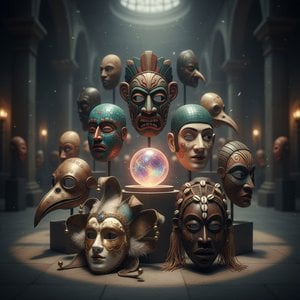
Embark on a profound journey through the world's most iconic mask artworks. Explore the spiritual depth, intricate craftsmanship, and rich cultural heritage of global traditions, from Chhau to Gomira, in this expert-led exploration of ancestral artistry and symbolic beauty.
 Saada
Saada Jaga
Jaga
 Teave teose kohta
 Juhend

 Laadi alla
 Sarnased teosed
 Slaidietendus
 KÜSIMUSED JA VASTUSID
 Statistika


 Loe lähemalt






































 Klaasivalik on saadaval ainult kuni 110 cm suuruses teostes


