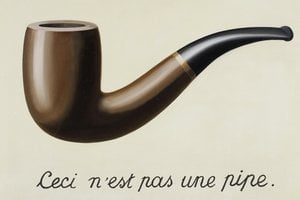
A Window into Surrealist Perception
René Magritte’s La Représentation (Representation) is not merely a painting; it's an invitation to question the very nature of seeing and being seen. Completed in 1937, this captivating work embodies the core tenets of Surrealism – a meticulous realism deployed to depict imagery that feels both familiar and profoundly unsettling. It’s a piece that doesn’t offer answers but instead thrives on provoking thought, challenging our assumptions about reality, illusion, and the act of representation itself.
The Anatomy of Illusion
The composition is strikingly intimate, presenting a tightly cropped view of a nude female torso and lower body. However, it's the presence of an ornate, gilded frame *within* the painting that truly defines Magritte’s intent. This isn’t a naturalistic depiction of the human form; rather, it presents the figure as an object on display – a representation of something, divorced from its inherent life and agency. The artist's masterful technique renders the curves and contours with remarkable anatomical accuracy, emphasizing the sculptural quality of the body through dramatic lighting and stark contrasts between light and shadow. This precision isn’t about celebrating sensuality in a traditional sense; it feels clinical, detached, reinforcing the idea that we are observing an image, a construct, rather than a living being.
A Legacy of Challenging Conventions
Magritte's artistic journey was one of constant evolution. Beginning with Impressionism and briefly exploring Cubism, he ultimately found his voice within the Surrealist movement in the mid-1920s. La Représentation is a mature expression of this period, reflecting his desire to dismantle conventional ways of seeing and thinking. Heavily influenced by Giorgio de Chirico’s metaphysical paintings, Magritte aimed to create art that posed questions rather than providing easy resolutions. The gilded frame itself serves as a deliberate nod to classical portraiture, acknowledging artistic tradition while simultaneously subverting it. He wasn't interested in simply replicating reality; he wanted to expose the mechanisms through which we perceive and interpret it.
Symbolism and Emotional Resonance
The symbolism within La Représentation is layered and open to interpretation. The frame acts as both a boundary, containing the figure, and an invitation, presenting her for our gaze. This duality raises complex questions about objectification, voyeurism, and the power dynamics inherent in looking. Is Magritte commenting on the way art constructs reality? Or perhaps reflecting on humanity’s tendency to categorize and control what we see? Despite its intellectual underpinnings, the painting possesses a quiet emotional resonance. It evokes contemplation and mystery, with its subdued palette and dramatic lighting creating an atmosphere of intimacy and vulnerability. For collectors, it represents an iconic example of Magritte's unique vision; for interior designers, it offers a sophisticated touch of surrealism that can add depth and intrigue to any space. Ultimately, the enduring appeal of La Représentation lies in its ability to simultaneously captivate the eye and challenge the mind – a hallmark of true artistic genius.
Küsimused ja vastused
Milline on teose „Representation“, autor René Magritte emotsionaalne toon?
Teose „Representation“, autor René Magritte kirjeldatud emotsionaalne toon on Mysterious. See kokkuvõtab tunnet, mida teos väljendab.
Kas ma saan näha teost „Representation“, autor René Magritte erinevates valgustingimustes?
Teost "Representation" saab uurida kiht kihti teose Röntgenkiirgus lehel, mis on interaktiivne vaatur, mida on inspireerinud restauraatori valgilaud ja mis pakub kujundist üksteist optilist lugemist.
Kas teoses "Representation" on nähtav tugev kerge-tume kontrast?
Teose "Representation" valgus-varjundite kontrast on Statement. Kontrast kirjeldab, kui teravalt erinevad heeled ja tumedad alad.
Kuidas leida teoseid, mis on sarnased teosele „Representation“, autor René Magritte?
Teosed, mis sarnanevad teosega „Representation“, autor René Magritte, on koondatud teose lehel Sarnased teosed.
Mille kohta on teos "Representation" ja milline on selle atmosfer?
Teos "Representation" kujutab teemasid surrealism, female form, representation, illusion, perception, anatomy, voyeurism, gilded frame ning selle meeleolu on Mystical.
Kuidas teose „Representation“, autor René Magritte värvikompositsioon on üles ehitatud?
Teose „Representation“, autor René Magritte väruanalüüs on tuvastatud Statement kontrast ja Unified Palette harmoonia.
Millissele stiilile kuulub "Representation"?
Teosest „Representation“, autor René Magritte tuntud kunstisuuna kuulub Surrealism stiili. See klassifikatsioon aitab teost paikutada sarnaste kunstnike ja teoste hulka.
Milline „Representation“, autor René Magritte trükkimõõt sobib soovitud ruumile?
Living Room ruumis on teose "Representation" jaoks soovitatav trükkimõõt Large.



 Vaata sisu
 Telli käsitsi maalitud reproduktsioon
 Jaga teost
 Jaga
Jaga
 Detailid
 Õppekate juhend

 Laadi alla
 Sarnased teosed
 Röntgenuuring
 Slaidietendus
 Statistika

 Loe lähemalt






































 Klaasivalik on saadaval ainult kuni 110 cm suuruses teostes