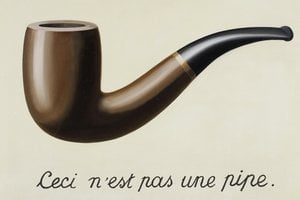
Lo stupo: A Surrealist Echo of Loss and Hidden Truths
René Magritte’s “Lo stupo,” painted in 1934, is more than just a depiction of a woman; it's an unsettling meditation on perception itself—a cornerstone of surrealism’s enduring fascination with the subconscious mind. The image presents a starkly simple composition: a female figure positioned centrally against a muted beige backdrop, her head adorned with two oversized breasts that float unnaturally above her skull.
The deliberate absence of anatomical detail is crucial to Magritte's artistic strategy. Rather than presenting a realistic portrayal of the human form, he strips away conventional representation, leaving only the suggestion of flesh and bone. This technique—a hallmark of Surrealist painters like Salvador Dalí—forces viewers to confront the limitations of visual perception and prompts contemplation about what lies beneath the surface of appearances.
Style and Technique: Embracing Paradox
- Surrealism: Magritte firmly rooted himself in the Surrealist movement, spearheaded by André Breton. This artistic philosophy rejected rational thought and embraced dreams, irrationality, and automatism—methods designed to bypass conscious control and tap into unconscious impulses.
- Flat Perspective: The painting employs a flattened perspective, characteristic of Magritte’s style, which diminishes depth and creates an illusionistic effect that defies natural reality. This deliberate distortion contributes to the artwork's dreamlike quality.
- Oil Paint on Canvas: Executed in oil paint on canvas, “Lo stupo” demonstrates Magritte’s meticulous attention to detail despite his rejection of realism. The subtle tonal variations within the beige background enhance the sense of atmosphere and contribute to the painting’s overall mood.
Historical Context: Navigating Uncertainty
Painted during a period marked by profound social and intellectual upheaval—the aftermath of World War I and the burgeoning anxieties surrounding scientific advancements—Magritte's work reflects the broader cultural preoccupation with questioning established norms and confronting existential dilemmas. Surrealism emerged as a reaction to the perceived failures of reason and logic in addressing pressing societal concerns, offering instead an exploration of psychological landscapes.
The painting’s genesis lies in Magritte’s personal experiences—specifically, his mother's tragic death by suicide. As documented in biographical accounts, Magritte recounted how he envisioned her body being recovered from the River Sambre, draped in a dress concealing her face—a visual motif that would reappear throughout his oeuvre and underscore his preoccupation with hidden grief and unresolved trauma.
Symbolism: The Floating Breasts – A Manifestation of Grief
"Lo stupo" is laden with symbolic significance. The oversized breasts represent not merely physical anatomy but also a profound emotional burden—the inescapable presence of loss and the impossibility of fully comprehending or articulating grief. Their ethereal floating suggests that these feelings transcend the boundaries of physicality, embodying an intangible yet pervasive force.
Furthermore, Magritte’s deliberate omission of facial features reinforces the artwork's central theme: the elusive nature of identity and the difficulty of accessing inner thoughts and emotions. The woman remains inscrutable, inviting viewers to project their own interpretations onto her image—a testament to Magritte’s genius in prompting psychological reflection.
“Lo stupo” continues to resonate with audiences today because it encapsulates the Surrealist impulse to destabilize conventional notions of reality and to explore the hidden depths of human consciousness. Its haunting beauty lies precisely in its refusal to offer easy answers, leaving viewers grappling with questions about perception, grief, and the enduring power of imagination.



 Eelvaade
 Lülita trükkitoodetele
 Saada
Saada Jaga
Jaga
 Teave teose kohta

 Laadi alla
 Sarnased teosed
 Röntgenuuring
 Slaidietendus
 Statistika

 Loe lähemalt






































 Klaasivalik on saadaval ainult suuruses kuni 110 cm