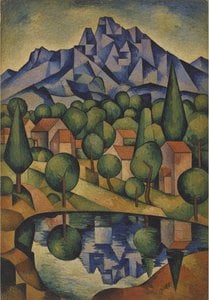
A Journey Through Color and Form: Paul Cézanne’s “The Bend in the Road”
Paul Cézanne’s “The Bend in the Road,” painted in 1906, just before his passing, is more than a landscape; it's an invitation. An invitation to contemplate the fundamental nature of reality itself, and to lose oneself within its vibrant hues and carefully constructed forms. This captivating vertical composition draws us into a serene valley, dominated by a dramatic bend in a winding road – a path that seems to lead not just across the land, but also through time and perception.
Cézanne’s genius lies in his ability to move beyond the fleeting impressions of Impressionism. While he embraced the vibrant color palettes favored by his contemporaries, he sought something deeper: an underlying geometric structure within nature. This is powerfully evident here – a deliberate construction of planes and angles, anticipating the radical deconstruction that would later define Cubism. It’s a testament to Cézanne's lifelong quest to understand and represent the very essence of what it means to see.
Technique and Materials: A Symphony of Brushstrokes
The painting is built upon a masterful technique, one that reveals itself with careful observation. Visible, vertical brushstrokes – thick and deliberate – layer burnt orange, peach, salmon pink, cobalt blue, lime green, and spring green, creating an astonishingly rich tapestry of color. Crucially, Cézanne employs unpainted canvas in strategic areas, a bold move that adds to the painting’s sense of lightness and emphasizes its constructed nature. This isn't simply a representation of a landscape; it’s a carefully considered composition, almost like a sculpted form emerging from the surface.
The texture itself is palpable – you can practically feel the artist’s hand at work. The oil paint has been applied with a remarkable degree of control and layering, resulting in a depth and complexity that draws the viewer closer. It's a technique demanding patience and meticulous attention to detail, reflecting Cézanne’s own rigorous approach to his art.
Color, Emotion, and Symbolism
The color palette is profoundly evocative – warm oranges and pinks of the rock formations contrast dramatically with the cool blues and greens of the valley trees. This isn't a literal depiction of nature; it’s an emotional response *to* nature, a feeling of peaceful contemplation and connection to the landscape. The painting exudes serenity, inviting us to step into its world and lose ourselves in its beauty.
Symbolically, the winding road represents journeys – both physical and metaphorical. It suggests transitions, challenges, and the ongoing quest for meaning. The imposing rock formations could be seen as obstacles or markers along this path, while the open valley hints at possibilities and hope. Cézanne’s repeated exploration of landscapes around Aix-en-Provence reflects a deep connection to his roots and a desire to capture the enduring spirit of his native region.
Cézanne's Legacy and Potential for Your Space
Paul Cézanne (1839-1906) was a pivotal figure in the history of art, profoundly influencing generations of artists. His emphasis on form, structure, and subjective perception paved the way for movements like Cubism and Fauvism. “The Bend in the Road” is not just a beautiful painting; it’s an investment in artistic heritage.
This artwork – or a high-quality reproduction – would be a stunning focal point in any space, adding energy and sophistication. Its vibrant colors and dynamic composition are particularly well-suited for hallways, entryways, or above fireplaces, creating a sense of calm and contemplation. Consider it an opportunity to bring a touch of artistic genius into your home, connecting you with the legacy of one of art’s most innovative minds.
Küsimused ja vastused
Kust saan leida sarnaseid teoseid kui „Teelööke“, autor Paul Cézanne?
Teosed, mis sarnanevad teosega "Teelööke", on loetletud teose Sarnased teosed lehel.
Millist tehnikat teose „Teelööke“, autor Paul Cézanne valmistamisel kasutati?
Paul Cézanne kasutas teose "Teelööke" loomisel Õlimaal kangaruumil tehnikat. See tehnika määrab originaalteose materjalilise olemuse.
Miks on teose "Teelööke" autoriõiguste staatus selline, nagu see on?
Paul Cézanne teos "Teelööke" on avalikus õiguses – selle autoriõigud onหมดunud. Autoriõiguse kaitseajad arvutatakse alates kunstniku surmaõigustest ning Paul Cézanne suri aastal 1906.



 Vaata sisu
 Lülita trükkitoodetele
 Jaga teost
 Jaga
Jaga
 Detailid
 Õppekate juhend

 Laadi alla
 Sarnased teosed
 Röntgenuuring
 Slaidietendus
 Statistika


 Loe lähemalt






































 Klaasivalik on saadaval ainult kuni 110 cm suuruses teostes