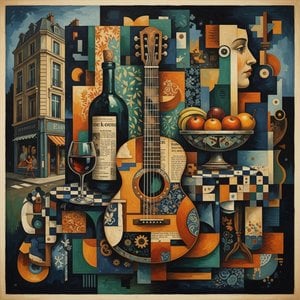
Subject and Composition of "Bottle, Glass, Violin"
"Bottle, Glass, Violin," created by Pablo Picasso in 1912, is a quintessential example of Synthetic Cubism. The artwork presents a still life arrangement featuring a bottle, a glass, and a violin placed upon what appears to be a tabletop. These objects are not depicted realistically but rather fragmented and reassembled into an abstract composition. The background remains muted, allowing the viewer's focus to remain firmly on the interplay of shapes and forms that constitute the subject matter.
Synthetic Cubism: A Revolutionary Style
Picasso’s work exemplifies Synthetic Cubism, a phase within the broader Cubist movement that emerged around 1912. Unlike earlier Analytic Cubism which focused on dissecting objects into their component parts, Synthetic Cubism introduced elements of collage and papier collé. This shift allowed artists to incorporate real-world materials directly into their artwork, blurring the lines between painting and sculpture. Picasso’s use of charcoal and what appears to be cardboard or textured paper in "Bottle, Glass, Violin" demonstrates this innovative approach. The style challenges traditional notions of representation, inviting viewers to actively engage with the artwork and reconstruct its meaning.
Historical Context and Influences
The creation of “Bottle, Glass, Violin” coincided with a period of significant artistic experimentation in Europe. Cubism itself was born from Picasso’s collaboration with Georges Braque, reacting against the conventions of Impressionism and Post-Impressionism. The early 20th century witnessed rapid technological advancements and societal shifts, which influenced artists to explore new ways of depicting reality. Synthetic Cubism reflected this spirit of innovation, embracing abstraction and challenging established artistic norms. The incorporation of everyday objects like a bottle, glass, and violin further emphasized the movement's desire to integrate art with modern life.
Symbolism and Emotional Impact
While seemingly simple in its subject matter, "Bottle, Glass, Violin" carries layers of symbolic meaning. The fragmented forms can be interpreted as representing the instability and complexity of modern existence. The violin, a symbol of music and harmony, is juxtaposed with the more utilitarian objects—the bottle and glass—creating a visual tension that reflects the contradictions inherent in contemporary society. Emotionally, the artwork evokes a sense of intellectual curiosity and invites contemplation. The muted palette and geometric forms create a calm yet stimulating atmosphere, encouraging viewers to actively participate in deciphering its meaning.
Technical Aspects and Artistic Merit
Picasso’s masterful use of charcoal is evident throughout the piece. The lines are bold and decisive, defining the fragmented shapes with precision. The incorporation of collage elements adds texture and depth, further enhancing the artwork's visual complexity. "Bottle, Glass, Violin" stands as a testament to Picasso’s genius and his pivotal role in shaping the course of 20th-century art. Its innovative approach to composition, its exploration of new materials, and its enduring emotional impact solidify its place as a landmark achievement within the Cubist movement.
Korduvad küsimused
Kuidas seda teost „Bottle, glass, violin“, autor Pablo Picasso saab kasutada kodukujunduses?
Teose „Bottle, glass, violin“, autor Pablo Picasso kohta on esitatud kaks soovitust: kasutus (Kinnisitus) ja ruum (Elutuba).
Mis on teose "Bottle, glass, violin" formaat?
„Bottle, glass, violin“, autor Pablo Picasso on Horisontaalne suund kompositsioon. Trüki suuruse valimisel on mõistlik kontrollida selle proportsioone.
Milline rahvuslik päritolu seisab teose "Bottle, glass, violin" Cubism taga?
Cubism suunaga teos "Bottle, glass, violin" on loodud kunstniku poolt, kes on pärit riigist Hispaania.



 Eelvaade
 Osta käsitsi maalatud teos
 Saada
Saada Jaga
Jaga
 Teave teose kohta
 Juhend

 Laadi alla
 Sarnased teosed
 Röntgenuuring
 Slaidietendus
 Q&A
Q&A Statistika

 Loe lähemalt






































 Klaasivalik on saadaval ainult kuni 110 cm suuruses teostes