A Meditation on Faith and Form
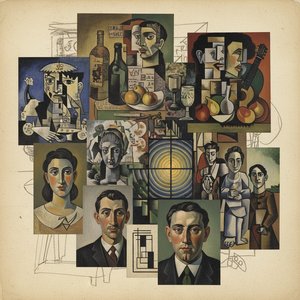
In the vast, revolutionary tapestry of Pablo Picasso’s career, certain works emerge not through grand scale, but through their profound ability to whisper to the soul. Bonne d’enfants (Good Child) is one such masterpiece. Created during the pivotal years between 1907 and 1908, this watercolor serves as a delicate bridge between the artist's early explorations of emotion and the radical, fragmented dawn of Cubism. At first glance, the piece presents a deceptively simple scene: a solitary figure captured in a moment of quiet devotion. Yet, beneath its minimalist surface lies a complex dialogue between the physical world and the spiritual realm, making it an irresistible focal point for any collection dedicated to the evolution of modern thought.
The subject matter is centered upon a figure kneeling in prayer or deep contemplation, a posture that immediately invokes the timeless language of religious iconography. Picasso, however, moves away from the rigid dogmas of traditional sacred art, choosing instead to prioritize gesture and emotion over anatomical precision. The figure exists in a state of beautiful vulnerability, stripped of unnecessary detail to highlight the raw essence of supplication. This focus on the internal experience of the subject allows the viewer to project their own reflections onto the canvas, transforming the artwork from a mere depiction of a person into a universal symbol of reverence and stillness.
The Alchemy of Color and Technique
Technically, Bonne d’enfants is a masterclass in the expressive potential of watercolor. Picasso utilizes loose, flowing washes that bleed softly into one another, creating an ethereal atmosphere that feels almost dreamlike. The composition is anchored by a warm, luminous yellow tone that bathes the background in a gentle, golden light. This choice of palette is crucial; it provides a sense of divine warmth, acting as a soft glow that emanates from within the paper itself. Against this radiant backdrop, Picasso employs subtle dry brush techniques to define the figure’s outline, creating a rhythmic tension between the blurred edges of the color and the deliberate, searching lines of the form.
This interplay of light and shadow is not rendered through traditional chiaroscuro but through the layering of translucent pigments. The result is a shallow depth that encourages the eye to linger on the surface textures rather than searching for a distant horizon. For the interior designer or collector, this quality makes the piece exceptionally versatile. Its soft, diffused luminosity allows it to integrate seamlessly into serene, minimalist environments, where its understated elegance can act as a meditative anchor without overwhelming the surrounding decor.
A Legacy of Transformation
To understand Bonne d’enfants is to understand Picasso at a crossroads. Coming on the heels of his groundbreaking Les Demoiselles d’Avignon, this work captures the artist in a state of intense experimentation. While he was beginning to dismantle the traditional rules of perspective and geometry that would define Cubism, he had not yet abandoned the profound emotional resonance found in his earlier periods. The piece embodies this duality: it possesses the structural fragmentation of a modernizing world, yet retains the soulful, impressionistic sensitivity of a classical master.
Owning a high-quality reproduction of this work is more than an acquisition of art; it is an invitation to participate in one of history's most significant artistic dialogues. Whether placed in a quiet study, a contemporary living space, or a curated gallery setting, Bonne d’enfants offers a perennial sense of peace. It remains a testament to the idea that even in the midst of radical change and structural upheaval, there is a fundamental, enduring beauty to be found in the simplest acts of faith and human connection.



 Eelvaade
 Lülita trükkitoodetele
 Saada
Saada Jaga
Jaga
 Teave teose kohta

 Laadi alla
 Sarnased teosed
 Röntgenuuring
 Slaidietendus
 Statistika

 Loe lähemalt






































 Klaasivalik on saadaval ainult suuruses kuni 110 cm