Eelvaade AR-eelvaade Lülita trükkitoodetele Osta käsitsi maalatud teos Saada
Teave teose kohta Juhend Lisa lemmikutesse Laadi alla Sarnased teosed Röntgenuuring Slaidietendus Q&A Statistika

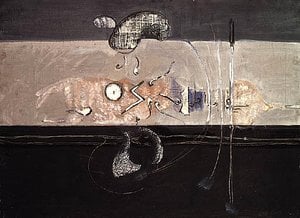
The Trial

Mõõtmed
550.0 x 370.0 cm

John Samuel Tunnard’s ‘The Trial,’ painted in 1944, delves into psychological exploration with layered perspectives and evocative motifs. Inspired by modernist fabric design and jazz, this artwork reflects a contemplative mood amidst the anxieties of WWII.

Discover John Samuel Tunnard (1900-1971): a key English modernist painter influenced by Surrealism. Explore his landscapes, portraits & textile designs at WahooArt.

Hankige trükiivaldatav fail, mis on kvaliteedilt palju parem kui veebilehel näidatud eelvaade. Kõik meie müüdavad digitaalsed pildid pärinevad meie arhiivist kõrge resolutsiooniga originaalfailidest — tavaliselt 5000 kuni 15 000 pikslit laiust — nii et saate julgelt trükida suurematsat, lüüdist teha või detailset sisu reproduktsiooni teha.

Meie stuudiost ei lahtu ükski fail puutumatuna. Digiekpert võrdleb värve algsest maalistimusega ja vajadusel korrigeerib neid, seejärel parandab selgust ja detaile professionaalsete retušimisvahendite abil — püüdes alati jääda truudeks kunstniku pintoonile ja stiilile. Tulemuseks on pilt, mis näeb välja nagu maali, mitte nagu filtreeritud skann.

Teet kinnituse enne lõplikku valmimist: meie ekspert saadab pildi 72 tunni jooksul e-posti ülevaatamiseks. Ei ole rahul? Paluge parandusi või korrektsioone ning kui kvaliteet ei vasta ootustele, võite paluda tagastamist.

See on kvaliteet, millele tuguvad väljaandjad, disainistuudiod, galeriid ja trükikojad.

Digitaalne kunstiteos

Laadi alla kõrge resolutsiooniga fail isiklikuks vaatamiseks, trükkimiseks ja loomingulisteks projektideks. ( Lülita trükkitoodetele Osta käsitsi maalatud teos)

Lõppsumma

€ 22,13

Sisse kuulub iga digitaalse pildi tellimusega

Eksperdi digitaalne kohaletoimetamine, garanteeritud

Valides WahooArt.com, ei saa sa lihtsalt pilti – saad professionaalselt parandatud digitaalse teose, mida on valmistatud täpsusega ja mis on toetatud rahuldamatusgarantiiga. Siin on kõik, mis sinu tellimusega automaatselt kaasneb:

Kiire digitaalne edastus

Teie kõrge resolutsiooniga digitaalne pildifail saadetakse teile e-posti 72 tunni jooksul pärast tellimist – kohe kasutamiseks valmis.

Tehisintellektiga täiustatud digitaalne fail

Teie teos on professionaalselt optimeeritud arenenud tehisintellekti tööriistade ja käsitsi redigeerimise abil, tagades maksimaalse detailitaseme, selguse ja värvitäpsuse.

Tasuta eluaegne uuesti saatmine

Kas kustutasid faili kogukalu unustamisel või kustutamisel? Puudub mure – saad selle uuesti igal ajal ilma lisatasuta.

Puuduvad importimaksud – alati

Nautige oma teoseid koheselt ilma tolli-, maksude või tarnimaskuludeta – digiletchargused on alati maksuvabadud.

Värvitäpsuse garantii

Me tagame, et teie digitaalne pilt kajastaks originaali värve professionaalsete tööriistade ja värvihalduse abil võimalikult täpselt.

100 päeva rahuldamatuse garantii

Kui te ei ole oma digitaalse pildi eest rahul, siis me parandame seda või tagastame 100% summast 100 päeva jooksul – küsimusteta.

100% raha tagastamise garantii

Ei ole rahul? Saate täielise tagastaja 100 päeva jooksul pärast digitaalse faili kättesaamist – ilma küsimusteta.

Suurema tellimuse soodustused

Osta 3 pilti, säästa 10% - Osta 5, säästa 15% - Osta 10+, säästa 20%. Sobib suurepäraselt loomingulisteks projektideks, galeriideks ja agentuurideks.

Teave teose kohta

  • Artistic style: Modernist
  • Title: The Trial
  • Artist: John Samuel Tunnard
  • Subject or theme: Psychological exploration; Dreamscape.
  • Notable elements or techniques: Perspective play; Void motifs; Ochre-yellow figure.
  • Movement: Surrealism

Kunstiteaduse kvartett

Iga küsimuse kohta on ainult üks õige vastus.

Küsimus 1:
What artistic movement is John Tunnard’s painting ‘The Trial’ primarily associated with?
Küsimus 2:
Where was John Tunnard's early career exhibition showcasing his work held?
Küsimus 3:
What is a prominent motif within Tunnard's painting 'The Trial', reflecting his broader artistic interests?
Küsimus 4:
Which influential figure inspired Tunnard’s exploration of perspective and its impact on conveying mood in ‘The Trial’?
Küsimus 5:
What was John Tunnard's role during World War II, contributing to his artistic inspiration?
After studying textile design at the Royal College of Art, John Tunnard began his career as a designer and fabric-buyer for John Lewis in London. In the 1930’s, he moved with his wife to Cornwall, establishing a silk block-printing business. It was while he was in Cornwall that Tunnard turned towards painting. Identified as an English Surrealist, his paintings were shown alongside Yves Tanguy, Paul Nash, Graham Sutherland and John Piper. He was widely regarded and exhibited during his life, with an early career exhibition at Peggy Guggenheim’s ‘Guggenheim Jeune’ gallery in London, (open between 1938-9). He would produce two major works for the 1951 Festival of Britain – a painting, The Return (1951) and a mural for the Regatta Restaurant. Influences on his work include Modern fabric design, an interest in marine life, free-association music (Tunnard was a keen jazz player), and the natural world, (he also collected rare insects for the Natural History Museum while it was still a part of the British Museum).A play on perspective gives this painting its macabre ‘down the rabbit hole’ ambience. This painting leads its viewer into a world of multiple planes, lines and voids. Peering into its visual machine, one’s investigations are quickly interrupted by a disappearing line, or a strike that crosses one’s view or bends one’s vision along a new route. The viewer’s eye experiences a kind of paroxysm while looking at this painting. A darting effect is produced that leaves us confused as to the ‘real’ nature of the pattern itself. Whatever was first understood becomes distorted and we are left with such questions as: where is the front? where is at the back? what indeed, is happening here?A number of motifs within this work are common across Tunnard’s practice at this time. The ochre-yellow figure to the right recurs in the work Ghost painted in the same year, and the sharp base-point of tentatively poised shapes are present in other paintings at this time. Voids, doorways, red colour accents, white scores across the composition and generally a dark, nocturnal palate, are all present throughout a body of work that Tunnard painted across the final years of the Second World War.A conscientious objector, Tunnard spent most of the war as a coastguard on the Cornish coast. In this role, his regular view would have been towards occupied France and across an embattled mass of sky and sea. An active stage of war, this coastal strip was the southernmost ‘front’ of Great Britain. A distorted political space, The Channel, much like this painting, was ideologically abstracted by opposing forces that brawled across it.The sea meets the sky in this painting, which recasts an agitated and sombre character of war. As a critic of The Times was to later write about Tunnard’s work during this period, his:‘imagery seems to spring directly from the war, from a time when deserted airships beneath the moon and skies scored with the smoke-trails of aerial battles brought a sudden anticipatory glimpse of the space-age. Mr Tunnard’s obsession with the dynamics of flight, and his visions of an upper ether patterned and articulated by them were never… documentary records, but more like romantic pictorial science-fiction.’ © Gemma Sharp 20101. Imagery derived from War. Mr John Tunnard’s Paintings’. The Times, 7th December 1959. p14.

Korduvad küsimused

Kuidas teose "The Trial" motiiv seobub John Samuel Tunnard tavalistega teemadega?

John Samuel Tunnard dokumenteeritud teemade — modern fabric design, jazz player inspiration, british surrealist vision, festival britain mural, cornish landscape motif — seas paneb teos "The Trial" erilist tähelepanu teemadel cornwall, landscape, marine life, perspective, psychological, jazz influence, symbolism.

Kust saan näha originaalteost „The Trial“, autor John Samuel Tunnard?

Teos „The Trial“, autor John Samuel Tunnard on näitustel British Council, London, Ühendkuningriik. Muuseumi keterangane viitab originaalteosele, mitte reproduktsioonidele.

Kas John Samuel Tunnard teos "The Trial" kuulub avalikku omandisse ja miks?

Teose "The Trial" autoriõiguste staatus - on endiselt autoriõiguse all under kaitse - tuleneb kunstniku surma aastast 1971.


Kunstniku elulugu

John Samuel Tunnard: A Life in Modern British Art

Early Life and Education

John Samuel Tunnard (1900-1971) was an English modernist painter and designer. Born in Sandwich, Kent, he initially studied design at the Royal College of Art from 1919 to 1923. This foundational training would prove crucial throughout his artistic career, influencing both his painting style and his later ventures into textile design.

Early Career & Textile Design

During the 1920s, Tunnard worked in various textile design roles in Manchester. This period provided him with practical experience and an understanding of pattern, color, and form – elements that would later become prominent features of his paintings. In 1926, he married Mary May Robertson, a partnership that would significantly shape both their personal and professional lives.

Artistic Development & Influences

By 1928, Tunnard began to focus seriously on painting. He taught design at the Central School of Arts and Crafts in London from 1929 onwards, further solidifying his engagement with artistic principles and pedagogy. His work during this time demonstrates a growing interest in modernist aesthetics. Tunnard’s style was notably influenced by Surrealism, although he never formally joined the movement. He participated in several surrealist exhibitions throughout the 1930s, including one at the Gordon Fraser Gallery in Cambridge.

Cornwall and a New Artistic Direction

In 1933, Tunnard and his wife moved to Cadgwith, Cornwall. There, they established a business producing printed silks, allowing them to combine their artistic talents with entrepreneurial endeavors. The Cornish landscape profoundly impacted Tunnard’s art, inspiring many of his later landscapes and providing a new source of visual motifs.

Major Works & Artistic Style

Tunnard's oeuvre encompasses both paintings – including notable landscapes and portraits – and textile designs. His painting style is characterized by its lyrical abstraction, dreamlike qualities, and vibrant color palettes. He often blended representational elements with abstract forms, creating a unique visual language that reflects his surrealist leanings.

  • His landscapes frequently depict the Cornish coastline, rendered in bold colors and fluid shapes.
  • His portraits explore psychological depth through expressive brushwork and unconventional compositions.
  • His textile designs showcase innovative patterns and color combinations, demonstrating his versatility as an artist.

Exhibitions & Recognition

Tunnard exhibited widely throughout his career. He showed work at the Royal Academy and with the London Group (which he joined in 1934). His participation in surrealist exhibitions further cemented his position within the British avant-garde.

Legacy & Historical Significance

John Samuel Tunnard is now considered one of the most important English modernist painters. His work represents a unique synthesis of Surrealism, abstraction, and landscape painting. Examples of his art can be found in prominent collections such as the National Galleries of Scotland. He contributed significantly to the development of modern British art, bridging the gap between traditional representation and abstract expression.

John Samuel Tunnard

John Samuel Tunnard

1900 - 1971 , United Kingdom

Lühikesed faktid

  • Name: John Samuel Tunnard
  • Movement: Modernism, Surrealism
  • Birth Date: 1900
  • Death Date: 1971
  • Birth Place: Sandwich, United Kingdom
  • Nationality: British
  • Date Of Birth: 1900
  • Date Of Death: 1971
  • Influenced By: Surrealism
  • Notable Works: Landscapes, Portraits, Textile Designs
  • Place Of Birth: Sandwich, United Kingdom