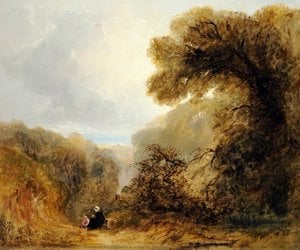
The Ethereal Vision of John Le Capelain
In the soft, diffused light of a nineteenth-century morning, where the sea mist clings to the rugged cliffs of Jersey, one finds the very soul of John Le Capelain’s artistry. Born in London around 1812, Le Capelain was a painter who possessed the rare ability to translate the intangible atmosphere of the Channel Islands into a visual language of profound tranquility. Though he was the son of a printer and lithographer, Samuel Le Capelain, and grew up amidst the industrious rhythms of London, his heart remained tethered to the misty landscapes of his father's native island. His journey from the structured world of lithography to the fluid, emotive realm of watercolor painting represents a remarkable evolution of a self-taught master who sought not just to depict scenery, but to capture the very breath of the landscape.
Le Capelain’s technique was nothing short of poetic. Eschewing formal academic training, he relied upon a keen, observant eye and an intuitive understanding of light and moisture. He became celebrated for a distinctive method of layering delicate watercolor washes, a process that allowed him to build depth and luminosity within his compositions. This meticulous approach resulted in his signature misty and foggy effect, where horizons dissolve into soft greys and pale blues, creating a sense of melancholic beauty and infinite space. His works often feature the dramatic silhouettes of Mont Orgueil or the serene coastal stretches of Jersey, all rendered with a subtle tonal variation that suggests the shifting moods of a maritime climate.
Royal Recognition and a Lasting Legacy
The trajectory of Le Capelain’s career reached its zenith through an extraordinary encounter with royalty. In 1846, during Queen Victoria’s historic visit to Jersey, the artist's talent was brought to the forefront of the public consciousness. The States of Jersey presented a volume of his drawings as an official souvenir to the Queen, a gesture that not only solidified his local prestige but earned him a prestigious royal commission to document the scenery of the Isle of Wight. This period marked the height of his creative influence, yet it was also shadowed by the onset of tuberculosis, a cruel illness that would claim his life in 1848 at the young age of thirty-six.
Despite his tragically short life, Le Capelain’s impact on the artistic identity of the Channel Islands remains indelible. His work serves as a vital historical window into the Victorian era, preserving the untouched splendor of landscapes that have since been altered by time. The significance of his contribution is reflected in several enduring tributes:
- Cultural Iconography: A view of Mont Orgueil, one of his most celebrated subjects, was so deeply woven into the local identity that it was featured on the reverse of the 1976 Jersey £20 banknote.
- Public Commemoration: His memory is honored within the very halls of governance in St. Helier, where the "Le Capelain Room" stands as a testament to his importance to the island's heritage.
- Artistic Preservation: The Jersey Heritage Trust continues to safeguard his paintings, ensuring that his ability to evoke the ephemeral beauty of fog and light continues to inspire new generations of admirers.
Ultimately, the art of John Le Capelain transcends mere landscape painting; it is an exploration of atmosphere and emotion. Through his mastery of the watercolor medium, he transformed the damp, heavy air of the British Isles into something luminous and eternal, leaving behind a body of work that remains as hauntingly beautiful as a morning mist lifting over the sea.



 Eelvaade
 Osta print
 Saada
Saada Jaga
Jaga
 Teave teose kohta

 Laadi alla
 Sarnased teosed
 Röntgenuuring
 Slaidietendus
 Loe lähemalt






































 Klaasivalik on saadaval ainult suuruses kuni 110 cm