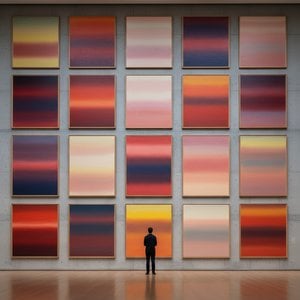
The Oran painting, created by
James Brooks in 1969, is a remarkable piece of art that showcases the artist's unique style and technique. Measuring 270 x 233 cm, this acrylic on canvas painting is a prime example of
Abstract Expressionism. The painting is currently housed at the
Smithsonian American Art Museum in the United States.
Artistic Style and Technique
James Brooks was known for his innovative use of staining, dilution, and accidental deterioration of canvases to create uncontrolled abstraction. In Oran, he applied his mixtures of commercial products and paints directly from the tube to create thick, deep textures. This technique gives the painting a dynamic and expressive quality.
Composition and Color Scheme
The composition of Oran features rhythmic arrangements of color, space, and shape. The dominant colors used in the painting are red and blue, which add depth and interest to the overall composition. The central figure in the painting appears to be a black object, possibly a guitar or musical instrument, surrounded by smaller figures, including one that resembles a person's head.
Artist's Background and Influences
James Brooks was an American artist born in 1906. He studied at the Southern Methodist University in Dallas, Texas, and later attended the Arts Student League in New York. Brooks was influenced by other notable artists of his time, including
Jackson Pollock and
Lee Krasner. His work has been exhibited at various museums, including the
Museum of Modern Art (MoMA) and the
Tate Gallery.
The Oran painting by
James Brooks is a significant piece of art that showcases the artist's unique style and technique. Its composition, color scheme, and texture make it a captivating work that continues to inspire art lovers today.
Küsimused ja vastused
Mida „Oran“, autor James Brooks kujutab?
Teose "Oran" teemad on abstract expressionism, color field painting, dynamic composition, textured surface”, “red and blue palette”, "gestural brushstrokes", american art”.
Kuidas teose "Oran" motiiv seobub James Brooks tavalistega teemadega?
James Brooks korduvad teemad hõlmavad pollock & krasner's impact, abstract exploration", post-war american art, emotional abstraction, "large-scale, dynamic forms", experimentation with texture, key to brooks' style; teos "Oran" keskendub abstract expressionism, color field painting, dynamic composition, textured surface”, “red and blue palette”, "gestural brushstrokes", american art”.
Kas teosele „Oran“, autor James Brooks on olemas juhend?
Teosele „Oran“, autor James Brooks on saadaval Juhend leht: trüvitav infoleht teose kohta, mis on loodud õpilasteks ja klassiruumis kasutamiseks.



 Vaata sisu
 Telli käsitsi maalitud reproduktsioon
 Jaga teost
 Jaga
Jaga
 Detailid
 Õppekate juhend

 Laadi alla
 Sarnased teosed
 Röntgenuuring
 Slaidietendus
 Statistika


 Loe lähemalt






































 Klaasivalik on saadaval ainult kuni 110 cm suuruses teostes