Muuseumikvaliteediga giclée- või kangasprint kiire tootmisega ja paindlikud viimistlusvõimalused. ( Osta käsitsi maalatud teos Lülita digitaalse pildi juurde)





























Vali meie eelmääratud suurused, mis vastavad teose algupärastele proportsioonidele.

Sisestage vajalik laius ja kõrgus, et see sobiks teie raamile või seinale. Trükki saab ainult lõigata, seda ei saa kunagi pildist suuremaks teha, seega ka erineva mustega suurus kaotab osa pildist. Enne trükkimist saadame teile kinnitamiseks digitaalse näidisprojektsiooni. Sellel lehel näidatud pilt ei kujuta reaalset lõiget — seda näitab ainult näidisprojektsioon.
Ülemaailmne tarne () 2 nädala jooksul, tavalise 4/5 nädala asemel. (16 november)
Three Lawyers
Reproduktsiooni suurus
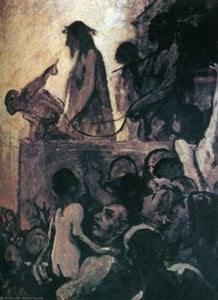
In the evocative monochrome of Honoré Daumier’s "Three Lawyers," we are invited into a world where the gravity of the law meets the biting wit of social critique. Created in 1857, this striking oil on canvas serves as a profound window into the mid-19th-century French legal system, captured through the eyes of an artist who knew the sting of injustice personally. Daumier, a man whose own brush was once deemed seditious by the state, utilizes a masterful palette of blacks and whites to sculpt figures that feel almost tactile in their presence. The scene is not merely a portrait of three professionals; it is a theatrical tableau of self-importance, where the heavy shadows and bright highlights work in tandem to expose the puffed-up egos of men who thrive within the labyrinth of bureaucracy.
The composition centers on three legal figures, standing in close proximity as they engage in what appears to be a spirited, perhaps even conspiratorial, exchange. One man holds a book—a symbol of the codified power they wield—while their postures suggest a shared sense of triumph and intellectual superiority. Daumier’s technique here is nothing short of extraordinary; by drawing inspiration from the chiaroscuro masters like Rembrandt and Velazquez, he extracts a rich, tonal depth from a limited spectrum. The way light catches the folds of their dark suits and illuminates their expressive faces creates a sense of movement and life, making the viewer feel as though they have stumbled upon a private moment of professional camaraderie.
Beyond the immediate spectacle of the lawyers' clever quips and unified front, Daumier embeds a haunting layer of symbolism that elevates the work from mere caricature to profound social commentary. While the central figures are preoccupied with their own prestige, the background reveals a much more somber reality. A weeping woman, relegated to the periphery and largely ignored by the men in power, serves as a poignant reminder of the human cost often left in the wake of legal maneuvering. This juxtaposition—the self-congratulatory unity of the powerful against the isolated grief of the vulnerable—is the heartbeat of the painting. It transforms the canvas into a silent protest, highlighting the disconnect between the mechanics of justice and the actual pursuit of mercy.
For the discerning collector or interior designer, "Three Lawyers" offers much more than aesthetic beauty; it provides a conversation piece steeped in historical weight and emotional complexity. The stark, dramatic contrast of the black and white tones allows this reproduction to integrate seamlessly into sophisticated, modern, or classical interiors, acting as a focal point that commands attention through its sheer narrative strength. Whether hung in a study, a library, or a contemporary living space, the painting brings with it an atmosphere of intellectual rigor and timeless reflection, inviting all who gaze upon it to look past the surface and contemplate the enduring complexities of human society.
„Three Lawyers“, autor Honoré Daumier on soovitav kingitus jaoks Corporate Gift. Teose reproduktsiooni saab anda kingitusena.
Teos „Three Lawyers“, autor Honoré Daumier pärineb 19th Century ajast. See ajastu annab teosele ajaloolise konteksti.
Formaat (Portrait) ja soovitatav ruum (Office) on teose „Three Lawyers“, autor Honoré Daumier kohta kirjutatud kaks paigutusandmet.


1808 - 1879 , Prantsusmaa

Explore the profound power of social commentary through art history. From Hogarth's satire to Banksy's subversion, discover how masterpieces reflect society's truths and elevate fine art collections with unparalleled depth and historical significance.
 Eelvaade
 Saada
Saada Jaga
Jaga
 Teave teose kohta
 Juhend

 Laadi alla
 Sarnased teosed
 Röntgenuuring
 Slaidietendus
 KÜSIMUSED JA VASTUSID
 Statistika


 Loe lähemalt









 Klaasivalik on saadaval ainult kuni 110 cm suuruses teostes