Hankige trükiivaldatav fail, mis on kvaliteedilt palju parem kui veebilehel näidatud eelvaade. Kõik meie müüdavad digitaalsed pildid pärinevad meie arhiivist kõrge resolutsiooniga originaalfailidest — tavaliselt 5000 kuni 15 000 pikslit laiust — nii et saate julgelt trükida suurematsat, lüüdist teha või detailset sisu reproduktsiooni teha.
Meie stuudiost ei lahtu ükski fail puutumatuna. Digiekpert võrdleb värve algsest maalistimusega ja vajadusel korrigeerib neid, seejärel parandab selgust ja detaile professionaalsete retušimisvahendite abil — püüdes alati jääda truudeks kunstniku pintoonile ja stiilile. Tulemuseks on pilt, mis näeb välja nagu maali, mitte nagu filtreeritud skann.
Teet kinnituse enne lõplikku valmimist: meie ekspert saadab pildi 72 tunni jooksul e-posti ülevaatamiseks. Ei ole rahul? Paluge parandusi või korrektsioone ning kui kvaliteet ei vasta ootustele, võite paluda tagastamist.
See on kvaliteet, millele tuguvad väljaandjad, disainistuudiod, galeriid ja trükikojad.
Laadi alla kõrge resolutsiooniga fail isiklikuks vaatamiseks, trükkimiseks ja loomingulisteks projektideks. ( Lülita trükkitoodetele Osta käsitsi maalatud teos)
Valides WahooArt.com, ei saa sa lihtsalt pilti – saad professionaalselt parandatud digitaalse teose, mida on valmistatud täpsusega ja mis on toetatud rahuldamatusgarantiiga. Siin on kõik, mis sinu tellimusega automaatselt kaasneb:
Teie kõrge resolutsiooniga digitaalne pildifail saadetakse teile e-posti 72 tunni jooksul pärast tellimist – kohe kasutamiseks valmis.
Teie teos on professionaalselt optimeeritud arenenud tehisintellekti tööriistade ja käsitsi redigeerimise abil, tagades maksimaalse detailitaseme, selguse ja värvitäpsuse.
Kas kustutasid faili kogukalu unustamisel või kustutamisel? Puudub mure – saad selle uuesti igal ajal ilma lisatasuta.
Nautige oma teoseid koheselt ilma tolli-, maksude või tarnimaskuludeta – digiletchargused on alati maksuvabadud.
Me tagame, et teie digitaalne pilt kajastaks originaali värve professionaalsete tööriistade ja värvihalduse abil võimalikult täpselt.
Kui te ei ole oma digitaalse pildi eest rahul, siis me parandame seda või tagastame 100% summast 100 päeva jooksul – küsimusteta.
Ei ole rahul? Saate täielise tagastaja 100 päeva jooksul pärast digitaalse faili kättesaamist – ilma küsimusteta.
Osta 3 pilti, säästa 10% - Osta 5, säästa 15% - Osta 10+, säästa 20%. Sobib suurepäraselt loomingulisteks projektideks, galeriideks ja agentuurideks.
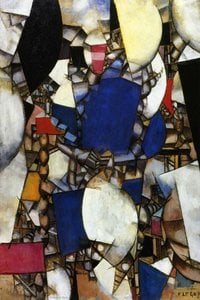
Fernand Léger's "The Flower That Walks," painted in 1953, isn’t merely a depiction of a flower; it’s an embodiment of the burgeoning modernist spirit grappling with the dynamism of the machine age. This vibrant canvas, brimming with bold geometric shapes and a playful energy, captures a pivotal moment in Léger's artistic evolution – his conscious effort to integrate the visual language of industry and technology into a distinctly personal aesthetic. Initially trained as an architect, Léger’s path shifted dramatically towards painting after arriving in Paris, drawn by the revolutionary currents swirling through the city’s avant-garde circles. Unlike many of his contemporaries who sought refuge in abstraction as a purely intellectual exercise, Léger embraced it as a means to represent the very essence of modern life – its rhythms, its structures, and its inherent movement.
The painting immediately commands attention with its audacious color palette: a joyous explosion of red, white, green, yellow, and orange. These aren’t delicate pastels; they're assertive, almost industrial hues, reminiscent of factory machinery and the vibrant signage that dominated the urban landscape of 1950s Paris. Léger deliberately avoided subtle gradations, favoring sharp contrasts and simplified forms. This stylistic choice reflects his fascination with the mechanics of the world around him – the precise angles of gears, the repetitive patterns of assembly lines, and the bold, unyielding structures of modern buildings. The central blue circle acts as a grounding element, a visual anchor amidst the swirling energy of the flower’s form.
“The Flower That Walks” is deeply rooted in the principles of Cubism, a movement that Léger championed alongside Pablo Picasso and Georges Braque. However, Léger pushed beyond the purely analytical deconstruction of traditional forms characteristic of early Cubism. Instead, he sought to synthesize fragmented perspectives into a new, unified visual experience – a concept he termed “Tubism.” This approach involved reducing objects to their essential geometric components, often depicting them as if viewed from multiple angles simultaneously. The flower itself is rendered through this lens: its petals are not smoothly curved but rather broken down into angular planes, suggesting both the organic and the mechanical.
Léger’s interest in machinery profoundly influenced his artistic vision. He saw a beauty in the precision and efficiency of industrial design, and he sought to capture that same sense of order and dynamism in his paintings. The flower's stylized form, with its simplified shapes and bold colors, echoes the aesthetic of early 20th-century automobiles and airplanes – symbols of technological progress and modernity. The suggestion of movement is particularly striking; the flower appears to be actively “walking,” a deliberate gesture that imbues the painting with a sense of life and vitality.
While Léger’s work is often associated with industrial imagery, it's crucial to recognize the underlying human element. The "flower" isn't simply an abstract form; it subtly evokes the human figure, particularly the torso and limbs. The petals can be interpreted as arms reaching out, while the central circle represents a head or chest. This deliberate ambiguity invites viewers to project their own interpretations onto the painting, fostering a sense of personal connection.
Furthermore, the flower’s “walking” action carries symbolic weight. It suggests a journey, a progression, and perhaps even a striving for something beyond the confines of its immediate surroundings. Léger himself described his work as an attempt to capture "the spirit of the machine age," but also to express a sense of optimism about the future – a belief that technology could be harnessed to create a more beautiful and fulfilling world. “The Flower That Walks” is, therefore, not just a depiction of a flower; it’s a visual manifesto for a new era.
WahooArt offers meticulously crafted hand-painted reproductions of Fernand Léger's "The Flower That Walks," allowing you to bring this iconic modernist masterpiece into your home or office. Our skilled artists replicate the painting’s vibrant colors, bold forms, and dynamic energy with exceptional attention to detail. Whether you are an art collector, interior designer, or simply someone who appreciates beautiful artwork, a WahooArt reproduction of “The Flower That Walks” is a stunning addition to any space – a testament to Léger's genius and a celebration of the spirit of modernism.
Teose "The flower that walks" on loonud Prantsusmaa-s sündinud Fernand Léger, tuginedes Cubism suunale. Kunstniku päritolu seob teose Cubism stiiliga, mida praktiseerivad Prantsusmaa kunstnikud.
Fernand Léger loobus teose "The flower that walks" 72 aasta vanuses. Kunstnik on sündinud aastal 1881 ning teos on dateeritud 1953.
Teos „The flower that walks“, autor Fernand Léger kuulub Cubism suunasse. See suund annab teosele stilistilise konteksti.


1881 - 1955 , Prantsusmaa
 Eelvaade
 Saada
Saada Jaga
Jaga
 Teave teose kohta
 Juhend

 Laadi alla
 Sarnased teosed
 Röntgenuuring
 Slaidietendus
 KÜSIMUSED JA VASTUSID
 Statistika

 Loe lähemalt