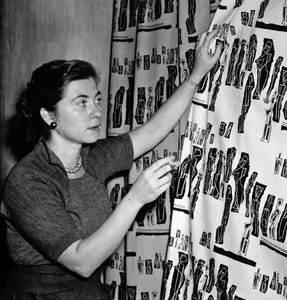
A Life Forged in Exile: The Artistic Journey of Fayga Perla Ostrower
Fayga Perla Ostrower’s life was a testament to resilience, a narrative woven from displacement and ultimately blossoming into a vibrant contribution to Latin American modernism. Born Fayga Perla Krakowski on September 14, 1920, in Łódź, Poland, her early years were shadowed by the rising tide of political instability and the looming threat of Nazi persecution. This sense of precarity would become a defining undercurrent throughout her life and work, subtly informing her exploration of identity, exile, and the search for belonging. The family’s subsequent relocation—first to Germany in 1921, then through Belgium, finally finding refuge in Brazil in 1934—was not merely a geographical shift but a profound disruption, a severing from roots that would forever shape her artistic vision. Settling in Nilópolis, near Rio de Janeiro, Ostrower began to forge a new life, one where art became both solace and a means of expression. Even as a young woman supporting herself as a secretary, she pursued free art classes at the Sociedade Brasileira de Belas Artes in 1939, demonstrating an innate drive that would propel her forward.
From Engraving to Abstraction: A Developing Style
Ostrower’s formal artistic training began in earnest with graphic arts courses at the Fundação Getulio Vargas in 1941, where she studied wood engraving under Axl Leskoschek and metal engraving with Carlos Oswald and Tomás Santa Rosa. These foundational skills in engraving techniques would remain central to her practice for years, initially manifesting in book illustrations that showcased her technical prowess. Her early work was characterized by a representational style, often depicting scenes of social realism—the lives of the working class, children from the favelas—reflecting a deep empathy and engagement with the world around her. However, this initial phase was not static. The 1950s marked a pivotal turning point in Ostrower’s artistic development, as she began to move towards abstraction. This shift wasn't abrupt but rather a gradual evolution, influenced by several factors, most notably her Fulbright scholarship in 1955 that allowed her to study graphic arts in New York City at the Brooklyn Museum Art School and Atelier 17. Exposure to new artistic ideas and techniques, particularly under the guidance of Stanley Hayter at Atelier 17, broadened her horizons and encouraged experimentation with printmaking processes. The influence of Paul Cézanne also proved crucial; she spoke of spending years deciphering his work before it unlocked a path towards Cubism and ultimately, her own unique abstract language.
International Recognition and Lasting Legacy
The recognition Ostrower garnered throughout her career was not confined to Brazil. Her work resonated internationally, earning her invitations to exhibit at prestigious venues such as the São Paulo Biennial (1951-1967), the Venice Biennial (1958 & 1962 – where she won an international engraving prize in 1958), and the Mexico Biennial (1960). These exhibitions not only showcased her talent on a global stage but also established her as a significant voice within Latin American modernism. Beyond her artistic practice, Ostrower was deeply committed to cultural organizations, serving as President of the Associação Brasileira de Artes Plásticas (Brazilian Association of Arts) from 1963-1966. This dedication to fostering the arts extended beyond her own work, demonstrating a belief in the power of art to connect and inspire. In 2002, a year after her passing on September 13th, 2001, in Rio de Janeiro, the Fayga Ostrower Institute was founded, ensuring the preservation and study of her art and legacy for generations to come. More recently, in 2023, her work was included in the exhibition *Action, Gesture, Paint: Women Artists and Global Abstraction 1940-1970* at the Whitechapel Gallery in London, further cementing her place within the broader narrative of international abstract art.
Themes of Displacement and Resilience
Fayga Perla Ostrower’s story is inextricably linked to the experiences of countless Jewish artists displaced by persecution during the 20th century. Her work embodies themes of exile, identity, and resilience—a quiet strength forged in the face of adversity. While her abstract compositions may not explicitly depict scenes of trauma or loss, they carry an emotional weight that speaks to a life marked by displacement and the search for belonging.
Her art is not merely about form and color; it’s about the feeling of being unmoored, of reconstructing identity in a new land. She played a crucial role in shaping the landscape of Brazilian modern art, challenging conventional norms and pushing the boundaries of abstract engraving. Her influence continues to inspire artists and scholars today, reminding us of the power of art to transcend borders and speak to the universal human experience.
Key Influences
- Axl Leskoschek, Carlos Oswald, Tomás Santa Rosa: Mentors at the Fundação Getulio Vargas who provided foundational training in engraving techniques.
- Stanley Hayter: Instructor at Atelier 17, influencing her experimentation with printmaking processes and encouraging a move towards abstraction.
- Käthe Kollwitz: A significant influence on Ostrower’s early work, particularly in its focus on social realism and empathetic depictions of the marginalized.
- Paul Cézanne: His exploration of form and color proved pivotal in Ostrower's transition to abstraction, unlocking a new artistic vocabulary for her.



 Eelvaade
 Osta print
 Saada
Saada Jaga
Jaga
 Teave teose kohta

 Laadi alla
 Sarnased teosed
 Röntgenuuring
 Slaidietendus


 Loe lähemalt






































 Klaasivalik on saadaval ainult suuruses kuni 110 cm