A Frenetic Vision of Modernity: Exploring Kirchner’s “Motorcycle Race with Preload”
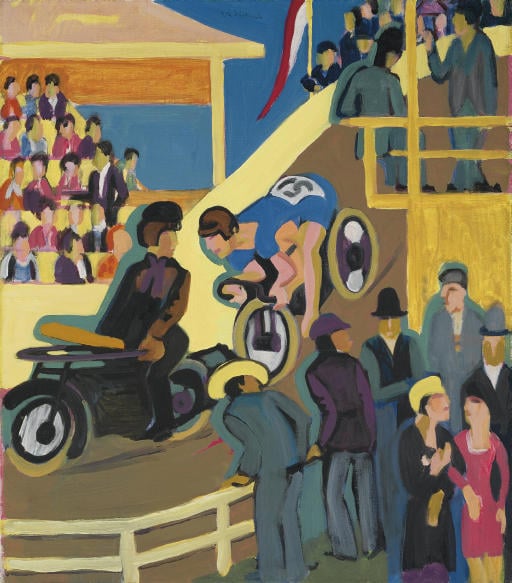
Ernst Ludwig Kirchner's "Motorcycle Race with Preload," painted in 1927-1928, isn’t merely a depiction of a sporting event; it’s a visceral embodiment of the anxieties and dynamism inherent in early 20th-century urban life. This work, rendered in oil on canvas, pulsates with an Expressionist energy—a deliberate distortion of reality designed to convey raw emotion rather than photographic accuracy. Kirchner, a founding member of Die Brücke (The Bridge), sought to capture not just what he saw, but how it *felt*, and this painting is a prime example of that ambition. The scene unfolds within a compressed space, dominated by the chaotic energy of the race itself, yet simultaneously hinting at the claustrophobia and relentless pace of modern existence.
The composition immediately grabs the viewer with its tilted perspective—a deliberate destabilization that mirrors the frenetic movement of the motorcycles. Diagonal lines, most notably those created by the track barriers and the receding architecture, generate a powerful sense of tension and forward momentum. Figures are densely packed, almost merging into one another, creating a visual cacophony that reflects the overwhelming nature of the event. Kirchner masterfully employs color to heighten this effect; vibrant yellows and oranges blaze across the canvas, contrasted sharply with the darker tones used for the racers and the shadowy background. This deliberate clash of hues isn’t simply aesthetic—it's a symbolic representation of the jarring realities of modern life, where pleasure and anxiety coexist in a turbulent dance.
Expressionist Techniques: Brushstrokes as Emotional Signifiers
Kirchner’s technique is central to understanding the painting’s emotional impact. He eschews smooth blending and meticulous detail, opting instead for thick, visible brushstrokes—an impasto application of paint that lends a raw, almost tactile quality to the work. These deliberate marks aren't accidental; they are expressive tools, conveying movement, energy, and the artist’s subjective experience. The painting feels unfinished in a way that deliberately amplifies its intensity. Notice how the brushwork intensifies around the racers, suggesting their speed and urgency, while remaining looser and more diffused in the background, creating a sense of distance and disorientation.
The simplification of forms—blocky figures and stylized motorcycles—further contributes to the painting’s Expressionist character. Kirchner wasn't interested in rendering realistic details; he was focused on capturing the essence of the subject – its energy, its chaos, its emotional weight. The lack of precise anatomical accuracy reinforces this impression, transforming the racers into archetypal figures representing the relentless drive and competitive spirit of the era. The use of color is equally symbolic: the bright yellows and oranges evoke a sense of excitement and danger, while the darker tones hint at the underlying anxieties and uncertainties of modern life.
Symbolism and the Urban Landscape
Beyond its depiction of a motorcycle race, “Motorcycle Race with Preload” offers a broader commentary on urban life in the early 20th century. Kirchner was deeply concerned with the alienation and fragmentation he observed in cities—the sense of isolation amidst crowds, the relentless pace of industrialization, and the loss of connection to nature. The densely packed composition can be interpreted as a metaphor for the overwhelming nature of modern society, while the blurred figures suggest a lack of individual identity within this chaotic environment. The painting’s energy mirrors the anxieties of a rapidly changing world—a world grappling with modernity's promises and its unsettling consequences.
Consider also the historical context: Kirchner was working during a period of significant social and political upheaval in Germany, marked by increasing industrialization, urbanization, and growing social unrest. “Motorcycle Race with Preload” can be seen as a reflection of these anxieties—a visual expression of the tensions and uncertainties that characterized this era. It’s a powerful reminder of how art can serve not just as a representation of reality, but as a vehicle for exploring complex emotions and ideas.



 Eelvaade
 Osta print
 Saada
Saada Jaga
Jaga
 Teave teose kohta

 Laadi alla
 Sarnased teosed
 Röntgenuuring
 Slaidietendus

 Loe lähemalt






































 Klaasivalik on saadaval ainult suuruses kuni 110 cm





