


Sellel lehel kuvatav kunstiteos on kaitstud autoriõigusega, mis tähendab, et meil ei ole seaduslikku õigust luua või müüa identset reproduktsiooni. Seda kaitset rakendatakse rahvusvaheliste kokkulepete alusel, nagu näiteks Berne konventsioon ning riiklike seadustega, sealhulgas nendega, mida on sätestatud USA autoriõiguse seadus – 17. peatükk.
See meetod järgib täielikult autoriõiguse reegleid, kuna see ei põhine kaitstud kunstiteose kopeerimisel või dupliteerimisel. Selle asemel on tegu loova reinterpreetatsiooniga – uue maaldisega, mis on algteosest inspireeritud, kuid ei ole sellest identiline.
Muuseumikvaliteediga giclée- või kangasprint kiire tootmisega ja paindlikud viimistlusvõimalused. ( Osta käsitsi maalatud teos Lülita digitaalse pildi juurde)





























Vali meie eelmääratud suurused, mis vastavad teose algupärastele proportsioonidele.

Sisestage vajalik laius ja kõrgus, et see sobiks teie raamile või seinale. Trükki saab ainult lõigata, seda ei saa kunagi pildist suuremaks teha, seega ka erineva mustega suurus kaotab osa pildist. Enne trükkimist saadame teile kinnitamiseks digitaalse näidisprojektsiooni. Sellel lehel näidatud pilt ei kujuta reaalset lõiget — seda näitab ainult näidisprojektsioon.
Ülemaailmne tarne () 2 nädala jooksul, tavalise 4/5 nädala asemel. (8 november)
Internment in Douglas
Reproduktsiooni suurus
In the delicate, monochromatic strokes of Internment in Douglas, we are invited to witness a moment frozen in the amber of history. Created in 1940 by the Austrian master Ernst Eisenmeyer, this evocative drawing serves as more than just a depiction of an urban street; it is a profound psychological landscape. The scene captures a bustling city thoroughfare, yet beneath the surface of daily activity lies a heavy layer of historical tension. As Eisenmeyer navigated the turbulent waters of displacement following the Anschluss, his work became a vessel for the anxieties of an era. Here, the rhythmic movement of figures—a man traversing the street with his belongings, the quiet presence of passersby—contrasts sharply with the underlying reality of confinement and the uncertainty of life during the Second World War.
The technique employed in this piece is a masterclass in tonal control and atmospheric depth. Utilizing the stark, honest medium of black and white, Eisenmeyer utilizes light and shadow to sculpt the architecture of the street. The fine lines that define the buildings and the hanging clock create a sense of structural permanence, which stands in poignant opposition to the transient nature of the human figures moving through the frame. Every element, from the parked bicycle to the scattered street furniture, is rendered with a precision that grounds the viewer in this specific time and place. For the collector, this drawing offers a sophisticated interplay of texture and contrast, making it an intellectually stimulating addition to any curated collection.
Beyond its technical prowess, Internment in Douglas resonates through its deep emotional symbolism. The street, while appearing functional, acts as a metaphor for the liminal space inhabited by those in internment—a world that is visible yet unreachable, a life continuing just out of grasp. The presence of personal items, like the suitcase carried by the central figure, speaks to the weight of baggage, both literal and emotional, carried by those fleeing persecution. This piece does not merely document a setting; it captures the very essence of resilience in the face of upheaval. It is an evocative work that invites contemplation on the fragility of peace and the enduring strength of the human spirit.
For interior designers and art enthusiasts alike, a high-quality reproduction of this work offers a unique opportunity to introduce a sense of historical gravity and contemplative elegance into a space. The monochromatic palette allows it to integrate seamlessly into modern, minimalist, or classical settings, providing a focal point that sparks conversation and invites deep reflection. Owning a piece of Eisenmeyer’s legacy is an act of preserving a vital chapter of twentieth-century history, bringing the profound empathy and haunting beauty of his vision into the contemporary home.
Teose "Internment in Douglas" autor on Ernst Eisenmeyer ja selle loomisaeg on 1940.
Teose „Internment in Douglas“, autor Ernst Eisenmeyer käsitsi maaldatud reproduktsiooni saab tellada otse selle Käsitsi maalatud reproduktsioon lehelt: käsitsi maalatud õlireproduktsioon linaelapale, valmistatud tellimusest.
Teose „Internment in Douglas“, autor Ernst Eisenmeyer tehnika on Drawing ning selle mõõdud on 30 x 22 cm.

To encounter the work of Ernst Eisenmeyer is to witness a profound dialogue between the fragility of human existence and the indomitable strength of the spirit. Born in Vienna in 1920 to a Jewish family of Austro-Hungarian descent, Eisenmeyer’s early years were shadowed by the rising tides of antisemitism that swept through Europe. The annexation of Austria in 1938 did more than just alter his nationality; it shattered his world, thrusting him into a harrowing odyssey of displacement and survival. His journey from the streets of Vienna to the grim confines of the Dachau concentration camp at the age of eighteen remains one of the most poignant chapters of his life. It was within this crucible of unimaginable suffering that Eisenmeyer first grasped the power of the pencil as a tool for bearing witness, producing seminal drawings that captured the dehumanizing reality of the camp with a raw, unflinching honesty.
The trajectory of his life, marked by both peril and resilience, eventually led him to England. After escaping the horrors of the concentration camp through the intervention of family in London, he found himself once again caught in the machinery of war as an "enemy alien" on the Isle of Man. Yet, even amidst the isolation of internment, his artistic impulse flourished. During this period, he turned his gaze toward his fellow detainees, creating a series of intimate portraits that served as a testament to human connection in the face of adversity. These works from the Isle of Man are not merely records of a time; they are soulful explorations of identity and endurance, reflecting a deep empathy for the displaced and the forgotten.
Eisenmeyer’s artistic evolution was shaped by a unique confluence of European traditions and personal upheaval. His formal training at the Slade School of Fine Art and later at the Camberwell School of Arts introduced him to the rich textures of British Impressionism and Expressionism. He found a kindred spirit in the unsettling, emotive anatomical explorations of Egon Schiele, whose influence can be seen in Eisenmeyer’s ability to render the human form with both meticulous precision and a palpable sense of vulnerability. This stylistic duality—the marriage of technical mastery with emotional depth—became the hallmark of his oeuvre.
As his career progressed, Eisenmeyer expanded his creative vocabulary far beyond the two-dimensional plane. While he established himself as a significant painter in London during the late 1940s, the mid-1960s saw his emergence as an international sculptor. His sculptural works, crafted from materials such as bronze, stone, and wrought steel, offered a more tactile dimension to his explorations of space and memory. Whether through the delicate line of a drawing or the heavy presence of a metal sculpture, his work consistently grappled with themes of place, encounter, and the indelible marks left by history upon the individual soul.
The significance of Ernst Eisenmeyer lies in his ability to transform personal trauma into universal art. His life was a testament to the complex, multi-sited trajectories of the twentieth-century émigré, and his work serves as a bridge between the shattered landscapes of pre-war Europe and the reconstructed world that followed. Throughout his long career, which saw exhibitions spanning from London and Vienna to Osaka and New York, he remained a steadfast chronicler of the human condition.
His achievements were recognized not only by the art community but also by his homeland; receiving the Medal of Honour from the City of Vienna stands as a profound tribute to an artist who, despite being driven from his birthplace by hatred, returned through his art to honor its history. Today, Eisenmeyer’s legacy endures through:

1920 - 2018 , Austria
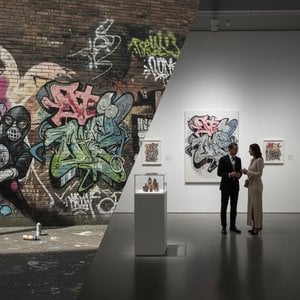
Explore the captivating journey of street art from urban walls to prestigious galleries. Discover how contemporary graffiti has evolved into a high-end collectible movement, redefining modern interior design and global art culture.

Explore the profound artistry of black and white photography. From historical mastery to the interplay of light and shadow, discover how monochrome captures timeless emotion and form through a sophisticated lens of art history.

Elevate your most cherished memories with WahooArt’s bespoke service. We transform your personal photos into breathtaking, hand-painted black & white oil masterpieces. Experience museum-quality craftsmanship and timeless elegance for your private collection. Discover the art of legacy.

Elevate your artistic practice with this expert guide to mastering the line. Discover advanced techniques in graphite, charcoal, and contour drawing designed for art students seeking technical precision and expressive depth in their fine art studies.
 Eelvaade
 Saada
Saada Jaga
Jaga
 Teave teose kohta
 Juhend

 Laadi alla
 Sarnased teosed
 Röntgenuuring
 Slaidietendus
 KÜSIMUSED JA VASTUSID
 Statistika


 Loe lähemalt









 Klaasivalik on saadaval ainult kuni 110 cm suuruses teostes


