Hankige trükiivaldatav fail, mis on kvaliteedilt palju parem kui veebilehel näidatud eelvaade. Kõik meie müüdavad digitaalsed pildid pärinevad meie arhiivist kõrge resolutsiooniga originaalfailidest — tavaliselt 5000 kuni 15 000 pikslit laiust — nii et saate julgelt trükida suurematsat, lüüdist teha või detailset sisu reproduktsiooni teha.
Meie stuudiost ei lahtu ükski fail puutumatuna. Digiekpert võrdleb värve algsest maalistimusega ja vajadusel korrigeerib neid, seejärel parandab selgust ja detaile professionaalsete retušimisvahendite abil — püüdes alati jääda truudeks kunstniku pintoonile ja stiilile. Tulemuseks on pilt, mis näeb välja nagu maali, mitte nagu filtreeritud skann.
Teet kinnituse enne lõplikku valmimist: meie ekspert saadab pildi 72 tunni jooksul e-posti ülevaatamiseks. Ei ole rahul? Paluge parandusi või korrektsioone ning kui kvaliteet ei vasta ootustele, võite paluda tagastamist.
See on kvaliteet, millele tuguvad väljaandjad, disainistuudiod, galeriid ja trükikojad.
Laadi alla kõrge resolutsiooniga fail isiklikuks vaatamiseks, trükkimiseks ja loomingulisteks projektideks. ( Lülita trükkitoodetele Osta käsitsi maalatud teos)
Valides WahooArt.com, ei saa sa lihtsalt pilti – saad professionaalselt parandatud digitaalse teose, mida on valmistatud täpsusega ja mis on toetatud rahuldamatusgarantiiga. Siin on kõik, mis sinu tellimusega automaatselt kaasneb:
Teie kõrge resolutsiooniga digitaalne pildifail saadetakse teile e-posti 72 tunni jooksul pärast tellimist – kohe kasutamiseks valmis.
Teie teos on professionaalselt optimeeritud arenenud tehisintellekti tööriistade ja käsitsi redigeerimise abil, tagades maksimaalse detailitaseme, selguse ja värvitäpsuse.
Kas kustutasid faili kogukalu unustamisel või kustutamisel? Puudub mure – saad selle uuesti igal ajal ilma lisatasuta.
Nautige oma teoseid koheselt ilma tolli-, maksude või tarnimaskuludeta – digiletchargused on alati maksuvabadud.
Me tagame, et teie digitaalne pilt kajastaks originaali värve professionaalsete tööriistade ja värvihalduse abil võimalikult täpselt.
Kui te ei ole oma digitaalse pildi eest rahul, siis me parandame seda või tagastame 100% summast 100 päeva jooksul – küsimusteta.
Ei ole rahul? Saate täielise tagastaja 100 päeva jooksul pärast digitaalse faili kättesaamist – ilma küsimusteta.
Osta 3 pilti, säästa 10% - Osta 5, säästa 15% - Osta 10+, säästa 20%. Sobib suurepäraselt loomingulisteks projektideks, galeriideks ja agentuurideks.
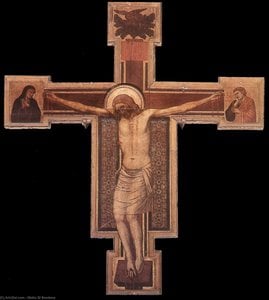
Cimabue loobus teose "Kristus" 47 aasta vanuses. Kunstnik on sündinud aastal 1240 ning teos on dateeritud 1287.
Ei – teos asub välismaal. Cimabue sünnimaa on Italia ning teose "Kristus" originaali hoiab endas muuseum, mis asub riigis Itaalia.
Originaalteose „Kristus“, autor Cimabue mõõdud on 448 x 390 cm.

In the bustling streets of Florence, Italy, a man named Giovanni Cimabue began his life around 1240. He was known to many by the names Cenni di Pepo or Cenni di Pepi, names that belonged to a man destined to shape the visual language of his age. He was a painter and a designer of mosaics, a craftsman whose hands worked with both the delicate brush and the enduring stone. His spirit was said to be strong, perhaps even rebellious, earning him a nickname that suggested a bull-headed determination. This stubbornness was not a flaw, but rather the driving force that allowed him to look at the rigid traditions of the Byzantine style and seek something more human.
His path was one of constant movement and evolving purpose. While his roots remained firmly planted in the Florentine tradition, his work carried him across the landscape of Tuscany. He did not merely replicate the icons of the past; he sought to breathe a sense of life into the figures he painted. This ambition led him to experiment with how light might fall upon a face or how a body might occupy space. He was a man caught between two worlds, honoring the spiritual formality of the old ways while reaching toward a new way of seeing the world through a more natural lens.
The final years of his life took him away from the city of his birth, leading him toward the coast. He eventually passed away in Pisa in 1302. Though his life was marked by the quiet labor of the workshop and the grand scale of mosaic design, his presence left a permanent mark on the history of Italian art. He lived through a time of profound change, acting as a bridge for those who would follow in his footsteps.
Born in Florence, Italy, around 1240, the young man who would become known as Cimabue entered a world where the traditions of Byzantium still held a firm grip on the spirit of art. He was a child of the Florentine streets, growing up in a landscape where the heavy, golden formality of the East met a new, restless desire for something more human. While the exact details of his childhood remain veiled by the passage of centuries, his early years were clearly shaped by the rigorous discipline of the Florentine workshops. Here, he learned to command the delicate medium of egg tempera and the demanding art of mosaic design, skills that would define his long career as both a painter and a designer of mosaics.
His training was not merely a matter of learning to apply pigment to wood, but a deep immersion into the sacred language of iconography. He absorbed the ways in which light was used to signify the divine, often through the application of shimmering gold leaf that seemed to radiate from the panel itself. Yet, even in these formative years, a certain strength of will began to emerge. There was a sense that he was not content to simply replicate the flat, symbolic figures of the past. Instead, he began to experiment with the way a body might occupy space, seeking to give his figures a sense of weight and presence that had been absent in the works of those who came before him. This early struggle to balance established religious tradition with a burgeoning interest in the natural world would become the defining characteristic of his hand.
In the quiet labor of his workshop, Cimabue sought to breathe a new kind of life into the sacred figures of his age. He worked largely with egg tempera on wood panels, a medium that demanded a patient, disciplined hand. To achieve the celestial glow required for his religious subjects, he often applied this pigment over a background of shimmering gold leaf. In other instances, he utilized distemper with gold leaf to create a sense of divine light. His hands were equally adept at the grand scale of fresco and the intricate, enduring patterns of mosaic, showing a versatility that allowed him to move between the walls of a cathedral and the intimate size of a devotional panel.
As his vision matured, a subtle change began to appear in the way he treated the human form. He moved away from the flat, two-dimensional silhouettes of the Byzantine tradition, seeking instead to capture the weight and presence of real flesh. He achieved this through a more sophisticated use of shading to suggest volume, allowing a face or a limb to appear rounded and three-dimensional rather than merely outlined. This growing interest in lifelike figural proportions meant that his saints and Madonnas possessed a physical reality that felt closer to the people who knelt before them. He was no longer content with mere symbols; he wanted to show the body as a vessel of actual weight and emotion.
The early years of his career reveal a man already wrestling with the weight of tradition. Around 1268, he produced a Crucifix, a work that would later be studied for its profound meditation on suffering. This was followed by the Crucifix at San Domenico in Arezzo, dating around 1270, where the body of Christ appears to buckle under the weight of his own agony. In that same period, he painted the Virgin and Child in Majesty surrounded by Six Angels, a work from 1270 that shows his hand working within the established patterns of the time. Even in these early efforts, one can sense a spirit seeking to move beyond the flat, distant figures of the past.
As the decades passed, his brush grew more daring. By 1278, he had completed the Madonna Enthroned with the Child, St Francis and Four Angels, a composition that brought a new sense of presence to the sacred figures. This evolution continued into the next decade. Around 1280, he executed the Maestà, now held in the Louvre, and the Flagellation of Christ, a complex scene that suggests a growing interest in spatial relationships. He was a man of many hands, also working in the medium of mosaic, leaving his mark upon the very stones of the Baptistery of Florence.
His later works show a refined ability to suggest volume and human emotion. A detail from his Madonna in Majesty, painted in 1285, reveals a subtle use of shading that hints at the physical reality of the Virgin. Even in smaller, more intimate pieces like the 13th-century Mocking of Christ, his ability to capture a sense of human experience remains evident. His output was vast, spanning from large altarpieces to small, devotional panels.
The legacy of Cimabue lived on through the hands of those who sat at his side in the Florentine workshops. Among his most significant pupils was Giotto di Bondone, who received crucial training under Cimabue's guidance. Their relationship was marked by a dynamic that pushed the boundaries of what a painter could achieve. It is said that during his apprenticeship, the young Giotto once playfully painted a fly upon a portrait Cimabue was working, a small prank that revealed a spirit as spirited as the master's own. While Giotto would eventually move toward a more radical naturalism, his foundation was built upon the lessons learned from Cimabue's evolving approach to form and expression.
Beyond this famous connection, Cimabue's influence reached other talented hands that operated within his artistic orbit. One such figure is the artist known as the Master of Varlungo, who has been identified as a principal pupil of Cimabue. This painter worked during the same transformative period, absorbing the stylistic shifts that Cimabue helped initiate. Through these students, the transition from the rigid Byzantine traditions toward a more humanistic style was carried forward, ensuring that the innovations of the master would ripple through the generations of Italian painters.
To follow the path of his brush is to travel across the great cities of Europe and beyond. In Paris, the Musée du Louvre holds the Maestà, a work that once graced the church of San Francesco in Pisa. The museum also recently welcomed The Mocking of Christ, which was acquired in 2023. These works allow us to see how his hand moved through the halls of such grand institutions, bridging the distance between the sacred spaces of the past and the public galleries of the present.
The spirit of his work remains deeply rooted in the Italian landscape. In Florence, the Galleria degli Uffizi preserves a detail of the Madonna in Majesty, offering a close look at his evolving hand. Nearby, the Museo dell'Opera del Duomo in Pisa keeps a detail of Christ Enthroned between the Virgin and St John the Evangelist. If one travels to Assisi, the Madonna with Child Enthroned, Four Angels and St Francis can still be found, while the Basilica of San Domenico in Arezzo holds the Crucifix that shows his departure from older traditions.
His reach extended far across the seas, finding homes in collections far from his Florentine origins. The Frick Collection in New York preserves The Flagellation of Christ, and the National Gallery in London holds a detail of the Crucifix. These scattered treasures remind us of the many hands that have cared for his legacy through the centuries.

1240 - 1302 , Italia
 Eelvaade
 Saada
Saada Jaga
Jaga
 Teave teose kohta
 Juhend

 Laadi alla
 Sarnased teosed
 Röntgenuuring
 Slaidietendus
 KÜSIMUSED JA VASTUSID
 Statistika


 Loe lähemalt