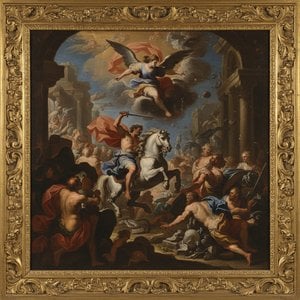
Paradise - A Venetian Baroque Masterpiece
Carlo Saraceni’s “Paradise,” painted circa 1598, stands as a testament to the burgeoning artistic fervor of Venice during its golden age—a period marked by unprecedented patronage and innovation. Immediately responding to Francesco Bassano’s ambitious altarpiece depicting the same subject at the Gesù in Rome, Saraceni deftly captured the spirit of Venetian artistic tradition while simultaneously embracing the stylistic advancements originating from northern Europe.
The Influence of Elsheimer and Caravaggio
Saraceni's vision is profoundly shaped by the pioneering landscapes of Adam Elsheimer, whose meticulous attention to detail and use of copper—a medium favored for its ability to render complex forms at a small scale—established a precedent that would reverberate throughout Baroque painting. Simultaneously, Saraceni absorbed Caravaggio’s revolutionary techniques of tenebrism – dramatic chiaroscuro – injecting into his work the visceral energy and psychological depth characteristic of Caravaggio's masterpieces.
A Religious Narrative Illuminated
The painting depicts a serene religious scene centered around Jesus Christ and Mary Magdalene, enveloped in an ethereal glow emanating from the upper portion. Below, a congregation gathers before a monumental stone, symbolizing divine authority and contemplation. The inclusion of figures like Saint John the Baptist—holding a flag representing victory—adds layers of symbolism to the composition.
Symbolism and Compositional Harmony
Beyond its immediate depiction of biblical figures, “Paradise” embodies broader symbolic representations of faith and redemption. The carefully orchestrated arrangement of elements—the radiant glory surrounding the Trinity, the positioning of saints and angels—creates a harmonious visual experience designed to inspire reverence and devotion. Saraceni’s masterful use of color and light contributes significantly to conveying this emotional resonance.
Provenance and Artistic Legacy
The painting's provenance remains unknown, but it is believed to have been commissioned by an aristocratic patron—likely portrayed as the man gazing out from the lower left corner. Saraceni’s “Paradise” exemplifies the Venetian Baroque style at its finest, securing his place among the foremost artists of the era and influencing generations of painters who followed.
- Artist: Carlo Saraceni (1579 – 1620)
- Birth Year: 1579
- Death Year: 1620
- Birth City: Venice
- Birth Country: Italy
Further research into Saraceni’s oeuvre reveals his exploration of landscape painting and his masterful assimilation of Caravaggio's tenebristic style. His contribution to Venetian Baroque art continues to inspire admiration and scholarly inquiry.



 Eelvaade
 Osta käsitsi maalitud maal
 Saada
Saada Jaga
Jaga
 Teave teose kohta

 Laadi alla
 Sarnased teosed
 Röntgenuuring
 Slaidietendus
 Statistika


 Loe lähemalt






































 Klaasivalik on saadaval ainult suuruses kuni 110 cm