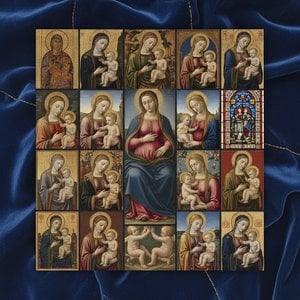
A Portrait of Devotion: Exploring Carlo Dolci’s “Madonna in Glory”
Carlo Dolci's "Madonna in Glory," painted around 1670, is not merely a depiction of the Virgin Mary; it’s an immersion into the heart of Florentine Baroque piety. This intimate portrait, likely intended for private devotion, reveals a masterclass in restrained emotion and meticulous technique – qualities that cemented Dolci's reputation as one of Florence’s most revered artists during his era. The painting immediately draws the viewer in with its dark, atmospheric background, punctuated by the subtle shimmer of stars, creating an immediate sense of solemnity and spiritual contemplation. The composition centers on Mary’s face and upper body, framed within a vertical format that emphasizes her dignified presence and directs our gaze upwards towards the halo encircling her head – a potent symbol of divine grace and holiness.
Dolci's style is distinctly Baroque, yet profoundly rooted in Florentine tradition. Unlike the grand, theatrical displays favored by artists in Rome, Dolci eschewed sweeping narratives for quiet intensity. His focus remained firmly on conveying spiritual depth through carefully rendered details and a restrained palette. The use of line is particularly noteworthy; precise lines define Mary’s face, her flowing robes, and even the folds of drapery, lending an incredible sense of volume and realism to the image. Shapes are predominantly organic – the curves of the clothing mimic natural forms, while subtle modeling creates a believable illusion of three-dimensionality.
The Language of Light and Color
The color palette is dominated by deep blues and purples, evocative of twilight or the mysteries of faith. These somber hues are masterfully contrasted with highlights of gold and pink within the halo and in Mary’s skin tones, creating a luminous effect that draws attention to her as the focal point. Dolci's technique relies heavily on layering translucent glazes – a hallmark of Baroque painting – to build up color and luminosity gradually. This painstaking process results in surfaces that possess an almost velvety quality, rich with subtle variations in tone and texture. The use of atmospheric perspective further enhances the sense of depth, fading the background into darkness while maintaining clarity for the central figure.
Symbolism and Spiritual Resonance
Beyond its technical brilliance, “Madonna in Glory” is laden with symbolic meaning. The halo itself represents Mary’s status as the Mother of God and a conduit to divine grace. Her gaze, directed upwards, suggests contemplation, prayer, or perhaps an acknowledgement of God's presence. The overall mood of the painting speaks volumes about Dolci’s deeply held faith – a devotion that permeated his artistic practice. It’s believed he painted a half-figure of the Savior wearing the Crown of Thorns every year during Passion Week, demonstrating a profound engagement with religious themes and a desire to evoke a similar sense of reverence in his viewers.
A Legacy of Piety: Carlo Dolci's Influence
Carlo Dolci’s work represents a significant contribution to Florentine Baroque art. His dedication to detail, combined with his ability to convey profound spiritual emotion, earned him considerable acclaim during his lifetime. He wasn’t driven by the ambition of large-scale projects; instead, he focused on intimate portrayals of religious subjects, often repeating compositions in multiple versions – a practice that allowed him to refine his technique and explore subtle variations in expression. His daughter, Agnese Dolci, was also a talented painter who frequently copied her father’s works, ensuring the continuation of his artistic legacy. Today, “Madonna in Glory” stands as a testament to Dolci's skill and devotion, offering viewers a glimpse into the serene piety that defined one of Florence’s most enduring artistic figures.
Discover “Madonna in Glory” by Carlo Dolci on WahooArt.com and explore a meticulously crafted hand-painted reproduction of this Baroque masterpiece.



 Eelvaade
 Lülita trükkitoodetele
 Saada
Saada Jaga
Jaga
 Teave teose kohta

 Laadi alla
 Sarnased teosed
 Röntgenuuring
 Slaidietendus
 Statistika


 Loe lähemalt






































 Klaasivalik on saadaval ainult suuruses kuni 110 cm