Muuseumikvaliteediga giclée- või kangasprint kiire tootmisega ja paindlikud viimistlusvõimalused. ( Osta käsitsi maalatud teos Lülita digitaalse pildi juurde)





























Vali meie eelmääratud suurused, mis vastavad teose algupärastele proportsioonidele.

Sisestage vajalik laius ja kõrgus, et see sobiks teie raamile või seinale. Trükki saab ainult lõigata, seda ei saa kunagi pildist suuremaks teha, seega ka erineva mustega suurus kaotab osa pildist. Enne trükkimist saadame teile kinnitamiseks digitaalse näidisprojektsiooni. Sellel lehel näidatud pilt ei kujuta reaalset lõiget — seda näitab ainult näidisprojektsioon.
Ülemaailmne tarne () 2 nädala jooksul, tavalise 4/5 nädala asemel. (21 november)
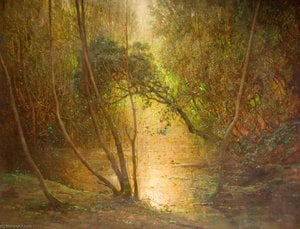
A Quiet Nook
Reproduktsiooni suurus
Sunlight breaks through a heavy canopy, spilling into a woodland clearing where time seems to pause. In this secluded nook, the air feels thick with the scent of damp earth and crushed grass. A few cattle graze in the center of this luminous stage, their forms catching the warm, pale cream of the sun. One cow, dark as the shadows surrounding them, stands near a small pool of water, while others—one white and one reddish-brown—move quietly through the dappled light. The trees frame the scene like heavy velvet curtains, their dark, overarching branches creating a natural vignette that pulls the eye toward the glowing heart of the forest. It is a moment of profound stillness, where the only movement is the slow, rhythmic chewing of the herd and the shifting patterns of light on the forest floor.
The texture of the scene is palpable, built through a heavy impasto technique that gives the landscape a physical presence. Every stroke feels intentional, as if the artist sought to capture the very weight of the atmosphere. The interplay of light and dark creates a dramatic chiaroscuro effect, pulling the viewer into the depth of the woods.
Painted in 1885, this oil on wood work reflects a deep connection to the landscape of the 19th century. The scene captures a sense of pastoral tranquility, a quiet observation of life in a woodland setting. The composition relies on the tension between the dark, shadowy edges and the bright, central clearing to direct the gaze. There is a subtle melancholy in the way the light illuminates only a fragment of the woods, leaving the rest to the mystery of the deep shadows. It is a study of how light defines space, turning a simple clearing into a sacred, private space for the creatures within it.
Espresso (#3d3c1f) on teose „A Quiet Nook“, autor William Hart domineeriv värv.
Teose "A Quiet Nook" puhul on soovitatav trükiformaat Small suurusega ja Portrait suunaga.
Teose "A Quiet Nook" loovija on William Hart. Selle lehe info kirjeldab William Hart algteost.

Ühendkuningriigis, Paisleys sündinud William Hart emigreeris koos oma perega 1831. aastal Ameerika Ühendusriikidesse, asudes lõpuks elama New Yorkis, Albany linnas. Tema kunstiline teekond algas õpilasena dekoratiivmaljari juures Albany's ja Troy's, kus ta kogus oma esimesed kogemused kootepaneelide maalistamisel maastikupiltidega. Pärast portretimealiste tegevuse perioodi ja ebakannatavat üritust tellimuste otsimiseks USA keskmistel os statesid, esindas Hart oma esimest teost 1848. aastal National Academy of Design'is. Euroop poodenud õppeperioodi järel naasid ta Ameerika liiku ja suunas oma tähelepanu maastikumaaliide poole. Lõpuks asunult elama New York Citysse, avas ta 1858. aastal stuudio Tenth Street Studio Buildingis ning teenis hiljem 1865. aastal Brooklyn Academy of Designi presidentina.
Olles Hudson River School'i liige, arendas Hart küpuse maastikust stiili, mis rõgutas valgusel ja atmosfääril, olles eriti viljakas skangulise päikesekuide ja eesplaanis leviva varju kujutamisel. Tema hiljemad teosed sisaldasid tihti karjakarja kui korduvat motiivi, esitledes sageli eesplaanis või keskmises kauguses rohu söövas või vett juubivas lehma pastoralistsel taustal. Lisaks õliõlimaliididele oli Hart tuntud oma erakordsete veetside poolest, sealhulgas ikoonilise teose "Naponock (Naponoch) Scenery, Ulster County, New York" poolest. Tema produktiivne loovtöö hõlmas skexeid, akvarelle ja sketsiraamatuid, millest paljud on säilinud tema pere poolt ning on säilitatud Albany Institute of History & Art'is.

1823 - 1894 , Üliingaine

Explore the profound mastery of nocturnal landscapes and chiaroscuro. Discover the soul within the shadows today.

Master the secrets of chiaroscuro, sfumato, and symbolism through expert analysis. Explore the profound power of light and shadow today.

Explore the profound emotional depth of Van Gogh's impasto technique. Discover how his sculptural brushstrokes and textured oil layers define Post-Impressionism through an expert art-historical lens, perfect for discerning collectors and fine art enthusiasts.

Explore the profound connection between technique and emotion. From the sculptural depth of impasto to classical mastery, decode the language of brushstrokes through an expert lens of art history and fine art connoisseurship.

Explore the evolution of pastoral landscapes from Titian to Impressionism with expert analysis. Discover the beauty of classical art today.
 Eelvaade

 Saada
 Jaga
 Teave teose kohta
 Juhend


 Laadi alla
 Sarnased teosed
 Röntgenuuring
 Slaidietendus
 KÜSIMUSED JA VASTUSID

 Statistika


 Loe lähemalt









 Klaasivalik on saadaval ainult kuni 110 cm suuruses teostes