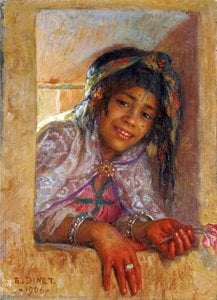
El erudito parisino y el sueño argelino
Nacido en el corazón de París el 28 de marzo de 1861, Alphonse-Étienne Dinet comenzó su viaje entre los prestigiosos pasillos del Lycée Henry IV. Como hijo de un prominente juez francés, sus primeros años estuvieron impregnados de rigor académico y de la atmósfera refinada de la Belle Époque. Su formación formal en la Académie Julian y la École nationale supérieure des Beaux-Arts le dotó de la destreza técnica de la tradición académica francesa; sin embargo, bajo este cimiento clásico latía una curiosidad creciente que acabaría por llevarlo mucho más allá de las fronteras de Francia. Fue su encuentro con el Magreb lo que verdaderamente encendería su espíritu artístico, transformando a un estudiante de la tradición francesa en un cronista de la vida norteafricana.Un alma transformada por el desierto
La relación de Dinet con Argelia fue mucho más que un mero interés profesional; fue una profunda metamorfosis espiritual y cultural. A medida que se sumergía en los paisajes y las costumbres de la región, las fronteras entre el observador y lo observado comenzaron a disolverse. Esta conexión profunda culminó en su conversión al Islam, lo que le llevó a adoptar el nombre de Nasreddine Dinet, un título que significa "defensor del Dīn". Esto no fue simplemente un cambio de nomenclatura, sino un giro fundamental en su perspectiva. Al dominar el árabe y traducir su literatura, alcanzó una comprensión íntima e interna de la cultura que retrataba. Su obra dejó de ser la de un forastero mirando desde fuera; en su lugar, se convirtió en una documentación conmovedora de una vida que había abrazado verdaderamente, caracterizada por un nivel de autenticidad etnográfica sin precedentes.La maestría de la luz y la verdad etnográfica
El arte de Nasreddine Dinet se define por una síntesis asombrosa de idealismo romántico y observación meticulosa. Inspirándose en el uso magistral de la luz y el color presente en las obras de Eugène Delacría, Dinet poseía una capacidad asombrosa para capturar la atmósfera cambiante del sol argelino. Sus lienzos vibran con la calidez del desierto y los tiernos matices de la existencia cotidiana. Ya sea al representar la intensidad dramática de L’Oued M'sila après la pluie o la inocencia silenciosa y conmovedora de Girl Playing With Her Brother, sus pinceladas transmiten tanto precisión científica como una profunda resonancia emocional. Capturó las texturas de las telas, el grano de la arena y el suave resplandor del crepúsculo con una precisión que honraba la dignidad de sus sujetos.Un legado perdurable en el arte orientalista
Más allá de sus lienzos individuales, el impacto de Dinet en el mundo del arte fue estructural y duradero. Como uno de los fundadores de la Société des Peintres Orientalistes, ayudó a dar forma al rumbo del movimiento, orientándolo hacia una representación más respetuosa y auténtica de la vida norteafricana. Su capacidad para fusionar el exotismo de Oriente con la sofisticación técnica de la pintura francesa dejó una huella indeleble en la historia del arte. Hoy en día, sus obras permanecen como testimonios vitales de un período de intenso intercambio cultural, erigiéndose como ventanas luminosas hacia un mundo donde el arte, la fe y el paisaje convergieron en una armonía perfecta y bañada por el sol.Preguntas y respuestas
¿De dónde es Nasreddine Dinet?
Nasreddine Dinet nació en Francia.
¿Cuántas obras de Nasreddine Dinet hay disponibles para explorar?
Puede explorar 58 obras obras de Nasreddine Dinet en la página Todas las obras de arte.
¿Dónde puedo visitar el museo virtual en 3D con las obras de Nasreddine Dinet?
La Galería 3D de Nasreddine Dinet es una página que muestra las obras del artista en una galería virtual tridimensional.