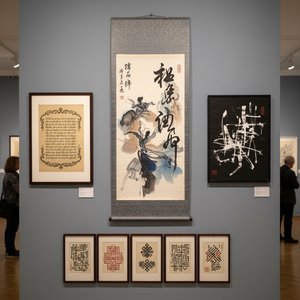
Mustafa Râkim: A Pioneer of Ottoman Calligraphy
Born in Oyüzü, Turkey in 1757, Mustafa Râkim emerged as a transformative figure in the world of Ottoman art. His early life details remain somewhat scarce, but he swiftly demonstrated an exceptional talent for calligraphy – a highly revered art form within Ottoman culture. He dedicated himself to mastering the intricacies of Islamic script, setting the stage for his future innovations and establishing him as one of the most influential calligraphers of his time.Artistic Development and Influences
Influenced profoundly by Hâfiz Osman, a prominent calligrapher of the 18th century, Râkim initially followed in his predecessor’s footsteps. However, he didn't merely imitate; rather, he sought to refine and elevate Osman’s style, placing an unprecedented emphasis on technical perfection—a characteristic that would define his entire artistic trajectory. This unwavering pursuit of precision drove him to meticulously analyze the proportions and forms within both the Sülüs and Nesih scripts, recognizing their inherent beauty and striving to unlock their full potential.Key Achievements and Innovations
Râkim’s contribution to Ottoman calligraphy transcends mere stylistic replication; he fundamentally reshaped its landscape. Notably, he extended Osman's style, broadening its scope beyond just Sülüs to encompass the elegant Nesih script—a daring move that signaled a significant advancement in artistic expression. Furthermore, he achieved ideal measurement between letter thickness and pen thickness, establishing a new standard for beauty in Jali-Thuluth script and *Tughras* (the signature seals of Ottoman Sultans)—symbols of imperial authority—demonstrating an unparalleled mastery of craftmanship. Perhaps most remarkably, Râkim is recognized as the first great Turkish painter in the Western sense, marking a pivotal moment in Ottoman art history and showcasing his versatility beyond the realm of calligraphy. His portrait of Sultan Selim III captivated audiences and inspired a poem dedicated to his artistic genius—a testament to his ability to capture the essence of human emotion through visual representation.Historical Significance and Legacy
Mustafa Râkim’s impact on Ottoman calligraphy is undeniable; art historians delineate Turkish calligraphic history into “pre-Rakim” and “post-Rakim” eras, acknowledging his monumental role in shaping its evolution. He bridged the gap between traditional Islamic calligraphy and the burgeoning modern Turkish identity, influencing generations of artists to come and cementing his place as a cornerstone of Ottoman cultural heritage. His work continues to inspire admiration for its beauty and sophistication, serving as a lasting reminder of the transformative power of artistic innovation—a legacy that resonates powerfully within the annals of Ottoman art history. ## Exploring His Work Today Numerous calligraphic masterpieces by Mustafa Râkim can be found in museums such as the Kıp Sabancı Museum in Istanbul, Türkiye. Collections like the *Murakka* (calligraphic album) containing works by Kadıasker Mustafa İzzet Efendi also showcase the beauty and influence of Ottoman calligraphy stemming from Râkim’s groundbreaking innovations—a visual testament to his enduring artistic legacy.Preguntas y respuestas
¿Qué tan populares son las obras de Mustafa Râkim?
La página de Estadísticas de Mustafa Râkim presenta estadísticas calculadas a partir de las obras del artista listadas en este sitio web.
¿Qué estados de ánimo expresan las obras de Mustafa Râkim?
La Rincón de emociones de Mustafa Râkim organiza las obras del artista según el estado de ánimo.
¿Dónde y cuándo nació Mustafa Râkim?
Mustafa Râkim nació en Ünye en 1757.