Louis Jambor: Bridging Symbolism and Emotion in the Heart of Parisian Art
Louis Jambor (1 august 1884 – 11 june 1954) stands as a fascinating figure within the landscape of Hungarian-American art, particularly remembered for his distinctive contribution to religious murals and poignant portraiture. Born in Budapest, Hungary, Jambor’s artistic journey unfolded across Europe and culminated in New York City, where he established himself as a respected illustrator and animator background artist. His oeuvre reflects a profound engagement with both classical ideals and the burgeoning expressive currents of the early 20th century—a duality that characterizes his enduring legacy.
Early Life and Artistic Training
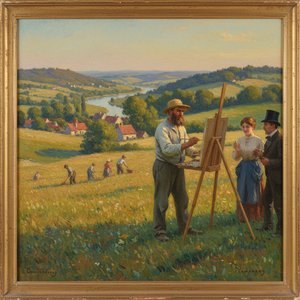
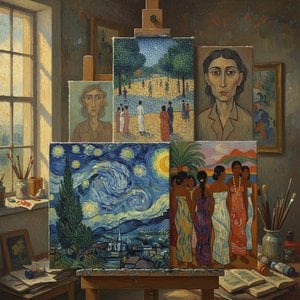
Jambor’s formative years were steeped in Hungarian artistic tradition, though he pursued formal training primarily at the Budapest Academy of Fine Arts. This grounding provided him with a foundational understanding of academic painting techniques while simultaneously nurturing an inclination towards symbolic representation—a stylistic preference that would become central to his later work. Notably influenced by Impressionism and Post-Impressionism, Jambor absorbed the expressive power of artists like Monet and Cézanne, recognizing their ability to capture fleeting moments of light and emotion. He diligently studied these masters, absorbing their techniques for capturing atmosphere and conveying emotional depth—skills that would prove invaluable throughout his artistic career.
Religious Murals and Artistic Vision
Jambor’s most celebrated achievements lie in his monumental murals adorning churches throughout France, notably the Chapel of the Salpêtrière Hospital in Paris. These ambitious projects exemplify Jambor's commitment to conveying spiritual narratives with meticulous detail and profound emotional resonance. His artistic vision prioritized capturing not merely visual accuracy but also conveying a palpable sense of faith and contemplation—a feat accomplished through masterful use of color palettes and compositional arrangements that drew heavily from Byzantine iconography. The Chapel’s murals stand as testament to Jambor's ability to transform architectural spaces into immersive experiences of religious devotion, inviting viewers to contemplate the divine presence within their surroundings. He meticulously researched Byzantine art, analyzing its symbolism and stylistic conventions to inform his own artistic endeavors—a dedication to scholarly rigor that underpinned his creative output.
Illustrations for ‘Little Women’ and Animation Contributions
Beyond his monumental murals, Jambor gained recognition as an illustrator, notably securing the prestigious commission to depict Louisa May Alcott’s beloved novel “Little Women.” His illustrations captured the spirit of Victorian domesticity with sensitivity and nuance—reflecting a humanist aesthetic that prioritized portraying characters' inner lives alongside their outward appearances. Furthermore, Jambor’s involvement in animation background artistry demonstrates his versatility as an artist, showcasing his ability to adapt his skills to diverse creative mediums. This collaborative experience broadened his artistic horizons and solidified his reputation as a multifaceted talent.
Portraiture and Recognition
Jambor cultivated a distinguished reputation as a portrait painter, capturing the likenesses of prominent figures from New York society. His portraits were characterized by their psychological depth—aiming not simply to reproduce physical features but to convey the subject’s personality and emotional state. This artistic endeavor underscored Jambor's belief in art’s capacity to illuminate human experience and solidify his position as a respected artist within his time. He possessed an extraordinary talent for capturing subtle nuances of expression, conveying emotion through carefully considered poses and gestures—a skill that distinguished him from many of his contemporaries.
Legacy and Historical Significance
Louis Jambor’s artistic output represents a significant intersection of stylistic influences—drawing upon Impressionism, Post-Impressionism, and Byzantine iconography. His enduring contribution to religious art is particularly noteworthy, reflecting the broader cultural context of the early 20th century as artists wrestled with questions of faith, morality, and human emotion. Today, Jambor’s murals continue to inspire awe and contemplation, while his illustrations for “Little Women” endure as cherished representations of Victorian literature—affirming his place as a pivotal artist whose work transcends temporal boundaries. He remains an exemplar of artistic integrity and creative vision—a testament to the transformative power of art to engage both intellect and emotion.