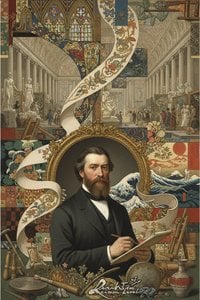
Juan Luna: A Titan of Philippine Romanticism
Juan Luna de San Pedro y Novicio Ancheta (1857 – 1899) stands as one of the Philippines’s most celebrated artists, a figure whose dramatic canvases captured the spirit of his era and cemented his place in the annals of European art history. Born in Bacnotan, Pangasinan, Luna possessed an innate talent for visual storytelling from a young age—a passion nurtured by early studies at Escuela de Derecho in Manila before he decisively embraced the path of artistic excellence at Academia de Artes y Letras. His journey to Spain in 1877 marked a pivotal moment, propelling him into the orbit of the Real Academia de Bellas Artes de San Fernando where he honed his skills under luminaries like José María Sertor and Eduardo Hibbert Palmer, absorbing the stylistic precepts of European Romanticism and Academic painting.
Early Artistic Influences & The Madrid Exposition Triumph
Luna’s formative years were steeped in classical tradition yet simultaneously receptive to burgeoning Romantic ideals. He diligently studied anatomy and perspective—skills that would prove invaluable in his subsequent artistic endeavors. However, it was the 1884 Madrid Exposition of Fine Arts where Luna truly ascended to international prominence. Alongside Félix Resurrección Hidalgo, he secured a remarkable double victory – gold for ‘La Batalla de Mactan’ and silver for ‘Spoliarium,’ marking an unprecedented achievement for Filipino artists abroad. These monumental paintings captivated audiences with their grandeur, theatrical composition, and masterful depiction of historical events—specifically Magellan's conquest of Cebu and the Roman Forum respectively—demonstrating Luna’s command of technique and his ability to convey profound emotion through visual imagery. The triumph at Madrid solidified Luna’s reputation as a visionary artist and propelled him into the spotlight of European artistic discourse.
Luna’s Artistic Style & Notable Works
Luna’s artistic style is characterized by a striking blend of European academic conventions and Romantic fervor. He meticulously rendered anatomical detail with unwavering precision, mirroring the influence of Michelangelo and Rubens—artists he deeply admired. Yet, his canvases pulsated with dynamism and dramatic lighting reminiscent of Eugène Delacroix and Théodore Gericault. Luna’s oeuvre encompasses a diverse range of subjects—literary scenes, portraits, mythological narratives, and historical dramas—all executed with breathtaking virtuosity. ‘Spoliarium,’ arguably his magnum opus, remains an enduring testament to his artistic genius, portraying the gruesome spectacle of a Roman funeral procession with unflinching realism and conveying a powerful critique of societal decay. Similarly, ‘The Death of Cleopatra’ exemplifies Luna's ability to infuse narrative storytelling with emotive intensity. His masterful handling of color and composition established him as a pioneer of Romantic painting in Spain and beyond.
Legacy & Impact on Philippine Art
Juan Luna’s legacy extends far beyond his artistic accomplishments; he served as an inspirational beacon for subsequent generations of Filipino artists. He championed the pursuit of artistic excellence and fostered a spirit of innovation within the Philippine art community. His unwavering dedication to portraying Philippine history and culture elevated Filipino art onto the international stage, establishing it as a distinct voice within the broader European artistic landscape. Today, Luna’s paintings reside in prestigious museums worldwide—including the National Museum of Fine Arts in Manila—serving as enduring symbols of Filipino creativity and national pride. Explore his captivating works at WahooArt.com for a deeper appreciation of this extraordinary artist's contribution to art history.
### Further Information:
Luna’s influence can be seen throughout Philippine art, inspiring artists to tackle ambitious themes and strive for technical mastery. His commitment to documenting Filipino heritage continues to resonate with audiences today.